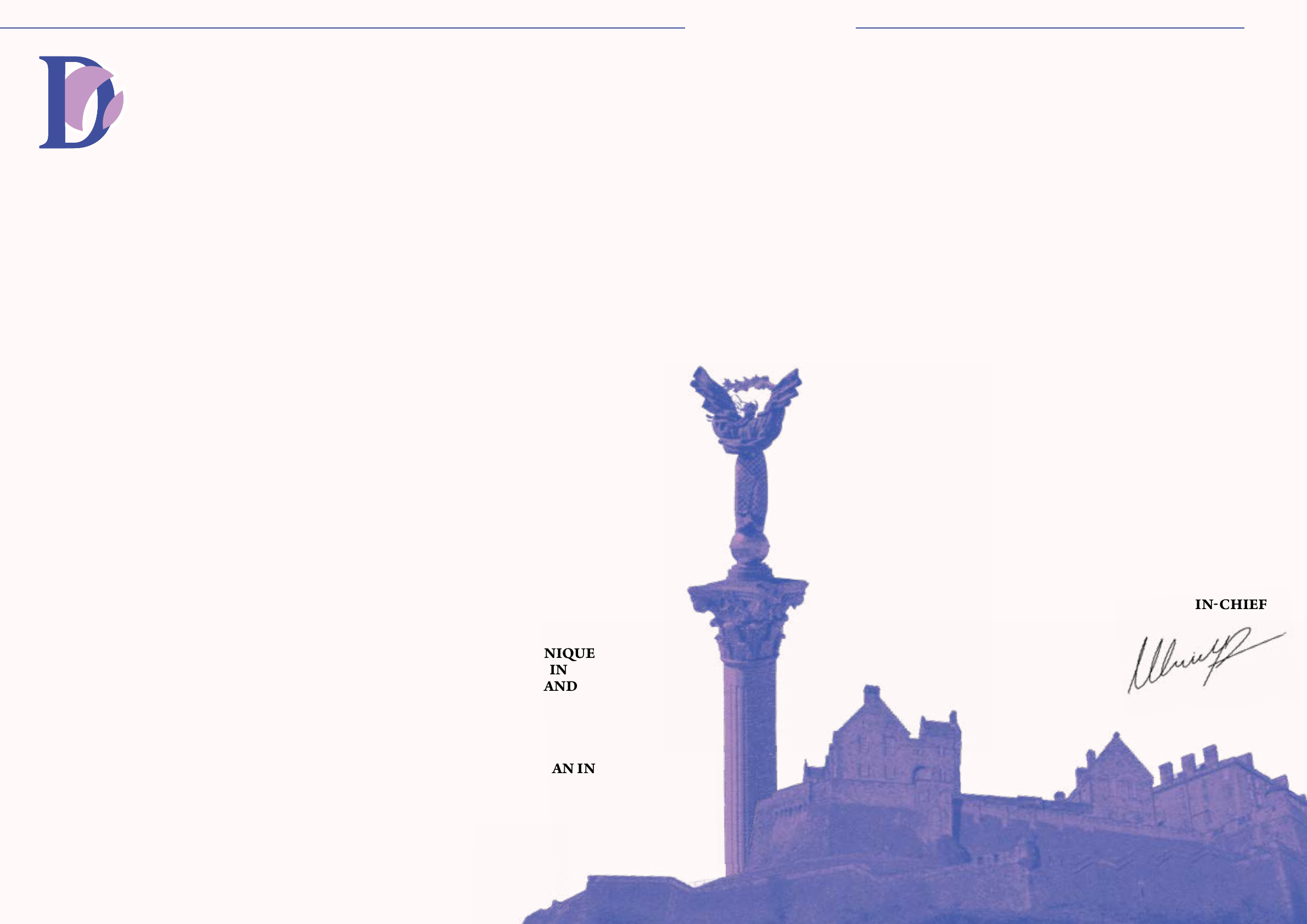
After the Second World War ended, the generation
that fought for the world’s freedom were lauded
as heroes, and rightly so. Unfortunately, the evil
of autocracy which they tried to quell in their own
time has reared its ugly head again. In Ukrainian,
the term ‘цвіт нації’ or ‘ower of the nation’ refers to
such people, the best which a society has to oer. It is
my belief that these individuals are not only ghting
on the front lines of today for a military victory; they
are ghting for their culture on the pages you are
A LETTER FROM
THE EDITOR
TABLE OF
CONTENTS
NOT THE MORNING I IMAGINED
THE CHRISTMAS OF UKRAINE FOR
THE WORD
WHY CHANGE THE TITLE?
THE CURIOUS CASE OF THE
“USEFUL” AND “NON-USEFUL” JEW:
IMBEDDED DOUBLETHINK IN
RUSSIAN SOCIETY
RECLAIMING HISTORY: HOW
RUSSIAN IS ODESA? BALANCING
BETWEEN EMPIRE AND AUTONOMY
MYTH IN THE CITY: COMPARATIVE
URBANISM IN KYIV UNDER
ORTHODOX COSMOLOGY AND
MARXIST IDEOLOGY
THE ARKA SVOBODY
UKRAYINS’KOHO NARODU: A SITE
OF MNEMONIC CONTEST AND THE
RECONFIGURATION OF POWER IN
CONTEMPORARY UKRAINE
THE RIGHT TO KNOW AND
THE DUTY TO REMAIN SILENT:
JOURNALISM IN TIMES OF WAR
JUST ENOUGH
THE TRANSFORMATION OF PUBLIC
SENTIMENT IN UKRAINE
HEGEMONY IN UKRAINE:
A CAUTIONARY TALE FOR
DEMOCRACY THE CRIMEAN TATARS: A UNIQUE
INDIGENOUS COMMUNITY IN
UKRAINE’S PAST, PRESENT AND
FUTURE
MY LANGUAGE
WHERE THE RIGHT DOOR
LEADS: LEARNING UKRAINIAN IN
CAMBRIDGE
IMAGE CREDITS
OUR TEAM
Oleksandra Atamanenko
Oleksandr Shtepan
Diana Postavka
Benya Pyatski
Daniil Malitskyy
Anna-Mariia Brynchak
Anastasiia Hryshchenko
Liubomyr Semeniuk
Dariia Hryshchenko
Kira Santalova
Oleksandr Diachenko
Andrii Kuzma
Maryna Santalova
Diana Shypovych
I have made some of the best friends of my life in
the Edinburgh Ukrainian community and through
them an entire new world of ideas has opened up
to me. Nevertheless, as a relative outsider, I have a
unique perspective and have watched with awe as
these people, who live daily with all the torments
of wartime, have thrived in the face of it. That
survival is even more important because of what it
truly means. This war is not only about territory,
but about society and community and knowledge,
which is why journals like this one are so important.
Our theme for this issue is ‘Why Study Ukraine?’. To
me, the answer is simple: to study Ukraine is to seek
understanding of the will of democracy to survive in
the face of terror. What better lesson could one hope
to learn in the world we live in today?
Dïaspora encapsulates exactly what Ukraine is
ghting for: its freedom and way of life. Because
even if an entire generation is devastated, their ideas
and spirit will live on. But if their achievements are
erased, and their culture, then it’s as if they never
existed. That is what Putin wants, and it is the one
thing we simply cannot allow.
EDITOR-IN-CHIEF
ULRICH POEHLMANN
about to read.
SPONSORS
4
6
14
20
30
38
44
52
54
66
76
84
94
96
104
106
108
2 3DЇASPORA JOURNAL

NOT THE
MORNING I
IMAGINED
Not the morning I imagined,
When I laid down to sleep in the dead of night.
Not the morning I imagined,
When they came to stare, with eyes devoid of light.
Those ‘comrades’ laced with their cloying lies,
Who froze the world with menacing fangs.
They gifted thunder to our skies,
And fear to children with silent pangs.
Are you our friends, if all you bring is sorrow?
You lie — and worse, your silence is a blade.
Are you our brothers, striking in the shadow?
I don’t want words. Just shoot. Let the bombs cascade.
There’s nothing sacred in shameless destruction.
No innocence to shield you in this war.
You won’t create joy from corpses or corruption.
No gift of blood can mend a shattered heart’s core.
Whether I stop, or move, the passerby can’t save me.
Your ‘sorry’ (извини) sounds as false as all your pleas.
Look closely — it’s you, your child, your history
Who plant again the seeds of an old disease.
Do you know your past, if books you’ve never read?
If you had learned, you wouldn’t strike so blindly.
Are you sincere, while hiding the truth instead?
You cry at traitors — and yet betray us too, unkindly.
You broke our bond like whores that scorn aection,
You’d smile and cheer if given half a chance.
You drank away the last of our connection —
While we press on. May your defeat wake you from this
trance.
The capital stands silent, grey and hollow.
Outside — a hush. Just trembling walls remain.
Dark birds driven mad by the lies they blindly follow,
While people watch their screens…
And I still chase the rhyme in pain.
Not the morning I imagined,
When what has happened — can’t be undone.
Not the morning I imagined,
Once you lose your morality — it can never be re-won.
OLEKSANDRA ATAMANENKO
P.S.
And I’m sorry it’s not in your “Russian tongue.”
My soul rings and moans alone.
For the senselessness of what you’ve “secretly” done,
You will in history, atone.
24.02.2022
4 5DЇASPORA JOURNAL
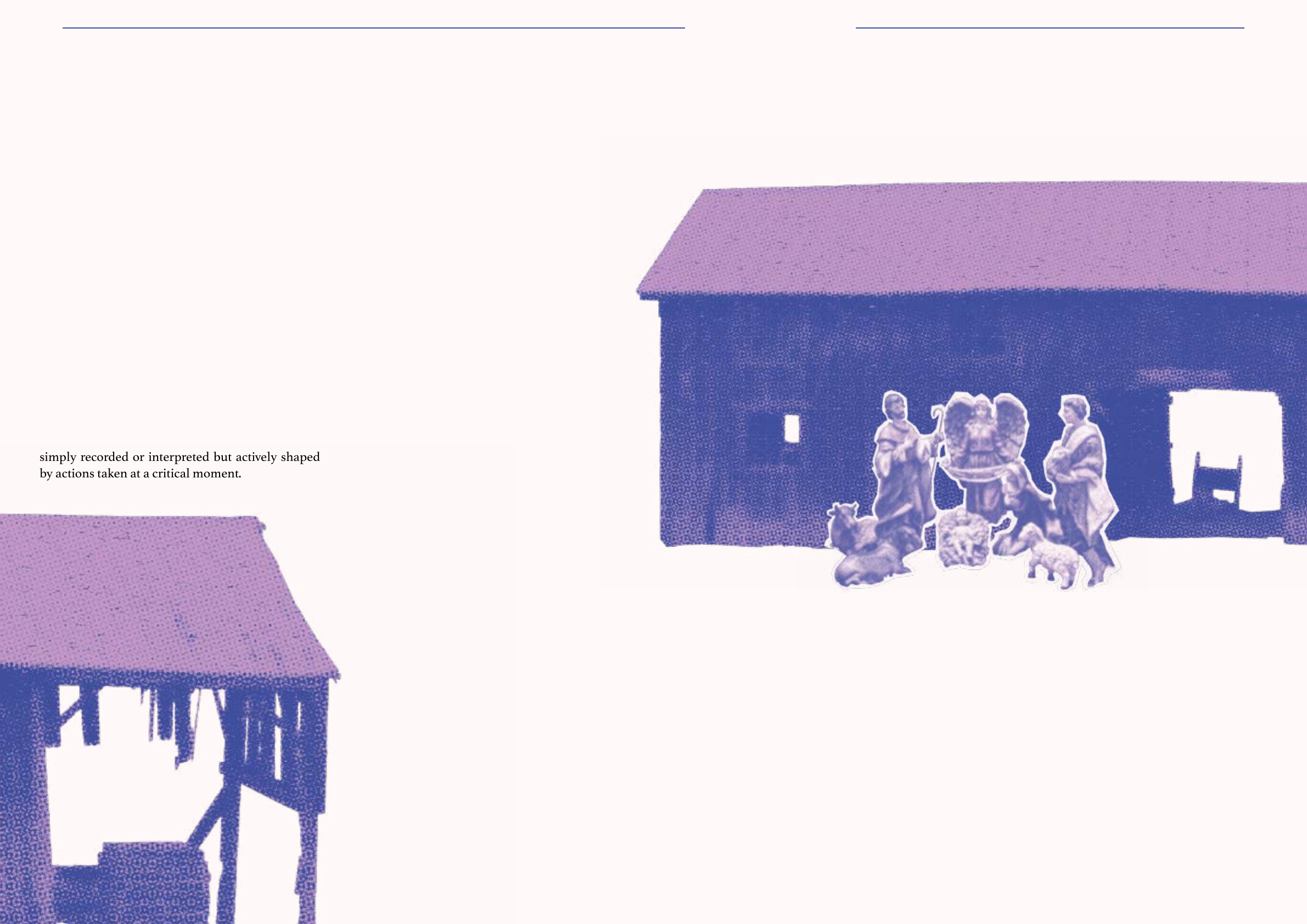
THE CHRISTMAS
OF UKRAINE
FOR THE WORD
A Manifesto for Ukrainia
Studies as a Strategic, Cultural,
ad Civilisational Iperative
OLEKSANDR SHTEPAN
here are moments in history when time ceases
to be exclusively a continuous chronological T
sequence (chronos), and a moment of vertical inter-
ruption appears in it. The Ancient Greeks called
such moments kairos: a qualitatively charged mo-
ment in time that requires decisive action. In kairot-
ic time, delay is no longer neutral, and historical ac-
tivity becomes inevitable. In this sense, history is not
simply recorded or interpreted but actively shaped
by actions taken at a critical moment.
Ukraine stands today where all of Europe stood at
its own birth: vulnerable and threatened, but pro-
foundly alive. This is Ukraine’s Christmas — not a
moment of comfort, but of incarnation. Life is born
not in palaces, but in stables; and tyrants, like Herod,
search for it to destroy it. To live under the constant
sightline of death is not a metaphor for Ukraini-
ans — it is a daily reality. And yet, this is precisely
the space in which identity is claried, values are
sharpened, and meaning emerges.
So why is Ukrainian Studies necessary right now?
Ukraine is not a ‘conict’. It is not a ‘grey zone bet-
ween Russia and Europe’. And it is not a ‘post-Sovi-
et space’. The Ukrainian people are a civilisational
entity whose existence disrupts the imperial logic of
Russia. That is why Russia has continuously sought
to erase Ukraine — linguistically, culturally, histor-
ically. To leave scorched earth behind. After all, a
free, European, democratic Ukraine is an existential
trauma for the Russian imperial psyche. It is a phan-
tom pain. And historically, the response to this pain
has been genocide. They already did this in 1932–33
and 1947, and they continue the tradition of terror
and elimination of Ukrainians and their cultural
heritage today.
WE ARE LIVING
IN SUCH A MOMENT NOW
After the collapse of the Soviet Union, Russia and its
sphere of inuence shrank to its smallest size since
the 18th century. Russia perceives NATO and the
entire model of collective agreement as an existen-
tial threat. The fact that Ukrainians, until recently
a ‘brotherly people’, have rejected Russian civilisa-
tion in favour of the West is a powerful and possibly
fatal blow to the Kremlin. The annexation of Belar-
us and Ukraine and the incorporation of the Baltic
and Central European countries, including Poland,
into its sphere of inuence are political goals of the
Kremlin in its eort to push NATO as far away from
its borders as possible.
WHY DO WE HAVE TO ACT NOW?
Europe is making a choice: whether to be pres-
ent now in history’s creation, or to retreat once
again into concern, neutrality, and ‘strategic am-
biguity’. This manifesto argues that establishing
Ukrainian Studies at the world’s leading univer-
sities and cultural institutions is not an academ-
ic luxury but a strategic necessity for Europe’s
survival, moral coherence, and intellectual de-
colonisation.
Oleksandr Shtepan is a Ukrainian expert in strategic communication and branding.
He previously served as an adviser and speechwriter to Ukraine’s third president, Viktor Yushchenko.
6 7DЇASPORA JOURNAL
For decades, Europe failed to understand this — not
because of a lack of evidence, but because of distort-
ed interpretive frameworks. Russian imperial narra-
tives dominated Slavic studies, cultural diplomacy,
opera stages, philological departments, and analyt-
ical centres. ‘Great Russian culture’ functioned as
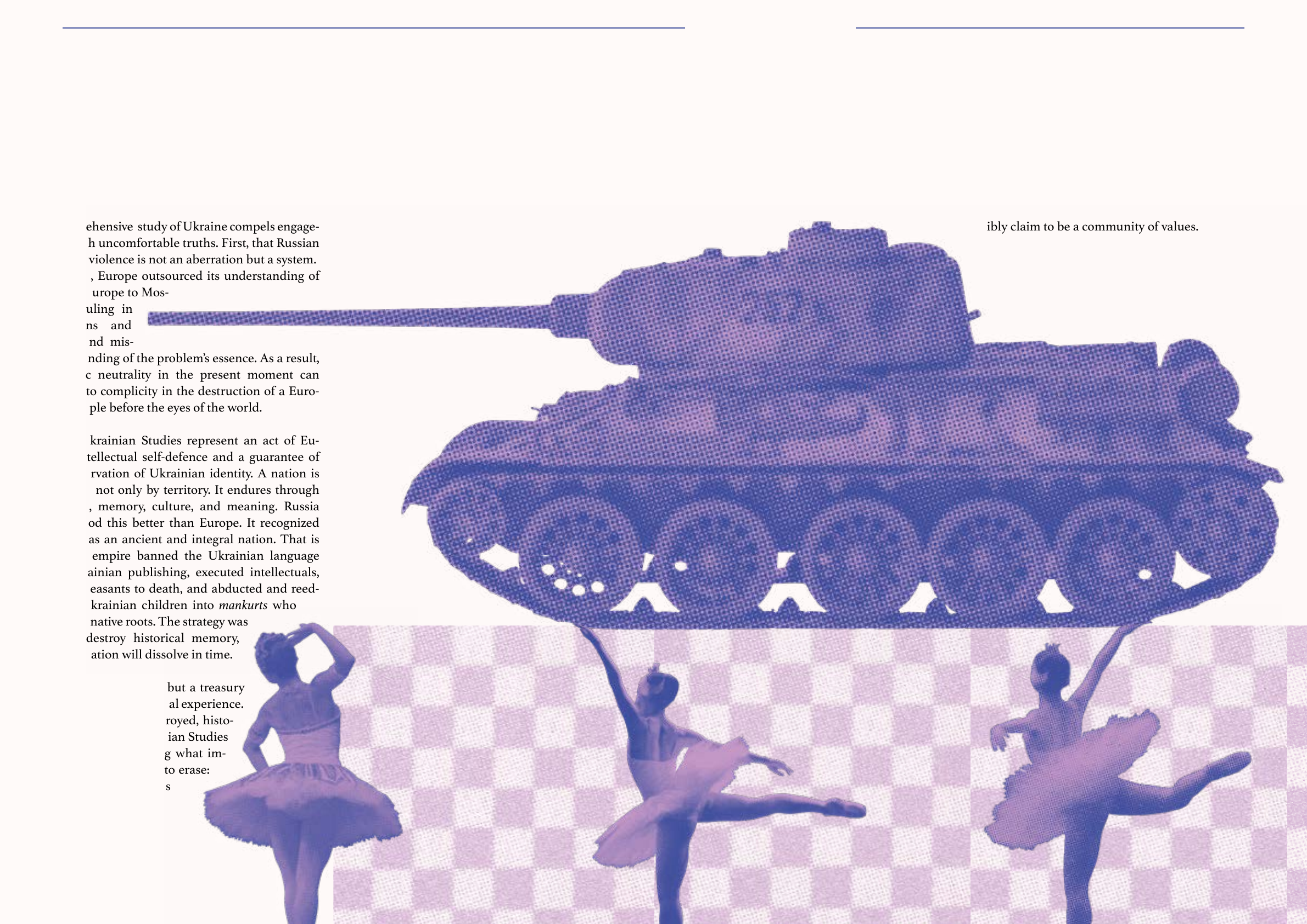
a form of anaesthetic soft power, yet Russian tanks
often followed immediately behind ballet pointe
shoes. Ukrainian Studies dismantles this illusion.
A comprehensive study of Ukraine compels engage-
ment with uncomfortable truths. First, that Russian
imperial violence is not an aberration but a system.
For years, Europe outsourced its understanding of
Eastern Europe to Mos-
cow, resuling in
distortions and
a profound mis-
understanding of the problem’s essence. As a result,
academic neutrality in the present moment can
amount to complicity in the destruction of a Euro-
pean people before the eyes of the world.
Today, Ukrainian Studies represent an act of Eu-
rope’s intellectual self-defence and a guarantee of
the preservation of Ukrainian identity. A nation is
sustained not only by territory. It endures through
language, memory, culture, and meaning. Russia
understood this better than Europe. It recognized
Ukraine as an ancient and integral nation. That is
why the empire banned the Ukrainian language
and Ukrainian publishing, executed intellectuals,
starved peasants to death, and abducted and reed-
ucated Ukrainian children into mankurts who
lost their native roots. The strategy was
simple: destroy historical memory,
and the nation will dissolve in time.
Language is not a tool but a treasury
– a repository of historical experience.
When language is destroyed, histo-
ry is amputated. Ukrainian Studies
is tasked with restoring what im-
perial violence sought to erase:
historical consciousness
The global institutionalisation of Ukrainian Stud-
ies will demonstrate that Ukrainian culture is not a
derivative of Russian culture, but self-suicient and
European; that Ukrainian history is not an appendix
to Russian history and that Ukrainian identity is nei-
ther invented nor provisional.
This matters not only for Ukrainians, but for Europe
itself. A Europe incapable of protecting the cultural
sovereignty of one of its largest nations cannot cred-
ibly claim to be a community of values.
materialised in language.
8 9DЇASPORA JOURNAL

Ukrainian Studies oer Europe a new optic – a way
to understand authoritarianism, resilience, and
democratic processes forged under pressure. At a
time when Europe faces populism, disinformation,
and democratic fatigue, this knowledge is not pe-
ripheral. It is vital.
Ukrainian Studies did not survive the 20th century
thanks to the state. It survived thanks to people. The
Ukrainian diaspora in Canada, the United States,
the United Kingdom, Germany, and Australia es-
tablished institutions when Ukraine was unable to
do so. The Harvard Ukrainian Research Institute
(HURI), the Canadian Institute of Ukrainian Stud-
ies (CIUS), and the Ukrainian Free University in
Munich (UFU) were all founded, nanced, and sus-
tained by communities that understood culture as a
frontline. Today, Ukrainian Saturday schools across
the United Kingdom and Europe are not nostalgic
clubs. They are micro-laboratories of contempo-
rary Ukrainian studies. Children from Mariupol,
Kharkiv, and Kherson now study Ukrainian lan-
guage, culture, and history in London, Nottingham,
and Edinburgh. They not only process trauma but
cultivate expertise. Ukrainians worldwide under-
stand Russia not from textbooks, but from lived re-
ality.
Just as African, Indigenous, and postcolonial stud-
ies reshaped global humanities, Ukrainian Studies
compel Europe to confront its own blind spots.
THE UKRAINIAN DIASPORA AS A
LIVING ECOSYSTEM
Ukrainians are not merely victims of history. They
are experts in how to survive under imperial rule.
Over three centuries, Ukrainians have learned to
adapt without surrender, to resist without losing
their humanity, to create culture under the threat
of total prohibition, to build horizontal democratic
structures under vertical oppression, and to take to
the squares in defence of dignity even when state in-
stitutions collapsed.
This is not abstract knowledge. It is lived experi-
ence – from Cossack councils and the traditions of
Magdeburg Law, through the Holodomors and the
Executed Renaissance, the dissident movement, the
Maidans, and today’s existential war. In contrast,
Russian political culture remains authoritarian and
vertically subordinated, governed by carceral codes.
It seeks a tsar, not a social contract. Ukrainians, by
contrast, have always relied on the community, not
the ruler.
This is not about cancelling Russian
culture. It has already demonstrated its
inability to restrain evil and crime, and
today the cultural presence of Russians
on the world stage serves more as an el-
ement of propaganda and evidence of
the inert thinking and naivety of West-
ern civilisation; moreover, it refuses
to associate it with the brutal murders
committed by the Russian authorities.
The issue is ending Russia’s monopoly
on knowledge.
The task is not boycott but displacement
through the restitution of stolen and
appropriated discoveries and names –
for example, noted Ukrainian cultural
activists Kazimir Malevich, Alexander
Archipenko, and Sonia Delaunay – and
through airming that Ukrainian cul-
ture is as European as Polish, Czech,
or German culture.
UKRAINIAN STUDIES AS STRATEGIC
KNOWLEDGE THE WORLD NEEDS
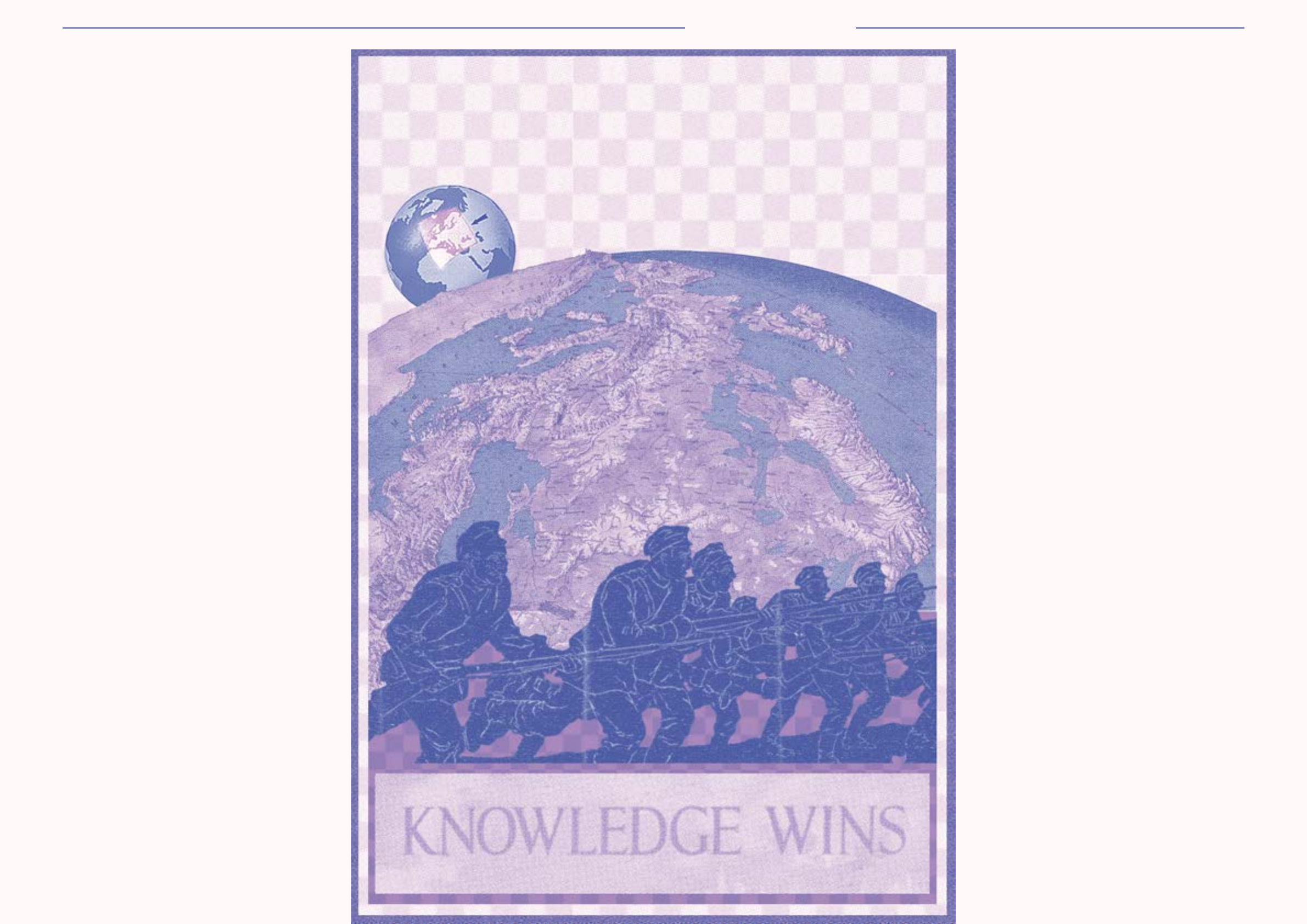
For decades, the European academic community
reproduced Russian imperial hierarchies: Russian
literature as ‘universal’, Ukrainian as ‘regional’; Rus-
sian history as ‘state-building’, Ukrainian as “na-
tionalist”. This was not scholarship but epistemic
violence.
Ukrainian Studies is part of a global movement to
decolonize knowledge – to dismantle the assump-
tion that empires possess a monopoly on narrative.
To exclude refugees from academic knowledge
production is to waste the most authentic source
of contemporary Ukrainian Studies. Universities
must cease viewing Ukrainian refugees merely as
beneciaries and recognize them as co-creators of
knowledge.
UKRAINIAN STUDIES AND THE
DECOLONISATION OF KNOWLEDGE
10 11DЇASPORA JOURNAL
This is a pivotal moment — recognising Ukraine’s
potential as an integral part of the European brand.
This is a moment of deconstruction of imperial pol-
itics. After the collapse of the USSR, the inuence
of the KGB on the entire post-Soviet space remained
virtually unchallenged. Hybrid information and
political warfare aected two generations of Ukrai-
nians — but on 24 February 2022, it all ended. For
Ukraine, this war is a chance to break free from
Russia’s imperial orbit. Once and for all. And this is
Ukraine’s only chance to remain on the geopolitical
map of the world. A change in narrative and a ho-
listic paradigm of perceiving Ukrainian culture as
part of European civilisation is needed. A better un-
derstanding of Ukraine’s political heritage and the
inner energy of the Ukrainian people will acceler-
ate the process of Ukraine’s integration into Europe.
This ongoing war demonstrates the unbreakable
spirit of Ukrainians, who not only perfectly under-
stand the nature of evil, but also bravely resist it.
This manifesto states unequivocally: Ukrainian
Studies represent a new model for the growth and
modernisation of European security. The war in
Ukraine is not regional. It is a Russian-European war,
with Ukraine on the front line. The fall of Ukraine
would mean the redrawing of European borders, the
appearance of Russian troops near Poland, Hunga-
ry, and Romania, and the expansion of cooperation
with authoritarianism and despotism. European lib-
eral democracy would not survive a single day after
Ukraine’s defeat. To understand Ukraine is to un-
derstand the logic of Russian escalation, the futility
of ‘peace negotiations’ without deterrence, and the
historical patterns of Russian deception. This new
knowledge will be a cornerstone in a stronger West-
ern diplomatic front.
Ukrainians know these patterns. Ukrainians are the
foremost experts on Russian imperial behaviour. Ig-
noring this knowledge is not shortsightedness but
negligence. Russia will not survive defeat—and it
will not retreat. Through defeat, Russia will destroy
itself from within. This is why it is crucial to prevent
their consolidation on the battleeld. Russia under-
stands only the language of force.
UNIVERSITIES AS ETHICAL TUNING
FORKS
Universities are not neutral marketplaces of ideas;
they are moral institutions.
At decisive moments in history, universities either
legitimise violence through silence or elevate cour-
age through action.
The establishment of Ukrainian Studies at leading
universities — with departments, research centres,
language programs, scholarships for refugees, and
partnerships with schools in the diaspora – is a test
of academic integrity.
It signals that Ukraine is recognised as a subject,
not an object; that knowledge will no longer pass
through imperial lters and that culture is under-
stood as a strategic domain of national security.
Therefore, call upon universities and cultural insti-
tutions to:
1. Establish centres for Ukrainian Studies as inde-
pendent, interdisciplinary units.
2. Create endowed professorships in Ukrainian
identity, history, language, culture, and politics.
3. Integrate the Ukrainian language into full degree
programs and specialisations.
4. Engage refugees and diaspora scholars as experts
and instructors.
5. Build partnerships with Ukrainian Saturday
schools and community organisations as living hubs
of knowledge.
It is precisely at this decisive moment that a Euro-
pean Ukraine is being born — within a new, free
family of nations. By studying Ukrainian studies
worldwide, we are strengthening European unity
together.
12 13DЇASPORA JOURNAL
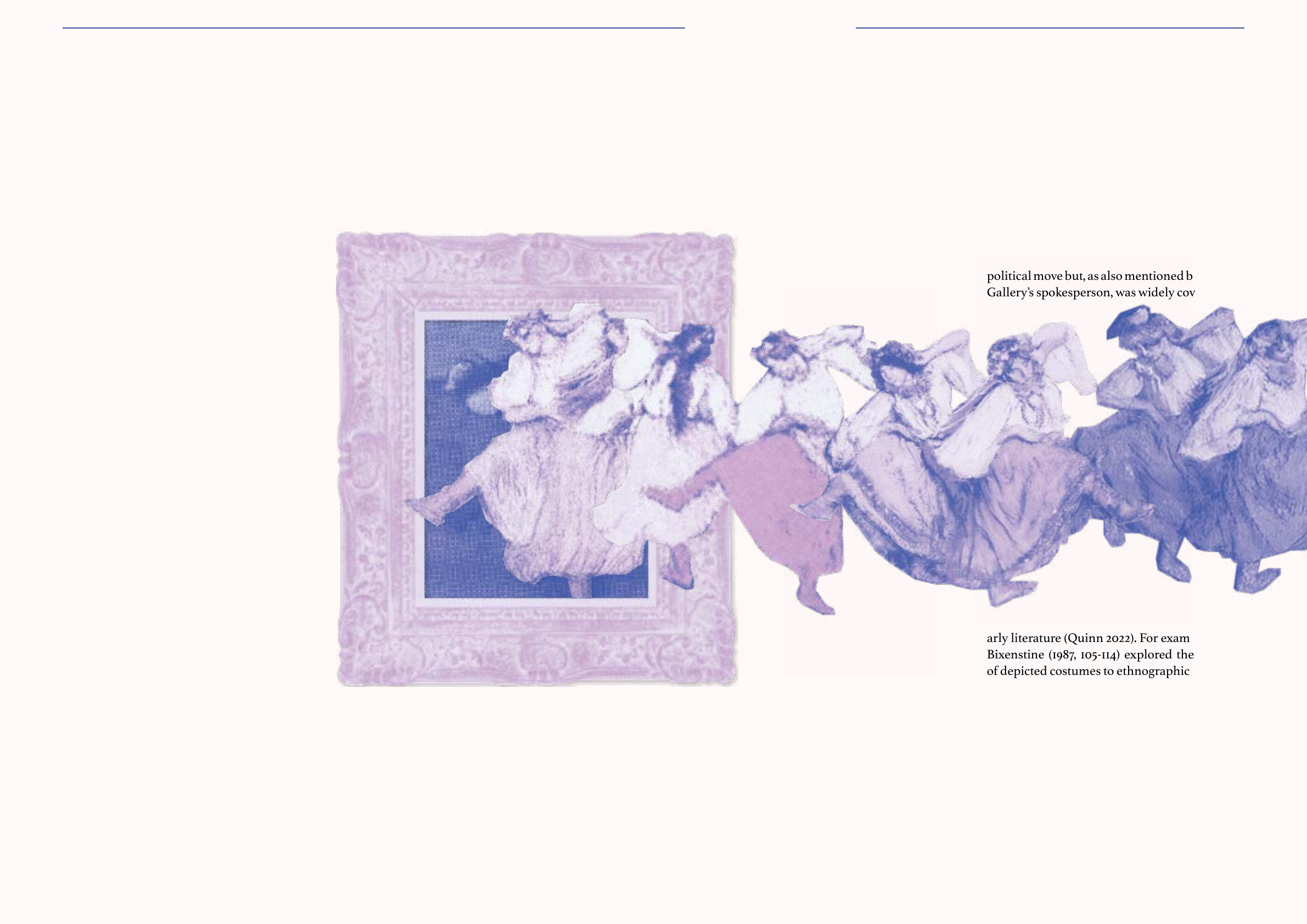
arly literature (Quinn 2022). For example, a study by
Bixenstine (1987, 105-114) explored the resemblance
of depicted costumes to ethnographic records of tra-
ditional Ukrainian attire. Thus, the original title was
giving a wrong impression of the illustrated dancers
representing Russian culture and tradition. While
there may be little signicance in this when a paint-
ing is lying in storage, the potential impact becomes
substantially more adverse when the artwork goes
on display. The National Gallery welcomed over 3.2
million visitors in 2024 (The National Gallery 2024),
and if the title hadn’t been changed, each one of
those people would potentially have stopped to ad-
mire Ukrainian dancers, just like I did, only to think
that they were contemplating an example of Russian
WHY IS IT NECESSARY TO CHANGE
THE TITLE?
sia’s full-scale invasion of Ukraine in February that
year (Quinn 2022). This change received a varied re-
sponse from the public: some were encouraged by
it, highlighting the need to correct the misrepresen-
tation of national culture, while others were critical,
concerned with the politicised distortion of the orig-
inal idea of the artist.
The rst reason for this is a correction of the public’s
idea about Ukrainian and Russian national heritage.
The change of this painting’s title was not a purely
political move but, as also mentioned by the National
Gallery’s spokesperson, was widely covered in schol-
WHY CHANGE
THE TITLE
National Idetity
ad Cultural
Appropriatio through
the Lens of Art
DIANA POSTAVKA
uring one of my visits to London, I had the
chance to spend a few hours in the famous
National Gallery. Whilst exploring one of the mag-
nicent impressionist halls, my eye was caught by
a painting hanging in the middle of the wall. In
places like this, where every corner is lled with a
masterpiece, it’s hard to imagine something stand-
ing out so sharply. It wasn’t the form or technique
that sparked my attention; it was the subject. Several
women in the foreground were depicted in an ac-
tive dancing motion. Dressed in loose white shirts,
long bright skirts, and red boots, with red necklaces
around their necks and ower wreaths with colour-
ful ribbons in their hair, their appearance clearly
resembled traditional Ukrainian costume. Turning
my head to the object label, I was not surprised to
learn that this was ‘Ukrainian Dancers’ by Edgar
Degas. I looked back at the painting and then let my
gaze slide around the room. I felt a warm sense of
pride, realising that a troupe performing tradition-
al dances of my country had inspired the work of a
famous French impressionist, and now was admired
by thousands of gallery visitors every day.
D
Doing further research on this artwork later, I was,
however, very much surprised to nd out that the
title ‘Ukrainian Dancers’ was only assigned to this
painting in April 2022. Before that, it was titled
‘Russian Dancers’, reecting the original name ‘Les
Danseuses Russes’ given to the painting by Degas.
A spokesperson for the National Gallery revealed to
The Guardian that the title of the work “has been
an ongoing point of discussion for many years,” and
the change process was accelerated following Rus-
14 15DЇASPORA JOURNAL
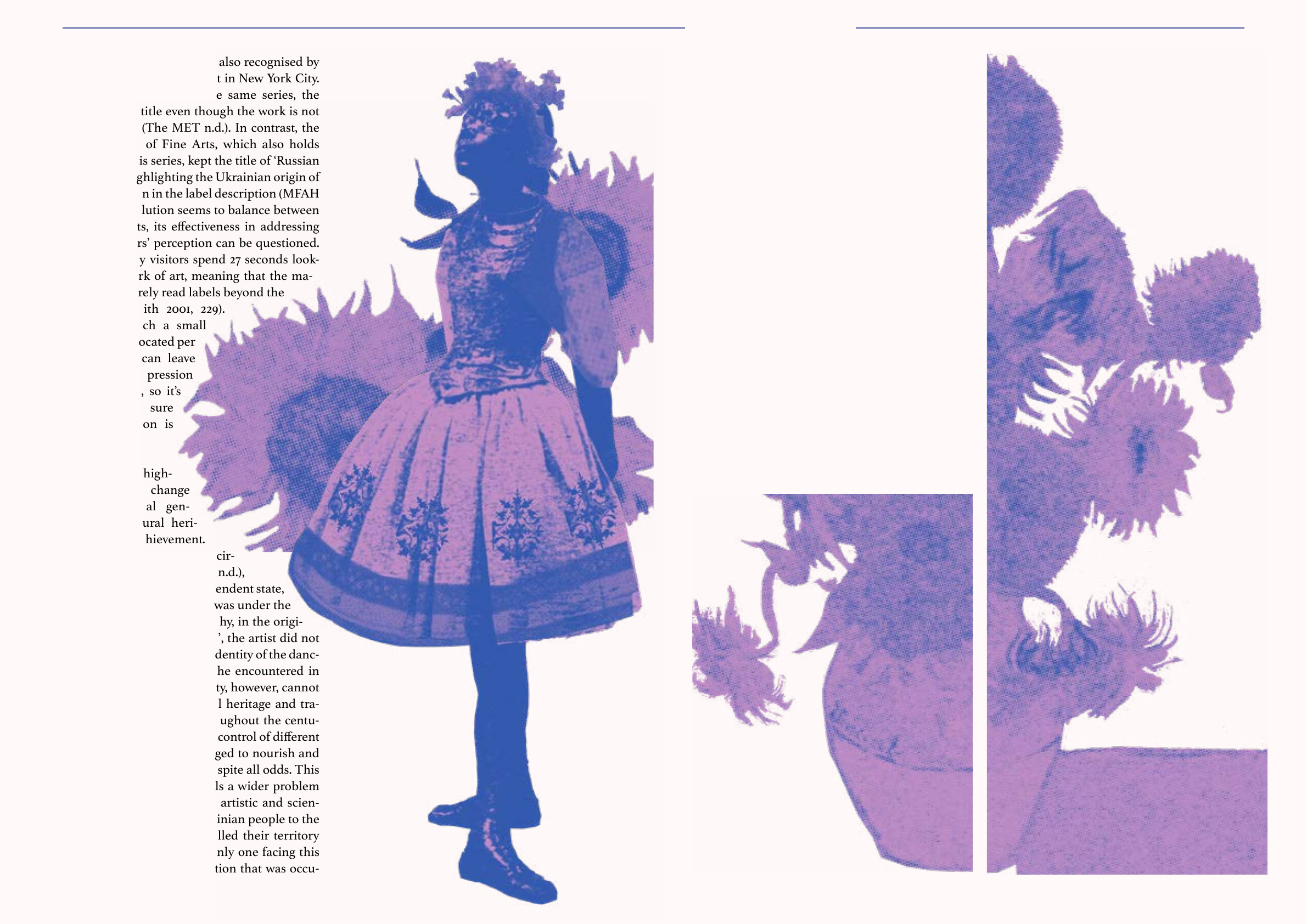
pied or colonised in the past, as dominating states
often appropriate signicant cultural attainments.
Critics of this title change were quick to label it a dis-
tinctly politicised move, but the truth is that art is
never free of politics. Our surroundings shape our
views, opinions and ideas, so it is unreasonable to
expect that any output of the human mind will not
be inuenced by such external factors. In addition,
artworks aren’t just pictures hanging on a wall, and
art galleries are not just places where these pictures
are kept. Every museum and gallery serves an educa-
tional purpose and thus has a responsibility to pro-
vide its audience with information that best reects
the accumulated knowledge around the subject. The
adjustment of the original name of the artwork is,
therefore, not an unprecedented practice: galleries,
on many occasions, have updated titles to remove
oensive terms and colonial language, as well as to
contextualise the subject matter and correct gener-
alisations. A prominent case is the 2015 initiative in
the Rijksmuseum in Amsterdam, where the whole
collection was reviewed to update unethical termi-
nology (Hooton 2015). Such changes are necessary
for art to t in with and reect contemporary society.
cultural heritage. This issue was also recognised by
the Metropolitan Museum of Art in New York City.
Holding another work from the same series, the
MET updated the title even though the work is not
currently on view (The MET n.d.). In contrast, the
Houston Museum of Fine Arts, which also holds
two works from this series, kept the title of ‘Russian
Dancers’, while highlighting the Ukrainian origin of
the depicted women in the label description (MFAH
n.d.). While this solution seems to balance between
the two viewpoints, its eectiveness in addressing
the issue of viewers’ perception can be questioned.
On average, gallery visitors spend 27 seconds look-
ing at a single work of art, meaning that the ma-
jority of visitors rarely read labels beyond the
painting title (Smith 2001, 229).
Yet, even with such a small
amount of time allocated per
work, a painting can leave
a memorable impression
on visitors’ minds, so it’s
important to make sure
that this impression is
not misleading.
The second issue high-
lighted by this title change
is the geographical gen-
eralisation of cultural heri-
tage and artistic achievement.
When Degas created his work, cir-
ca 1899 (The National Gallery n.d.),
Ukraine did not exist as an independent state,
and most of its current territory was under the
Russian Empire. This explains why, in the origi-
nal name ‘Les Danseuses Russes’, the artist did not
correctly recognise the national identity of the danc-
ing troupe whose performance he encountered in
Paris. The lack of state sovereignty, however, cannot
rewrite the belonging of cultural heritage and tra-
ditions to a specic nation. Throughout the centu-
ries, Ukraine was split under the control of dierent
states, and yet our people managed to nourish and
preserve their unique identity despite all odds. This
title change, nevertheless, unveils a wider problem
of the prescription of historical, artistic and scien-
tic contributions made by Ukrainian people to the
heritage of the state that controlled their territory
at the time. Ukraine is not the only one facing this
problem: it is familiar to any nation that was occu-
16 17DЇASPORA JOURNAL

Bixenstine, Lisa. 1987. “Edgar Degas’ Russian
Dancers Series (1897–99): Their Dating, Pastel Tech-
nique, and Their Context within His Late Period
(1885–1908).” The Ohio State University.
Hooton, Christopher. 2015. “Museum to Rename
Any Artworks with Oensive Titles.” The Inde-
pendent, Accessed December 14, 2025. https://www.
the-independent.com/arts-entertainment/art/news/
museum-to-rename-any-artworks-with-oensive-ti-
tles-a6772616.html
MFAH (Museum of Fine Arts, Houston). n.d.
“The Russian Dancer.” Accessed December 17, 2025.
https://emuseum.mfah.org/objects/40670/the-rus-
sian-dancer
Quinn, Ben. 2022. “National Gallery Renames De-
gas’ Russian Dancers as Ukrainian Dancers.” The
Guardian. https://www.theguardian.com/artand-
design/2022/apr/03/national-gallery-renames-de-
gas-russian-dancers-as-ukrainian-dancers
Smith, Jerey. 2001. “Spending Time on Art.” Em-
pirical Studies of the Arts 19 (2).
The Metropolitan Museum of Art (The Met). n.d.
“Dancers in Ukrainian Dress.” Accessed December
15, 2025. https://www.metmuseum.org/art/collection/
search/459097
The National Gallery. 2024. “National Gallery
Anniversary Attracts 4.7 Million Worldwide Visits in
2024 and Over 159 Million Digitally.” Accessed De-
cember 20, 2025. https://www.nationalgallery.org.uk/
about-us/press-and-media/press-releases/nation-
al-gallery-anniversary-attracts-4-7-million-world-
wide-visits-in-2024-and-over-159-million-digitally
The National Gallery. n.d. “Ukrainian Dancers by
Hilaire-Germain-Edgar Degas” Accessed December
14, 2025. https://www.nationalgallery.org.uk/paint-
ings/hilaire-germain-edgar-degas-ukrainian-danc-
ers
Putting this case into a wider perspective, it isn’t
merely a title change. This is a prominent example
of the international eort to address cultural appro-
priation and facilitate the restoration of Ukrainian
national identity on the world stage. The main
signicance, however, lies in how this case can be
relevant for other countries, serving as a model for
reclaiming national achievements and correcting
generalised mislabelling. To sum up, many lessons
can be learned from Ukraine regarding the preser-
vation of national identity, and I hope this one will
help us build a world where, when walking into a
gallery or museum, we can see the culture of every
nation represented and credited correctly.
WHY DOES THIS MATTER?
BIBLIOGRAPHY
18 19DЇASPORA JOURNAL
THE CURIOUS CASE
OF THE ‘USEFUL’
AND ‘NONUSEFUL’
JEW Ebedded Doublethink i
Russia Culture
BENYA PYATSKI
A young child walks home from school and asks his mother,
‘Mom, why does everyone at school call me a “Zhid”’?
The mother replies, ‘Just be patient and wait’.
Years later, the child comes home from college and asks the same question.
The mother replies, ‘Just be patient and wait’.
After nishing university and obtaining a PhD, he still comes home and asks his mother the same question.
The mother replies, ‘Just be patient and wait’.
Finally, one day, he wins the Nobel Prize in Science, and people start to call him a famous
Russian scientist.
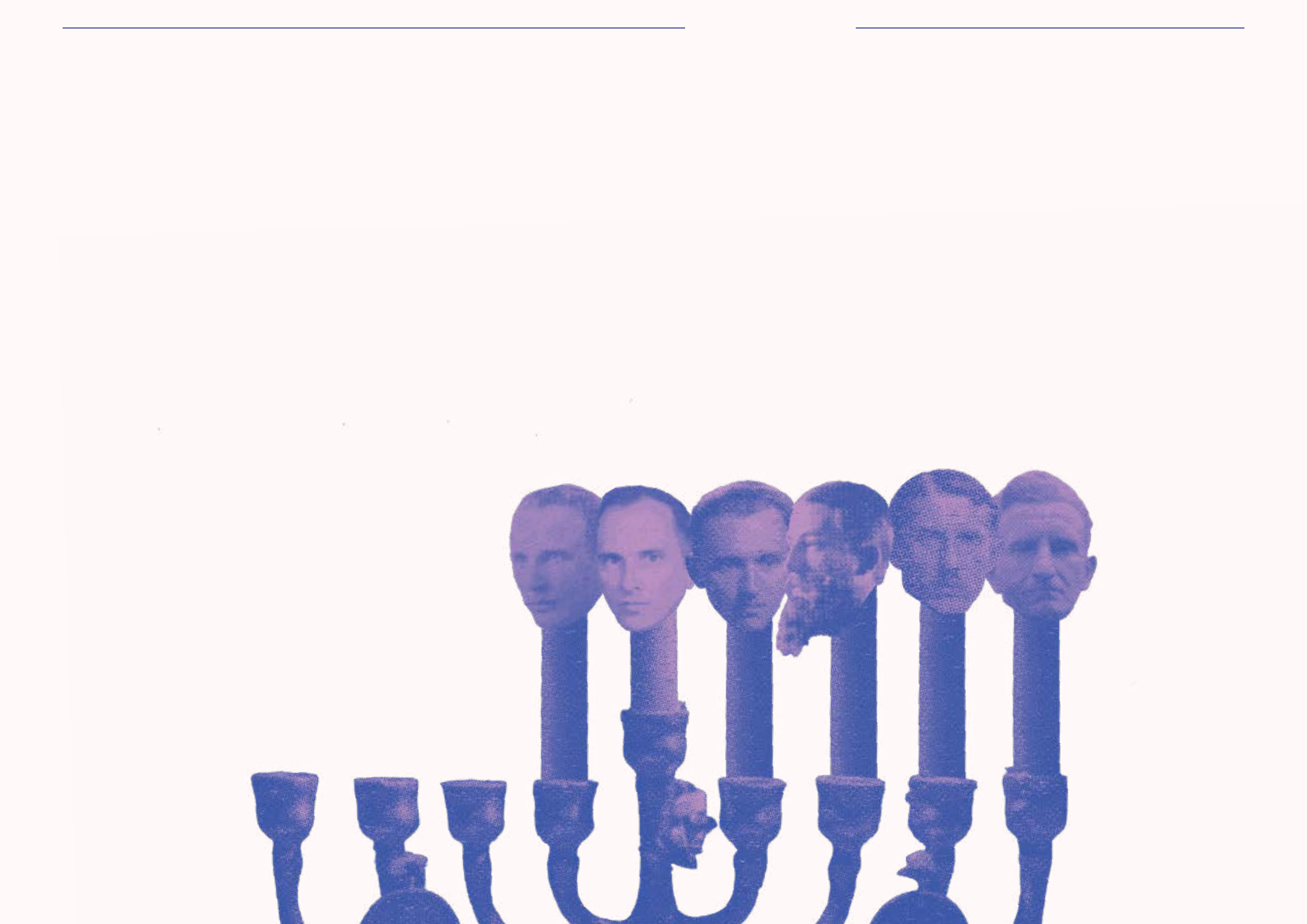
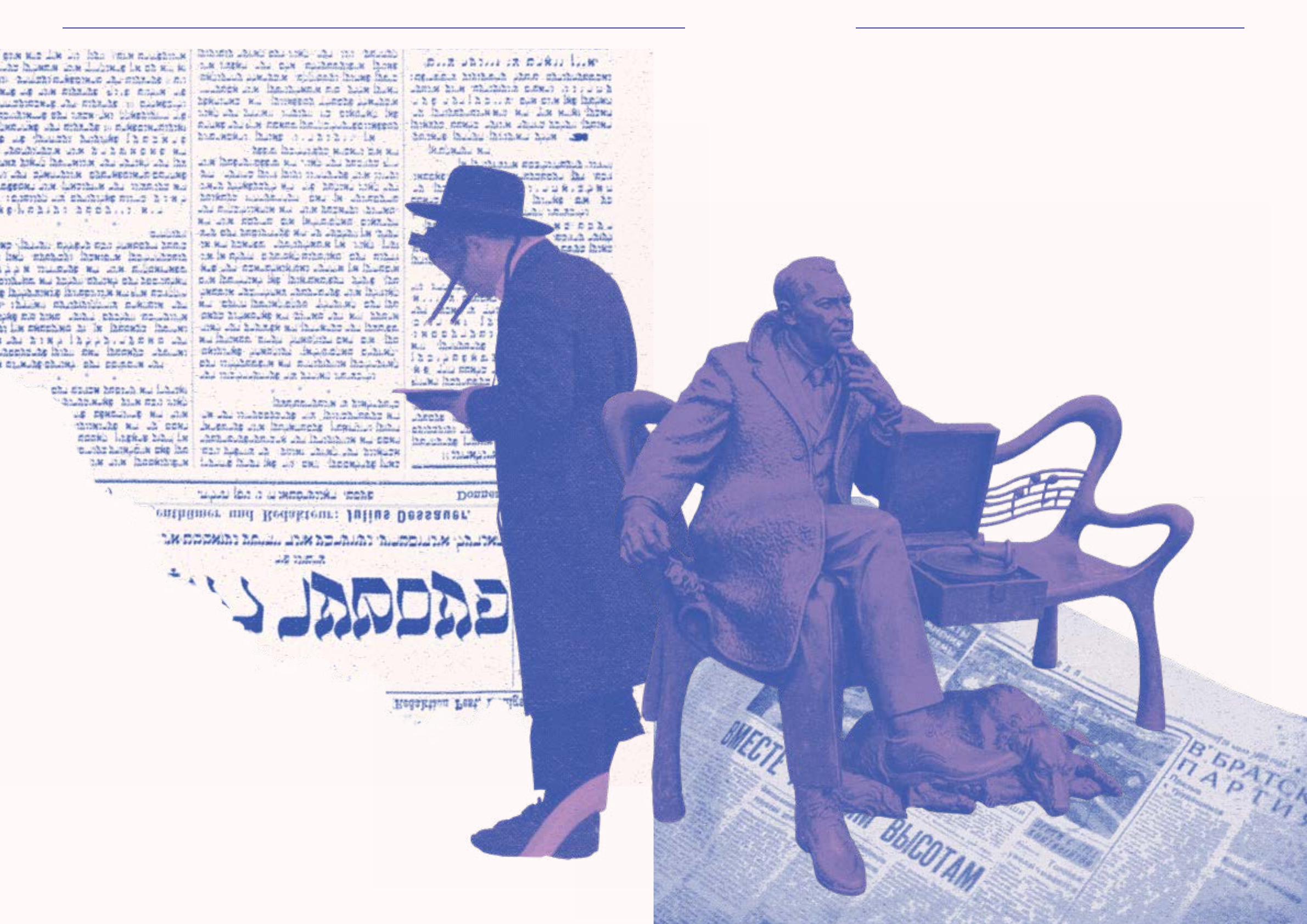
On the fth day of Chanukah, I was very kindly given
a gag gift by the Ukrainian Society of Northumbria
University. What I received was something bizarre
and something I had previously only encountered in
an obscure Reddit post - it was a Ukrainian ag, red
on black instead of blue on yellow, bearing a Jewish
Star of David at its centre. The ag (without the star)
is commonly associated with the Ukrainian Insur-
gent Army (UPA) and the Organisation of Ukrainian
Nationalists (OUN); two nationalist movements op-
erating primarily in western Ukraine from the 1920s
to the 1950s that sought independence from
the Soviet Union through partisan
warfare. The OUN was explicitly
antisemitic from its inception and
carried out pogroms (organised mas-
sacres of Jewish settlements). The
UPA, though not initially antisemitic,
frequently redirected anti-Bolshevik,
anti-Russian, and anti-Polish resentment towards
Jewish populations, especially during periods of
collaboration with the Nazis (Державний Архів
Львівської Області, document 21; Zhukov 2007).
The ag, however, actually predates both organ-
isations and has a longer history as a war ag of
Ukraine (a role it continues to full to this day) (Vo-
loshanenko 2024). Its association with the OUN and
UPA, though, has become a major target of Russian
propaganda in an attempt to justify the invasion of
Ukraine as a campaign of denazication. Indeed,
it is not contradictory in Russian media to portray
Ukraine as both Nazi-run and part of a grand Jewish
conspiracy aimed at undermining Russian Ortho-
doxy and seizing power. So, although placing one of
Judaism’s core symbols on a ag associated with his-
torically antisemitic groups is ironic in and of itself,
this is only surface-level irony. The deeper irony is
that this ag serves as a near-perfect visual sum-
mary of the Russian worldview toward Jews, forged
through nearly three centuries of oppression, forced
assimilation, and paradoxical ideology.
Even more egregiously, Russian Foreign Minister
Sergei Lavrov openly stated in 2022 that ‘the fact
[that Zelenskyy is Jewish] does not negate the Nazi
elements in Ukraine’. Lavrov went on
to claim that Hitler himself had
‘Jewish blood’ and that ‘for
some time we have heard from
the wise Jewish people that
the biggest antisemites were
Jewish’ (NBC News 2022).
The absurdity of saying that
the architect of the Holocaust
was Jewish is obvious. What
is often overlooked, however, is
Lavrov’s deliberate phrasing. Call-
ing the Jewish people ‘wise’ in the
same breath was not a slip of the
tongue — it reects Russia’s deep-
ly embedded, self-serving cultural
mechanism for categorising Jews
into ‘useful’ and ‘non-useful’.
WHY WRITE THIS?
20 21DЇASPORA JOURNAL
‘USEFUL’ AND ‘NON-USEFUL’ JEWS
Russian culture does not simply recognise Jews as
Jews. Instead, it divides them into categories: ‘useful’
Rossiyane and ‘non-useful’ Zhids. A ‘useful’ Jew ceas-
es to be Jewish in the public imagination as their Rus-
sication is complete; a ‘non-useful’ Jew becomes a
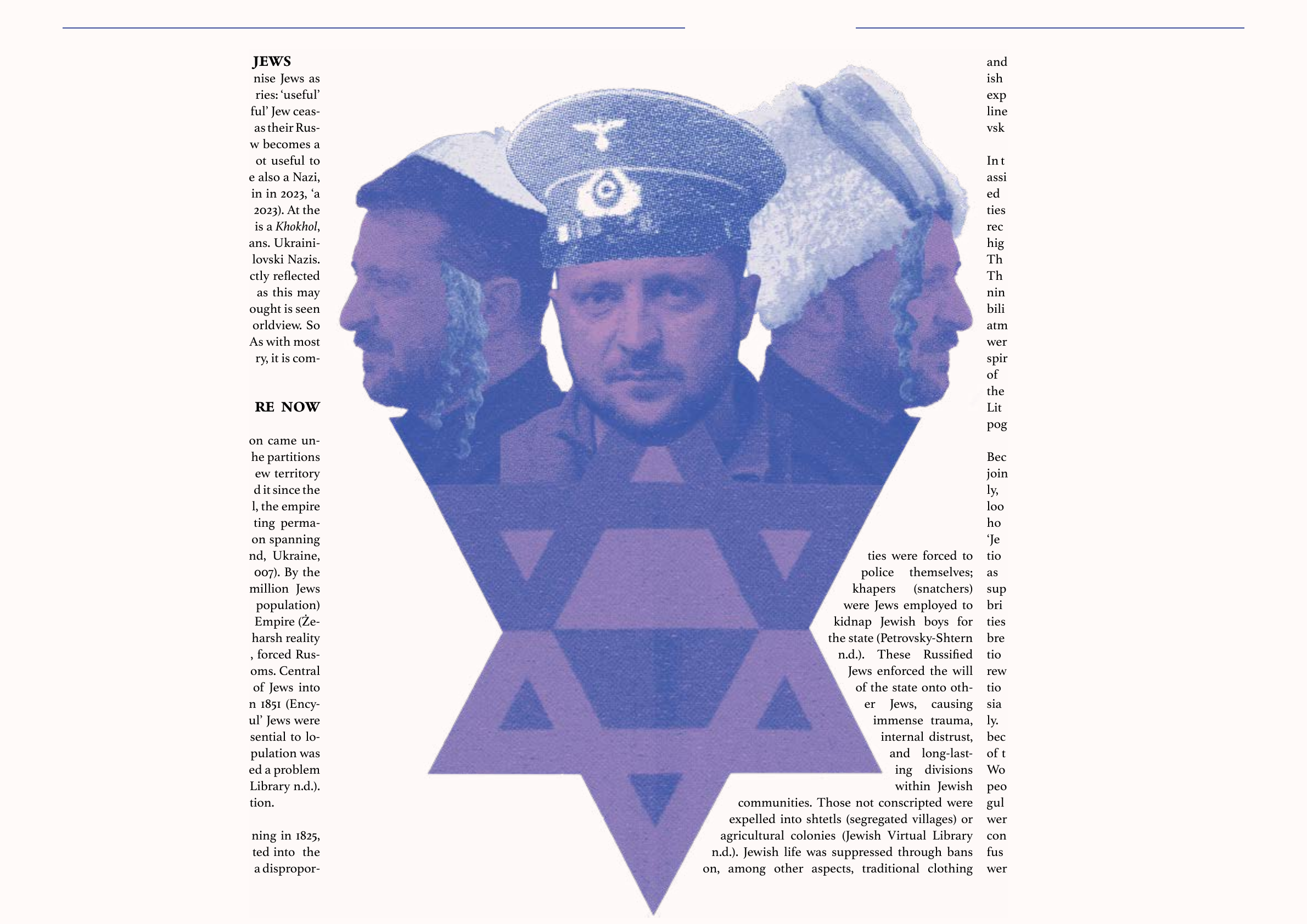
problem. Zelenskyy, as a Jew who is not useful to
Russia, becomes a Zhid. He is therefore also a Nazi,
and as per statements by Vladimir Putin in 2023, ‘a
disgrace to the Jewish people’ (Meduza 2023). At the
same time, because he is Ukrainian, he is a Khokhol,
a derogatory Russian term for Ukrainians. Ukraini-
ans, in turn, become Zhidovski-Khokhlovski Nazis.
This perception of Ukrainians is perfectly reected
in the ag that I was given. As absurd as this may
sound, this self-contradictory line of thought is seen
as completely logical in the Russian worldview. So
where do these constructs come from? As with most
things in Eastern European Jewish history, it is com-
plicated, violent, and old.
CONGRATULATIONS, YOU ARE NOW
RUSSIAN. DO NOT RESIST.
The rst time a large Jewish population came un-
der Russian imperial control was after the partitions
of Poland from 1772 to 1795. With the new territory
came millions of Jews who had populated it since the
Middle Ages. To get them under control, the empire
created the Pale of Settlement, restricting perma-
nent Jewish residence to a dened region spanning
modern-day Lithuania, Belarus, Poland, Ukraine,
and Moldova (Encyclopaedia Judaica 2007). By the
early nineteenth century, around 5 million Jews
(about 40 per cent of the world’s Jewish population)
lived within the borders of the Russian Empire (Że-
browski n.d.). The Pale, however, was a harsh reality
where Jews faced systematic exclusion, forced Rus-
sication, and nearly a century of pogroms. Central
to this system was the categorisation of Jews into
‘useful’ and ‘non-useful’, formalised in 1851 (Ency-
clopaedia Judaica 2007). Initially, ‘useful’ Jews were
wealthy merchants and individuals essential to lo-
cal commerce; the rest of the Jewish population was
deemed ‘non-useful’ and therefore posed a problem
for Russian hegemony (Jewish Virtual Library n.d.).
The solution to it — forced transformation.
By the order of Tsar Nicholas I, beginning in 1825,
Jewish boys were forcibly conscripted into the
military starting at age twelve (although a dispropor-
ties were forced to
police themselves;
khapers (snatchers)
were Jews employed to
kidnap Jewish boys for
the state (Petrovsky-Shtern
n.d.). These Russied
Jews enforced the will
of the state onto oth-
er Jews, causing
immense trauma,
internal distrust,
and long-last-
ing divisions
within Jewish
communities. Those not conscripted were
expelled into shtetls (segregated villages) or
agricultural colonies (Jewish Virtual Library
n.d.). Jewish life was suppressed through bans
on, among other aspects, traditional clothing
and pe’ot (traditional Jewish sidelocks). Most Jew-
ish soldiers who refused conversion were treated as
expendable assets and sent as ill-equipped front-
line infantry to be used as cannon fodder (Petro-
vsky-Shtern n.d.).
In the 1840s, Nicholas I expanded his policy of forced
assimilation through state-run Jewish schools, fund-
ed by extortionate taxes levied on Jewish communi-
ties themselves. Jews who completed these programs
received the right to live outside the Pale and pursue
higher education and enjoyed a higher legal status.
They were no longer Zhidy, they became Rossiyane.
That status, however, was ckle. Starting in the late
nineteenth century, Russia was facing political insta-
bility, military defeats, and revolution. In this tense
atmosphere, antisemitism reached its climax. Jews
were blamed for an imagined international con-
spiracy, resulting in the state-sponsored publication
of The Protocols of the Elders of Zion, the banning of
the Hebrew alphabet in 1915, mass expulsions from
Lithuania and Courland, and a new series of severe
pogroms which killed over 100,000 Jews.
Because of this oppression, Jews disproportionately
joined the revolutionary movements of 1917. Initial-
ly, Bolshevik rule abolished legal antisemitism and
loosened restrictions on Jewish life. These policies,
however, did not last. Under Soviet leadership, the
‘Jewish problem’ was reframed as one of assimila-
tion (with assimilated Jews themselves often acting
as enforcers). Judaism, Hebrew, and Zionism were
suppressed. Secular Yiddish culture was tolerated
briey, then dismantled. In 1919, Jewish communi-
ties were dissolved, their property conscated. He-
brew study was prohibited, and religious institu-
tions were shut down. Yiddish texts were forcibly
rewritten in Cyrillic to sever the language’s connec-
tion to Hebrew. Jews were compelled to speak Rus-
sian, adopt Russian names, and assimilate cultural-
ly. With the ascension of Stalin to power, Soviet Jews
became legally marked by the pyatoye (the fth line
of the passport that identied ethnicity), and post-
World War II, they were labelled ‘enemies of the
people’, purged from common society, and sent to
gulags (Correspondent 1997). Of course, exceptions
were made for ‘useful’ Jews. Post-Stalin, those who
continued Jewish life would become known as Re-
fuseniks and were labelled ‘social parasites’ and
were subsequently punished until the reforms of
tionate number were
younger). They were
placed in cantonist mil-
itary schools (specically
for underage Jews) until
adulthood and then draft-
ed for twenty-ve years
of service (ibid.). The
objective was clear
— to destroy Jew-
ish identity and
convert Jews to
Russian Or-
thodoxy. The
Tsar stated plainly: ‘the purpose of the ed-
ucation of the Jews is to bring them nearer to
the Christians and to uproot their harmful be-
liefs, which are inuenced by the Talmud’ (ibid.).
To meet conscription quotas, Jewish communi-
22 23DЇASPORA JOURNAL
the late 1980s. Throughout this period,
the categories remained; they were just more ei-
ciently enforced.
CULTURE COMPLETES THE PICTURE
State policy alone is not responsible for these ac-
tions, however. Culture nished the job. Throughout
the Soviet period, Jewish art, music, theatre, science,
and literature were translated into Russian, stripped
of their unique Jewish identity, and rebranded as
national products. The eects of this cultural era-
sure are still visible to this day. As a crowdfunded
source which reects the socio-cultural attitudes
of its contributors, Wikipedia serves as a perfect
example: Leonid Utyosov, born Leyzer Iosifovich
Weissbein and Mark Bernes, born Menakhem-Man
Neukh-Shmuylov Neyman, were among the most
well-known performers of the rst half of the twen-
tieth century in the Soviet Union; both were Jewish,
born in Ukraine, and grew up speaking Yiddish. Yet
Russian Wikipedia describes Utyosov as an ‘ethnic
Russian and Soviet artist’, and Bernes simply as a
‘Soviet artist’. Their Jewish identities disappear.
Mullet), and ‘Крутится, Вертится, Шар Голубой’
(Тhe Blue Ball Spins and Turns) were originally
written in Yiddish, about Jewish life, and performed
by Jewish artists like Utyosov and Bernes. The chan-
son genre to which these songs belong, often con-
sidered quintessentially Russian, in fact comes from
the Jewish-Ukrainian culture of the late nineteenth
and early twentieth centuries.
By contrast, Rabbi Menachem Mendel Schneerson
— the founder of Chabad — born in Ukraine and
raised speaking Yiddish, is labelled explicitly as Jew-
ish. His father was executed, his family persecuted,
and he ed the Soviet Union. He was not useful for
Russian culture and hegemony, and although fa-
mous, neither Russian Wikipedia nor the Russian
people consider him Russian.
Even iconic ‘Russian’ songs such as ‘Мурка’ (Mur-
ka), ‘Шаланды Полные Кефали’ (Barges, Full of
24 25DЇASPORA JOURNAL

So, what does this have to do with Ukraine? The
historical relationship between Ukraine and the
Ashkenazi Jewish population is long, enduring,
and reciprocal. Jewish culture became ingrained
in Ukrainian culture just as Ukrainian space and
language shaped Jewish life. A clear example is
the stereotypical Odesite. Odesites are known for
speaking a distinctive dialect of Russian marked by
Yiddish-inuenced grammar, pronunciation, and
rhythm, including the famously unrolled ‘r’. They
are also known for a style of humour deeply associ-
ated with Jewish tradition, so much so that an entire
genre of jokes revolves around an Odesite named
Rabinovich (a stereotypically Jewish surname). This
cultural fusion persists even within the Jewish dias-
pora today. When my local Rabbi, whose family left
Ukraine over a century ago, learned that my family
had come from Berdychiv, he exclaimed that it was
good luck to meet a Jew from Berdychiv, showing a
sentiment rooted in shared cultural memory rather
than religion alone. Linguistically, this relationship
culminated in the creation of Ukrainish, a hybrid of
Ukrainian and Eastern Yiddish which became the
most common dialect of Yiddish in the early 20th
century and the standard for Yiddish theatre, litera-
ture, and academia (Katz n.d.).
UKRAINISH
This deep cultural integration led, in the Russian
imagination, to an association between Jews and
Ukrainians. Within the existing Russian framework
of Rossiyane and Zhidy, Jews, whose culture had
become an integral part of Ukrainian life, were re-
cast as a corrupting force, producing Khokhols - the
‘non-useful’ Ukrainian counterpart to the ‘non-use-
ful’ Jew. This logic surfaced explicitly for the rst
time following the Second World War. Soviet propa-
ganda emphasised alleged Jewish and Zionist par-
ticipation in the UPA, particularly during the early
1950s purges of Soviet Jews, when supposed links
between Jewish and Ukrainian nationalism were
fabricated and amplied through hoaxes and staged
‘revelations’ (Romerstein 2004).
PUTTING IT ALL TOGETHER
So where does that leave us? It leaves us with a Rus-
sian worldview shaped by centuries of forced assim-
ilation, cultural extraction, and deeply embedded
ideological hypocrisy. One in which Jews and Ukrai-
nians are understood not as peoples, but as func-
tions. Within the framework of Russkiy Mir, culture
and identity are judged not by origin or truth, but
by perceived usefulness. Jewish culture and Jews
deemed to be ‘useful’ may be absorbed, renamed,
and celebrated as Russian, while Jewish culture and
Jews deemed ‘non-useful’ are to be marginalised,
criminalised, painted as a threat to the Russian iden-
tity.
Thus Ukraine, whose culture was deeply interwo-
ven with Jewish life, becomes suspect. Jews become
corrupting agents and Ukrainians — their product.
By this logic, Jews can be Nazis, Nazis can be Jews,
and Ukrainians can be both not
because reality supports it,
but because deemed
usefulness is the
only category
that matters.
The ag I was given is not a contradiction. It is a con-
clusion. It represents a worldview in which logic is
irrelevant, history is selectively rewritten, and iden-
tity is conditional. In Russia this is not viewed as
‘irony’ — it is a tradition.
26 27DЇASPORA JOURNAL
BIBLIOGRAPHY
Yuri, Zhukov. “Examining the Authoritarian Mod-
el of Counter-Insurgency: The Soviet Campaign
Against the Ukrainian Insurgent Army.” Institute
for National Strategic Studies, Sept. 2007, https://
web.archive.org/web/20170204005053/http:/scholar.
harvard.edu/files/zhukov/files/2007_Zhukov_SWI.
pdf?m=1360038945.
“Річчя Відновлення Незалежності України.”
Державний архів Львівської області, https://web.
archive.org/web/20170105084537/http:/www.ar-
chivelviv.gov.ua/materials/exhibitions/do-21-richch-
ja-vidnovlennja-nezalezhnosti-ukrajini/1146/.
Волошаненко, Вікторія. Синьо-Жовтий
Прапор — Наш Оберіг, Маркер і Ідентичність”.
Кропивницький Історик Про Український Стяг.
2024, https://suspilne.media/kropyvnytskiy/820265-
sino-zovtij-prapor-nas-oberig-marker-i-identicnist-
kropivnickij-istorik-pro-ukrainskij-stag/.
“Zelenskyy, a Jewish Nazi”: The Use of An-
ti-Semitic Tropes by Russian Propaganda Against
Ukraine. https://en.detector.media/post/zelenskyy-
a-jewish-nazi-the-use-of-anti-semitic-tropes-by-
russian-propaganda-against-ukraine. Accessed 31
Dec. 2025.
YouTube. https://www.youtube.com-
watch?v=A0PY72pWXRI. Accessed 31 Dec.
2025.
“Https://Www.Jewishvirtuallibrary.Org/the-
Pale-of-Settlement.” Jewish Virtual Library,
https://www.jewishvirtuallibrary.org/the-
pale-of-settlement. Accessed 31 Dec. 2025.
“Anniversary of the Pale Settlement Decree.”
Żydowski Instytut Historyczny, https://www.jhi.pl/
en/articles/anniversary-of-the-pale-settlement-de-
cree,243. Accessed 31 Dec. 2025.
“Https://Www.Jewishvirtuallibrary.Org/Rus-
sia-Virtual-Jewish-History-Tour.” Jewish Virtual
Library, https://www.jewishvirtuallibrary.org/rus-
sia-virtual-jewish-history-tour. Accessed 31 Dec.
2025.
The YIVO Encyclopedia of Jews in Eastern Eu-
rope. https://encyclopedia.yivo.org/article/244. Ac-
cessed 31 Dec. 2025.
The YIVO Encyclopedia of Jews in Eastern Eu-
rope (n.d.). https://encyclopedia.yivo.org/article/235
Romerstein, Herbert. “Divide and Conquer: The
KGB Disinformation Campaign against Ukrainians
and Jews | the Institute of World Politics.” The Insti-
tute of World Politics, November 2004. https://web.
archive.org/web/20230405190737/https://www.iwp.
edu/papers-studies/2004/11/01/divide-and-conquer-
the-kgb-disinformation-campaign-against-ukraini-
ans-and-jews/.
Meduza. “Putin Says Zelensky ‘Isn’t Jewish but
a Disgrace to the Jewish People’ — Meduza,” 2023.
https://meduza.io/en/news/2023/06/16/putin-says-
zelensky-isn-t-jewish-but-a-disgrace-to-the-jewish-
people.
Correspondent, J. “Ethnicity Line Axed from
Russian Passports.” The Jewish News of North-
ern California, October 31, 1997. https://jweekly.
com/1997/10/31/ethnicity-line-axed-from-rus-
sian-passports #:~:text=Although%20commu-
nist%20leaders%20spoke%20of,of%20educa-
tion%2C%20work%20and%20politics..
28 29DЇASPORA JOURNAL
RECLAIMING
HISTORY How Russia is
Odesa? Balacing
Betwee Epire ad
Autooy
DANIIL MALITSKYY
Odesa is one of the largest and most signicant cit-
ies in Ukraine today — a bustling port on the north-
ern shore of the Black Sea, often described as a city
of opportunity, a multicultural metropolis, and
the “Southern Palmyra” (Lecke and Sicher 2023, 3).
Starting in 1794, the city experienced an era of rapid
growth and transformation, which continued up un-
til the end of the 19th century, a period that shaped
much of modern Odesa.
Yet, the city’s past has increasingly become the sub-
ject of political appropriation. Russian political and
media discourse persistently portrays Odesa as an
inherently Russian city, founded by Catherine II,
built by the Russian empire, and populated primar-
ily by Russians. This narrative, repeatedly used in
oicial statements, textbooks, and wartime rheto-
ric, presents Odesa’s urban history as evidence of a
A CONTESTED PAST
Russian claim to the city. However, such claims rely
on a simplied reading of the past, which conates
imperial governance with cultural ownership and
ignores the complex conditions under which Odesa
emerged.
Focusing on the period between 1794 and 1859, this
article discusses the historical extent of imperial au-
thority in the city and the forces behind its growth.
Particular attention is given to the porto franco re-
gime, introduced in the early 19th century, which
granted Odesa extensive tax exemptions and trade
privileges, substantially reducing imperial control
over local commerce. By reclaiming Odesa’s early
history from reductive imperial narratives, it is pos-
sible to challenge contemporary claims of Russian
ownership. A look at the city’s past shows that its
prosperity did not emerge under tight Russian con-
30 31DЇASPORA JOURNAL
trol, but from a curbing of that control. This unique
lack of Russian authority is, in fact, what allowed a
diverse set of communities, economic actors, and
expertise to form in the rst place, leading to the
creation of one of the most important port cities on
the shores of the Black Sea.
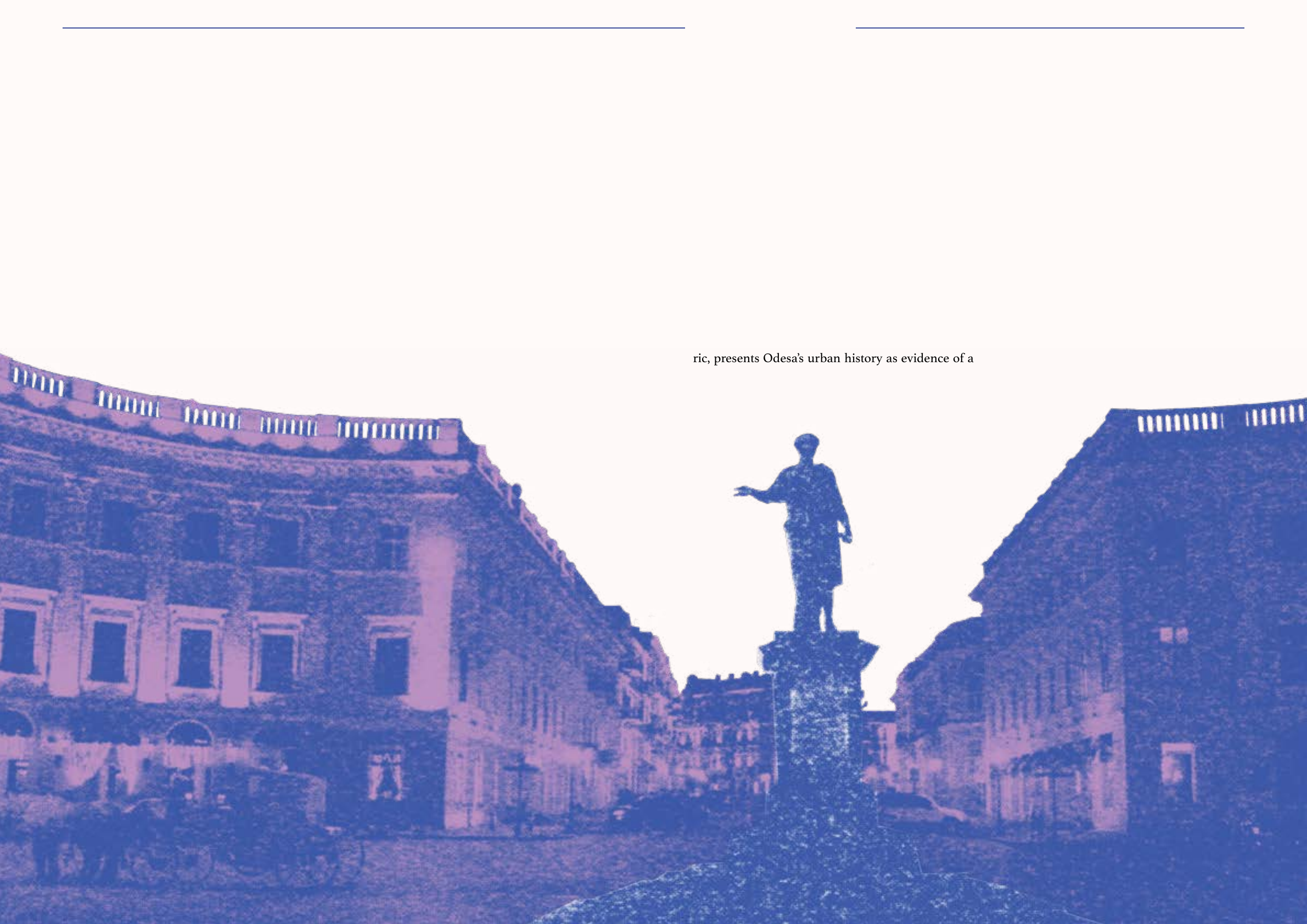
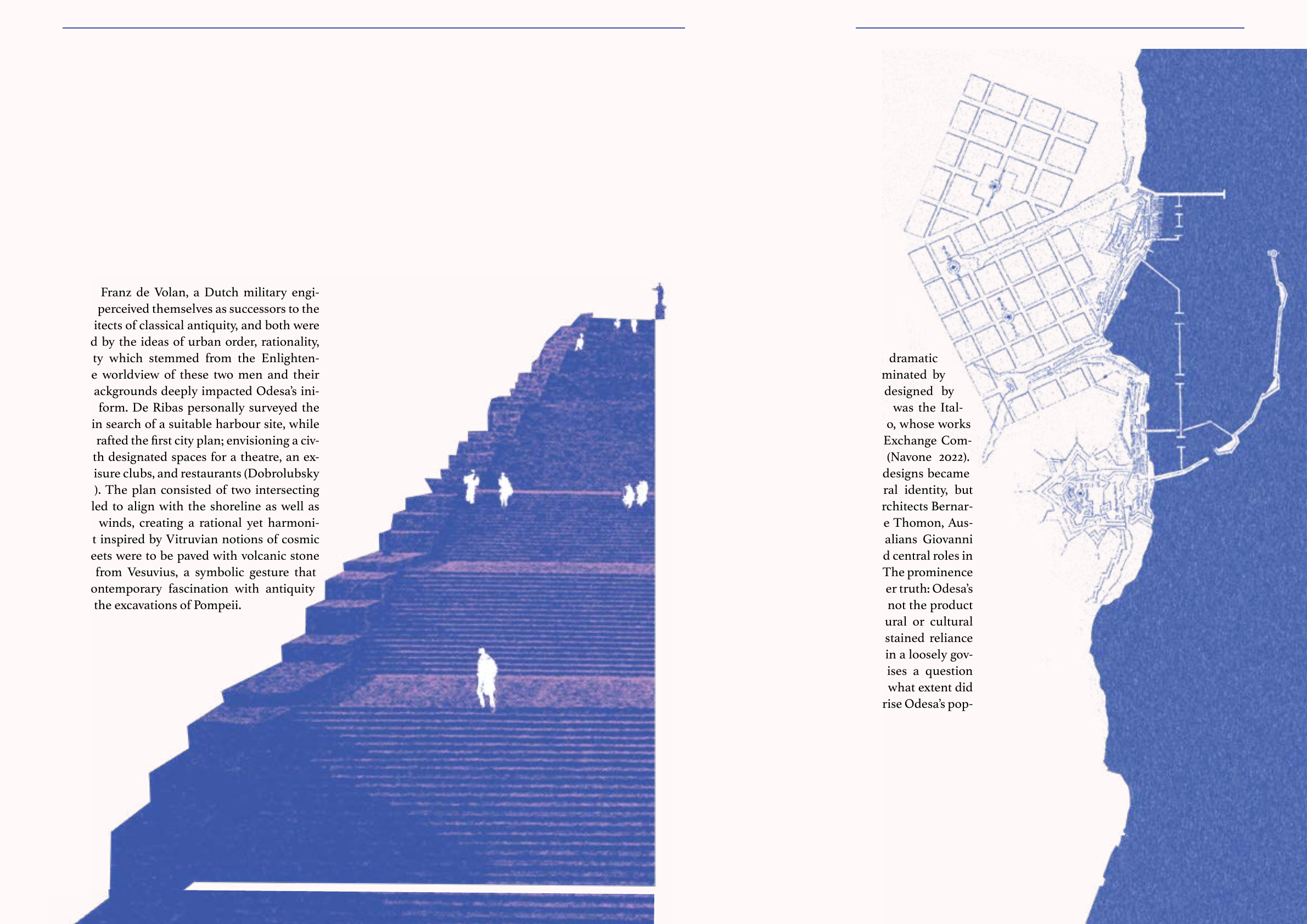
Most of Odesa’s early planning was done by foreign
professionals in Russian service, creating a cosmo-
politan air that would dene the city in the years
to come. Among the most inuential gures were
José de Ribas, a Spanish-Irish oicer in the Russian
Army and Franz de Volan, a Dutch military engi-
neer. Both perceived themselves as successors to the
great architects of classical antiquity, and both were
inuenced by the ideas of urban order, rationality,
and beauty which stemmed from the Enlighten-
ment. The worldview of these two men and their
military backgrounds deeply impacted Odesa’s ini-
tial urban form. De Ribas personally surveyed the
coastline in search of a suitable harbour site, while
de Volan drafted the rst city plan; envisioning a civ-
ic core with designated spaces for a theatre, an ex-
change, leisure clubs, and restaurants (Dobrolubsky
et al. 2016). The plan consisted of two intersecting
grids angled to align with the shoreline as well as
prevailing winds, creating a rational yet harmoni-
ous layout inspired by Vitruvian notions of cosmic
order. Streets were to be paved with volcanic stone
imported from Vesuvius, a symbolic gesture that
echoed contemporary fascination with antiquity
following the excavations of Pompeii.
By 1859, the city had undergone a dramatic
transformation. Its centre was dominated by
neoclassical architecture largely designed by
foreign professionals. One of them was the Ital-
ian architect Francesco (Franz) Boo, whose works
include the Vorontsov Palace, the Exchange Com-
mittee, and the Potemkin Stairs (Navone 2022).
Boo’s Palladian and Neoclassical designs became
emblematic of Odesa’s architectural identity, but
he was far from alone. The Swiss architects Bernar-
dazzi and Jean-François Thomas de Thomon, Aus-
trians Fellner and Helmer, and Italians Giovanni
Frapolli, Giorgio Torricelli all played central roles in
shaping the city’s urban landscape. The prominence
of these gures underscores a broader truth: Odesa’s
emergence as a major port city was not the product
of any coherent Russian architectural or cultural
programme, but instead one of sustained reliance
on foreign expertise operating within a loosely gov-
erned imperial periphery. This raises a question
which extends beyond planning: to what extent did
this cosmopolitanism also characterise Odesa’s pop-
ulation?
Following a series of successful military campaigns
against the Ottomans (1787-1792), the Russian Em-
pire encouraged large-scale migration into newly ac-
quired territories in the northern Black Sea region.
Under Catherine II, settlers were oered incentives
that were exceptional by contemporary standards:
These ambitions far exceeded the material reality of
the early settlement. Corruption and misappropri-
ation of funds undermined de Ribas’ oice. When
the Duke de Richelieu, a French nobleman and pol-
itician who ed France during the Revolution, ar-
rived in 1803, Odesa remained largely undeveloped.
As the Marseille merchant Charles Sicard observed,
“The city was only sketched out; there were very few
houses, small, poorly built, and uncomfortable…
and only one jetty harbour” (de Montclos 2016, 37).
Richelieu himself reportedly struggled to nd suit-
able lodging among the earthen huts which still
dominated the town (Herlihy 1986).
CONSTRUCTION: FOREIGN MINDS
AND IMPORTED VISIONS
Despite these conditions, Richelieu’s arrival
was a turning point. He invested in greenery
across the city (street vegetation as well as
parks and botanical gardens), invited more
foreign experts to assist with the city’s de-
velopment, and founded the Richelieu
Lyceum. The lyceum quickly became
one of the most respected education-
al institutions in the Russian Empire,
attracting students and faculty from
across Europe and transforming Ode-
sa into an intellectual and commer-
cial hub.
POPULATION:
INCENTIVES FLOW, PEOPLE FOLLOW
32 33DЇASPORA JOURNAL
intelligentsia ed the aftermath of the French Rev-
olution, and many others arrived as runaway serfs
(predominantly from Ukrainian territories). Jew-
ish migrants, constrained elsewhere by the Pale of
Settlement, also found Odesa to be a haven for res-
idence and commerce. This powerful combination
of opportunity and relative freedom produced a re-
markably multicultural population. In 1803, the city
counted approximately 4,500 inhabitants (Herlihy
1986, 34), with Greeks forming the largest foreign
community, a position later surpassed by Jews (Sif-
neos 2018, 34-36). By 1859, Odesa’s population had
increased to around 116,000, accompanied by the
formation of several suburban districts. This rap-
id growth made Odesa the third-largest city in the
Russian empire, after St. Petersburg and Moscow,
and the largest city within the territory of modern
Ukraine (Herlihy 1986, 232).
Oicial demographic statistics, however, obscure as
much as they reveal. In the context of the Russian
empire, ‘Russian’ often functioned less as a marker
of ethnic or national identity than as an administra-
tive or social designation. Language use, legal status,
and self-identication within an imperial frame-
work could all result in classication as Russian,
regardless of origin. Consequently, census gures
frequently overemphasised the Russian population,
masking the city’s heterogeneous composition. By
mid-century, Odesa had evolved from a small en-
clave of foreign administrators and traders into a
densely populated metropolis shaped by migrants,
fugitives, working-class communities, and merchant
dynasties. This demographic transformation not
only fuelled economic growth but also reshaped the
city’s urban form, density, and social geography.
free land, freedom of religion, and exemption from
military conscription (Gervits 2024, 34). These free-
doms, rarely available in the Russian interior, were
designed to accelerate development in a frontier
zone which the empire lacked the capacity to popu-
late and administer directly.
At the turn of the nineteenth century, much of Eu-
rope was marked by political unease and economic
uncertainty, while Odesa remained comparatively
stable and open. As a result, the city attracted mi-
grants from all over Europe and the empire itself.
Every community had a dierent reason for com-
ing: Greeks sought economic opportunity and relief
from Ottoman governance, members of the French
In the rst half of the nineteenth century, Odesa’s
physical size nearly tripled, yet it remained a rela-
tively compact and dense city. The most signicant
addition to the urban fabric beyond the city’s core
was Moldovanka, a predominantly Jewish neigh-
bourhood which developed rapidly and informally.
Often described as impoverished and unsafe, Mol-
dovanka stood in sharp contrast to the city’s neo-
classical origins. A clear spatial boundary separat-
ed it from the rest of the city: Staroportofrankovska
Street. Unlike the carefully designed city centre,
streets and blocks in Moldovanka reected the pres-
sures of accelerated migration and the practical
needs of a growing population rather than classical
ideals of order.
Oicially incorporated into Odesa in 1820, Mol-
dovanka had existed as a suburb prior to that, its
name deriving from an earlier Moldovan settlement
founded by refugees escaping Ottoman rule (Rich-
ardson 2008, 110). Despite widespread deprivation,
it was full of civic infrastructure. Moldavanka con-
tained public squares and green spaces, bordered
Dukovskyi Garden to the east, and housed one of
the city’s largest medical institutions, the Jewish
GROWTH:
WHEN MIGRATION DRAWS THE MAP
Hospital (now City Clinical Hospital No. 1). Its grad-
ual absorption into the city illustrates how Odesa
grew naturally, at its own pace rather than that of
the empire. Such informal urbanisation would have
been diicult in the more tightly controlled cities
of the Russian interior. In Odesa, the cosmological
and classical principles that underpinned the city’s
initial plans gave way to pragmatic adaptation. Yet,
Moldovanka’s growth is also a testament to the city’s
historic attraction to outsiders. Odesa drew migrants
not because it oered comfort, but because it oered
access to work, trade, and relative freedom under a
milder form of imperial oversight. Economic oppor-
tunity, combined with exible administration and
regulation, allowed neighbourhoods like Moldo-
vanka to become integral components of the city’s
urban system.
34 35DЇASPORA JOURNAL
Merchants and entrepreneurs played a crucial role
in Odesa’s nineteenth-century development. From
1803 to 1859, private capital was the primary source
of funding for much of the city’s construction. It be-
gan with Count de Richelieu’s initiative to allocate
free plots of land on the condition that buildings be
completed within two years (Herlihy 1986, 36). This
policy stimulated investment and ensured rapid ar-
chitectural growth. A particularly signicant insti-
tution in this process was the Exchange Committee,
an organisation established in the 1840s which rep-
resented the interests of traders before local authori-
ties. By 1859, the Committee had become an interme-
diary between Odesa’s business community and the
Belge, Boris, and Katja Wezel. “Entangled Com-
petition: Globalization, Imperial Domination,
and Local Development in the Port Cities of Riga
and Odesa.” Slavic Review, Vol. 81, no. 3 (2025):
https://resolve.cambridge.org/core/journals/slav-
ic-review/article/entangled-competition-global-
ization-imperial-domination-and-local-devel-
opment-in-the-port-cities-of-riga-and-odesa/
D86D921E6DCE95C7562983AFE2B71244.
Dobrolubsky, Andrey, Nadia Ieksarova, and Vlad-
imir Yeksarov. “Smart port city of Odessa: brilliant
embodiment of Vitruvius’ theories of beauty.” Vit-
ruvio, Vol. 1, no. 1 (2016): https://polipapers.upv.es/
index.php/vitruvio/article/view/5157.
Gervits, Maya. “Plague, Quarantine, and Environ-
mental Design in Nineteenth Century Odesa.” Plan-
ning Perspectives, Vol. 39 (2024): https://www.tand-
fonline.com/doi/full/10.1080/02665433.2023.2204494.
Herlihy, Patricia. “Odessa: Staple Trade and Ur-
banization in New Russia.” Jahrbücher für Ges-
chichte Osteuropas, Bd. 21, H. 2 (1973): https://www.
jstor.org/stable/41044735.
Herlihy, Patricia. Odessa: A History, 1794–1914.
Harvard University Press, 1986.
Herlihy, Patricia. Odessa Recollected: The Port
and the People. Academic Studies Press, 2019.
Lecke, Mirja, and Efraim Sicher. Cosmopolitan
Spaces in Odesa: A Case Study of an Urban Context.
Academic Studies Press, 2023.
Montclos, Brigitte. “Les Chemins d’Odessa
Civilisation et architecture à Odessa.” Cahiers
slaves, no. 14 (2016): https://www.persee.fr/doc/cas-
la_1283-3878_2016_num_14_1_1135.
Navone, Nicola. “Ticino architects in Odesa.”
Swiss National Museum, September 29, 2022. https://
blog.nationalmuseum.ch/en/2022/09/ticino-archi-
tects-in-odesa/?utm.
Puryear, Vernon J. “Odessa: Its Rise and Interna-
tional Importance, 1815-50.” Pacic Historical Re-
view, Vol. 3, no. 2 (1934): https://www.jstor.org/sta-
ble/3633378?seq=1.
Richardson, Tanya. Kaleidoscopic Odessa: Histo-
ry and Place in Contemporary Ukraine. University
of Toronto Press, 2008.
Sifneos, Evrydiki. Imperial Odessa: People, Spac-
es, Identities. Brill, 2018.
(Puryear 1934, 195-196). Although temporarily dis-
rupted by the Crimean War, this sustained peri-
od of growth consolidated Odesa’s position as the
largest grain-exporting port in the Russian empire.
Although Odesa began with only a few trade con-
nections in 1803, due to the porto franco regime,
that foundation grew into a thriving port economy
by 1859. The city’s resulting wealth transformed its
economy and reshaped its architecture, with mer-
chants investing heavily in rebuilding and mod-
ernising its central districts.
The true history of Odesa’s nineteenth-century de-
velopment challenges claims that portray the city as
an archetypal product of Russian imperial design.
Between its oicial founding in 1794 (which is dis-
puted since several settlements already existed be-
forehand) and the end of the porto franco regime
in 1859, Odesa emerged not as a model imperial city
under central authority, but as a space where impe-
rial control was partial, negotiable, and frequently
absent. Its growth relied on exceptional administra-
tive practices, economic freedom, and sustained re-
liance on foreign expertise and private capital rather
BIBLIOGRAPHY
municipal government, facilitating communication
between the two and lobbying for the development
of commercial infrastructure (Belge et al. 2025, 536).
Economic data documents the scale of Odesa’s com-
mercial success: in 1803, the port exported approxi-
mately 87,700 tons of grain, a gure that increased
almost tenfold to over 826,000 tons by the late 1850s
than direct state planning or investment. The city’s
cosmopolitan character was neither accidental nor
decorative. It was produced by policies that prior-
itised exibility over regulation, accommodation
over discipline, and opportunity over uniformity.
Migration ows, informal urban expansion, and the
prominence of non-Russian professionals were not
just deviations from an imperial norm, but the very
mechanisms through which the city functioned.
Seen through this lens, Odesa’s prosperity appears
inversely related to the intensity of Russian inter-
vention. Where the Russian state governed lightly
(through tax exemptions, delegated authority, and
permissive regulation), the city ourished. Where
order was imposed unevenly, as in suburban dis-
tricts like Moldovanka, life adapted pragmatically
rather than collapsing.
Odesa’s success thus grew not from Russianness,
but from the limits of Russian power and the space
those limits created for mobility, enterprise, and plu-
ralism. Reclaiming this history is of immeasurable
importance today. In an era where urban pasts are
often exploited to legitimise territorial expansion
and normalise violence, Odesa’s early development
oers a counter-narrative to imperial appropriation.
The city’s success as a European port on Ukrainian
soil is due specically to the absence of imperial
control, resulting in a municipal ethos dened by
pragmatism and openness.
TRADE:
GRAIN MOVES AND REVENUE ARRIVES
36 37DЇASPORA JOURNAL
MYTH IN THE CITY
Urbanis i Kyiv uder Orthodox
Cosology ad Marxist Ideology
T
DARIIA HRYSHCHENKO
his article examines how myth operated as a
generative force for the urban formation of
Kyiv at two transformative and ideologically diver-
gent moments: the 1830s, when the city was re-
imagined as a ‘Holy City’ within the Orthodox
cosmology of the Russian Empire and the peri-
od between 1923 and 1930, when Soviet plan-
ners sought to implement the Marxist idea
of proletarian ascendancy. Myth, as Roland
Barthes conceives it, functions as a ‘sec-
ond-order semiological system’ through
which ideology is naturalised and ren-
dered self-evident (2014, 223). In urban-
ism, this process manifests materially, as
metaphysical narratives and ideological
doctrines are translated into the or-
ganisation of streets, the placement of
monumental structures, and the hierar-
chy of spatial ensembles.
Mircea Eliade’s notion of the axis mundi further
illuminates this translation: through separa-
tion and socially produced space sacred and
cosmologically signicant points of orienta-
tion in the city give physical form to the link
between earthly and transcendent order (Eli-
ade 1959, Lefebvre 1991). In Kyiv, both periods
reveal how ideological myth, whether sacred
or secular, functioned as a spatialising
force, producing urban syntax that leg-
ibly inscribed authority and or-
der onto the cityscape.
In the 1830s, the Russian imperial administration
pursued an agenda of urban mythmaking in Kyiv,
mobilising Orthodox-Christian cosmology to legit-
imise political power. The Polish November Upris-
ing of 1830–31 had exposed the fragility of Russian
control over the western provinces, where Polish
elites retained disproportionate inuence (Bilenky
2018,17). Kyiv, with its diverse population of Poles,
Ukrainians, Jews, and Russians, became a stage
upon which imperial authority could be spatially
reairmed (Liber 1992, 12). By order of Tsar Nicholas
I, planners and architects sought to materialise the
myth of Kyiv as inherently ‘Russian Orthodox’ and
‘holy’, appropriating its historical connection to the
Baptism of Kyivan Rus in 988 and framing the city as
a ‘New Zion’ (Tolochko 2004, 250-253; Bilenky 2018,
4). This myth was implemented through spatial hi-
erarchy: the divine, the Tsar, the clergy, and subjects
were inscribed into urban form through elevation,
centrality, and visibility. The city’s natural topogra-
phy (hills on the Right Bank of the Dnipro River and
at plains on the Left) was used to reinforce this hi-
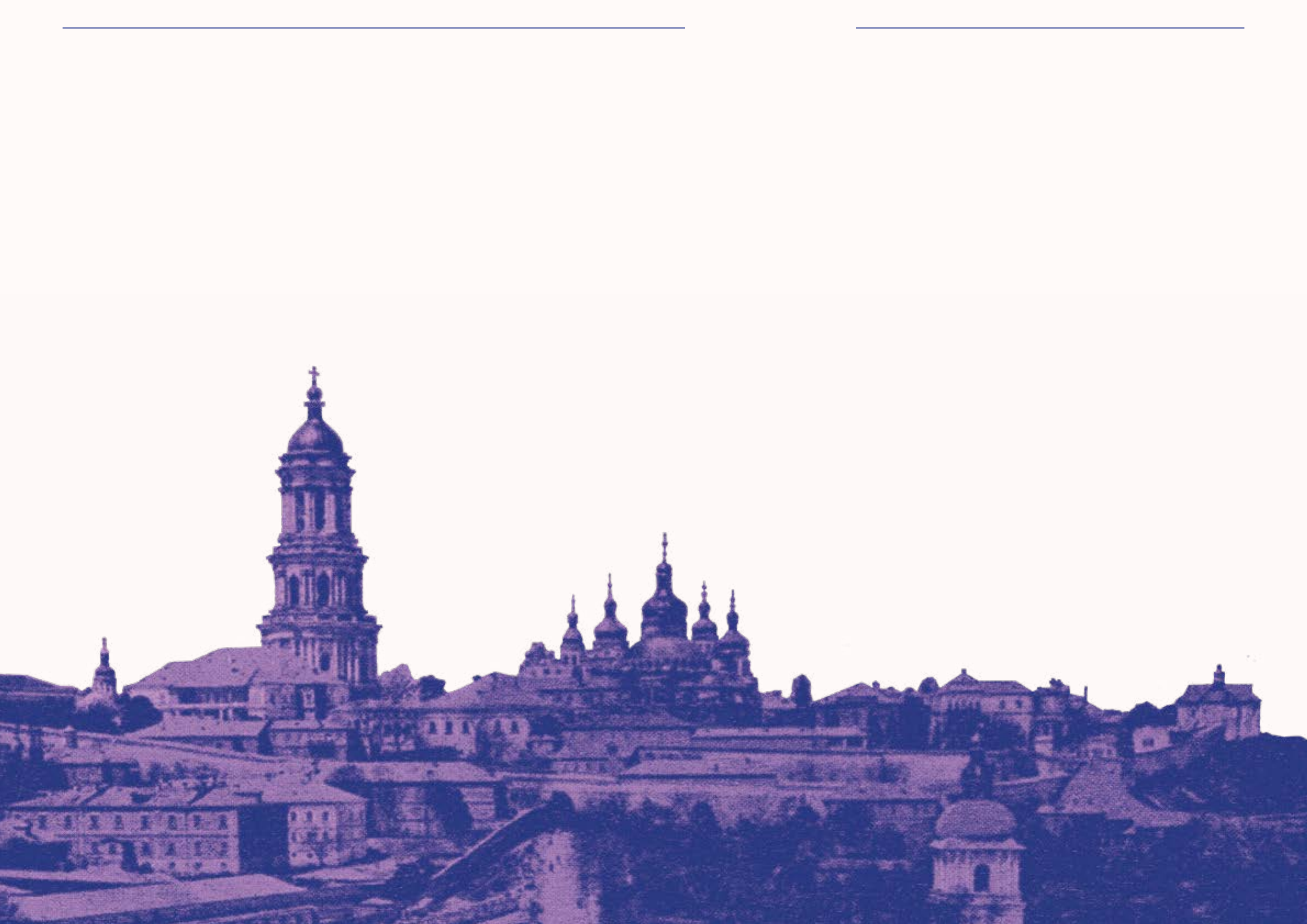
erarchy. The Kyiv Pechersk Lavra, a prominent cave
monastery, situated atop a hill on the Right Bank,
functioned as an axis mundi, establishing a visual
and symbolic centre that dominated both skyline
and consciousness. Pilgrimage routes to the Lavra
ascending from Podil, the merchants’ district within
the city, and the towns of Vasylkiv and Bilogorod-
ka from the outside translated this cosmology into
bodily experience.
The picturesque ensemble of churches scattered
across the hills along the Dnieper further rein-
forced the Orthodox vision of sacred geography
and was widely recognised as iconographic (Bilenky
2018, 20). While it could be argued that Kyiv lacked
a spatial diagram reecting the transition from the
square, signifying earth, to the circle, signifying the
divine, this critique primarily applies to the peri-
od between 1700 and 1800, when Kyiv was dened
by the three separate settlements of Pechersk, the
Old Town, and Podil (Kostof 1991). By the 1830s, the
imperial urban programme sought to consolidate
these areas through expansion inland on the Right
Bank. The introduction of a Roman-inspired grid,
which was used to assert the idea of the ‘holy mili-
tary city’ adapted to the hilly topography, balancing
the irregular terrain with a rationalised spatial order
in divine discourse (Bilenky 2018, 90). The grid func-
tioned not only as a mechanism of practical urban
organisation but also as an instrument of imperial
control and surveillance, transforming sacred to-
pography into a legible civic hierarchy (Beebeejaun
2021).
38 39DЇASPORA JOURNAL

Within this framework, the placement of key struc-
tures articulated the mythological and political nar-
rative. Churches dominated the skyline, asserting
religious supremacy; the Palace occupied another
hill but remained subordinate in scale and prom-
inence, maintaining the theological hierarchy of
God over Tsar. Podil, the mercantile district located
along the lower riverbank, was deliberately margin-
alised in elevation, reinforcing social and cosmolog-
ical ordering. The centripetal organisation around
the palace consolidated the urban pull toward a
mythologically sanctioned epicentre, producing a
city in which belief became geometry, and imperial
authority assumed the guise of cosmic inevitability.
The 1830s plan thus enacts what might be described
as ritual spatiality, in which movement, perspective,
and built form collectively reinforce the narrative of
Orthodox cosmology and imperial legitimacy.
A century later, between 1923 and 1930, Kyiv became
the site of an analogous, yet ideologically inverted,
exercise in urban mythmaking under Soviet author-
ity. The Soviet state sought to materialise the Marx-
ist myth of proletarian ascendancy, conceiving the
city as a medium through which socialist ideology
could be naturalised and experienced spatially. The
reconguration of Kyiv during this period replaced
vertical sacred hierarchies with horizontal collec-
tivism: churches were demolished or repurposed
(including Lavra, which was turned into an antire-
ligious museum in 1929), and industrial plants were
constructed chaotically under ‘Temporary Building
Regulations’, along new axes until 1934 when Kyiv
became the capital of the Ukrainian SSR, and the
General Plan of Kyiv was developed in 1936 (Ponom-
aryova and Ryan 2021). These industrial complexes
asserted the primacy of production over transcen-
dence, and the symbolic and functional centre of the
city shifted from the ecclesiastical ridge of the Right
Bank towards the industrial and administrative
nodes of newly built districts, stepping away from
the square aspiration of the imperial ‘Holy City’.
The Soviet approach to spatial order retained a se-
lective continuity with imperial techniques, particu-
larly in the use of centralisation and grid-based plan-
ning. Key administrative and ideological buildings
from the imperial period were often repurposed to
signify the authority of the proletariat over the bour-
geoisie. Yet, unlike the verticality of the 1830s, new
districts were laid out away from the Right Bank’s
hills, emphasising horizontality and uniformity and
consequently embedding the myth of proletarian
equality into the city’s morphology (Lissitzky 1984).
The grid, inherited from earlier imperial plans, was
reinterpreted as a rationalist instrument for revo-
lutionary eiciency rather than imperial control,
reecting the Marxist privileging of functional and
collective logic over symbolic hierarchy (Lissitzky
1984). Despite this transformation, the spatial im-
print of prior myths persisted, as historical churches
and streetscapes continued to punctuate the skyline
and inform urban legibility (Bilenky 2018).
Soviet planners articulated ideological myth
through both the location of these structures and
how people interacted with them. Palaces of Culture,
administrative buildings, and factories were con-
structed in each respective district, with the main
administrative centre located to the west of the pre-
existing Palace, diminishing its status to reect col-
lective production and civic participation, creating
an almost ritualistic urban experience similar to the
pilgrimage routes of the 1830s. In both cases, move-
ment through the city enacted belief, whether in
the divine order or in socialist transformation. The
shift from sacred verticality to secular hori-
zontality exemplies the implementation
of myth, illustrating the capacity of ideolo-
gy to shape not only what is built but how
it is inhabited, perceived, and navigated.
A comparison of the two periods underscores both
divergence and continuity in the urban deployment
of myth. In the imperial period, vertical hierarchy
and ecclesiastical dominance codied the cosmic
order and legitimised Tsarist authority, while in the
early Soviet era, horizontal collectivism and indus-
trial centrality naturalised the authority of the pro-
letariat. Both periods, however, conceived the city as
a ‘cosmos in miniature’, in which order, hierarchy,
and a symbolic centre were essential for the distri-
bution of ideological narratives.
40 41DЇASPORA JOURNAL

Both regimes utilised grid-based planning, yet while
the imperial grid functioned as an explicit instru-
ment of surveillance and control, the Soviet grid was
portrayed as rational urban design for functionality.
Both periods utilised monumental architecture to
signify authority, whether through gilded domes,
palaces, or industrial plants. In both cases, the city
became a semiotic system where ideology was en-
coded through geometry.
The persistence of myth across regimes also reveals
the layered nature of urban semiotics. Structures,
routes, and visual hierarchies instituted in one ideo-
logical system leave enduring traces which subse-
quent regimes either incorporate or displace. The
historic churches in the skyline of the cityscape con-
tinued to inform perception and movement even as
new ideological layers were added in the Soviet pe-
riod. This interplay between continuity and rupture
demonstrates that urban form is a medium through
which power, ideology, and belief are enacted ma-
terially.
Ultimately, a comparative analysis of Kyiv’s urban
form in the 1830s and 1920s illustrates how myth
functions as both an instrument and a product of
urban planning. In both cases, architecture mate-
rialised myth, whether divine or proletarian. The
city became a diagram of ideological cognition, a
tangible representation of cosmological and politi-
cal narratives. Kyiv’s urban fabric, therefore, exem-
plies how belief can assume geometric form, pro-
ducing a space which legitimises authority, shapes
experience, and renders ideology understandable.
The distinct approaches of these two periods, while
ideologically opposed, converge in their recogni-
tion of the city as a canvas for mythic inscription,
demonstrating the enduring role of semiology in
the study of urban form and the production of ideo-
logical space.
BIBLIOGRAPHY
Barthes, Roland. 2014. Mythologies. Paris: Con-
temporary French Fiction.
Bazhan, Mykola Platonovych, and Akademiia
Nauk Ukraïns’koï RSR. 1969. Soviet Ukraine. Edited
by Mykola Platonovych Bazhan. Kyiv: Editorial Of-
ce of the Ukrainian Soviet Encyclopedia, Academy
of Sciences of the Ukrainian S.S.R.
Beebeejaun, Yasminah. 2021. “Provincializing
Planning: Reections on Spatial Ordering and Im-
perial Power.” Planning Theory 21(3).
Bilenky, Serhiy. 2018. Imperial Urbanism in the
Borderlands: Kyiv, 1800–1905. Toronto: University of
Toronto Press.
Eliade, Mircea. 1959. The Sacred and the Profane:
The Nature of Religion. New York: Harcourt.
“Heaven Round, Earth Square.” 2025. Ortho-
dox Arts Journal.
Kostof, Spiro. 1991. The City Shaped: Urban
Patterns and Meanings through History. Lon-
don: Thames and Hudson.
Lefebvre, Henri. 1991. The Production of
Space. Oxford: Basil Blackwell.
Liber, George O. 1992. “Periphery and Center.”
In Soviet Nationality Policy, Urban Growth, and
Identity Change in the Ukrainian SSR 1923–1934.
Cambridge Russian, Soviet and Post-Soviet Studies.
Cambridge: Cambridge University Press.
Lissitzky, El. 1984. Russia: An Architecture for
World Revolution. Cambridge, MA: MIT Press.
Malakov, Dmytro. 2008. Prybutkovi budynky
Kyieva [Revenue Buildings of Kyiv]. Kyiv: Kyiv Na-
tional University of Construction and Architecture.
Ponomaryova, Anna, and Brian D. Ryan. 2021.
“Will Kyiv’s Soviet Industrial Districts
Survive? A Study of Transformation, Preservation,
and Demolition of Industrial Heritage in Ukraine’s
Capital.” Journal of Planning History 20(3).
Tolochko, Oleksii. 2004. “Kyievo-rus’ka spadsh-
chyna v istorychnii dumtsi Ukraїny pochatku XIX
st.” In Ukraїns’ki proekty v Rosiis’kii imperiї, edited
by V. F. Verstiuk, V. M. Horobets’, and O. P. Toloch-
ko, 250–331. Kyiv: Naukova dumka.
42 43DЇASPORA JOURNAL

THE ARKA SVOBODY
UKRAYINS’KOHO
NARODU
ANNA-MARIIA BRYNCHAK
n Kyiv, monuments tell stories about the past.
The Arka Svobody Ukrayins’koho Narodu (Arch I
of Freedom of the Ukrainian People), hereafter re-
ferred to as the Arch, is a notable example. Built
under Soviet rule in 1982 as the ‘People’s Friendship
Arch’ to symbolise Russian-Ukrainian unication,
the Arch’s meaning has shifted signicantly since
Ukraine’s independence. Rather than being an out-
dated edice, it now serves as a prominent site for
historical remembrance, representing the ongoing
struggle between Ukrainian and Russian ideologies
while simultaneously expressing fundamentally
opposing views of the two nations’ past and present
relationships.
A Site of Meonic Cotest ad the
Reconguratio of Power i
Moder Ukraie
The Arch is a modern battle of narratives. By chang-
ing its name and appearance after Russia’s full-scale
invasion, Ukraine confronted the Arch’s Soviet her-
itage and asserted its narrative of sovereignty. This
strategy has helped Ukraine demonstrate its iden-
tity and challenge Russian eorts to impose histori-
cal unity and legitimise its invasion. This essay will
examine concepts of memory and power, discuss
the Arch’s Soviet history, and explore changing atti-
tudes before and after 2022. Finally, it will show how
the Arch’s transformation serves as a form of resis-
tance and continues to shape power dynamics.
44 45DЇASPORA JOURNAL

MEMORY, POWER, AND SYMBOLISM
To understand how sites like the Arch function
now, we must consider ideas from memory studies
and political theory. Collective memory is a crucial
idea which goes beyond the individual and refers to
groups of people recalling the past collectively. Jan
Assmann (2008) describes collective memory as a
dynamic, ongoing process in which groups actively
create and revise their shared sense of history. It is
about how societies as a whole choose to remem-
ber, emphasise, and forget — a process which is
frequently impacted by contemporary problems
and perspectives. The process of creating col-
lective memory is tightly linked to power
dynamics. As Birgit Molden highlights,
collective memory is a space where dif-
ferent groups compete (2016). Powerful
groups, such as states, typically want
to establish a dominant, oicial nar-
rative of history, which Molden re-
fers to as ‘mnemonic hegemony’. This
is their attempt to shape how history is
perceived and used; however, this is rare-
ly the only narrative. Other groups some-
times generate ‘resistant pasts’ — alternate
methods of remembering that contradict the
dominant narrative and establish dierent
identities or interpretations of events.
SOVIET FRIENDSHIP
The Arch, built in 1982 during the Soviet era as the
People’s Friendship Arch, was unveiled as part of the
ceremonies for the USSR’s 60th and Kyiv’s 1,500th
anniversaries. It was built to represent the ‘unica-
tion of Ukraine with Russia’ and highlight their rela-
tionship within the context of the Soviet Union. This
message was conveyed through the Arch’s design: its
rainbow-esque form was joined by sculptures, in-
cluding a bronze group of Russian and Ukrainian
workers holding a Soviet Order of Friendship of
Peoples. This visual reinforced the Soviet ideology
of fraternal unity among the republics, focusing on
Russian-Ukrainian ties and the nations’ supposed
shared destiny. Building such a monument in Kyiv
aimed to embed this narrative into the city’s collec-
tive memory and enforce loyalty to the Soviet state’s
vision. The goal was clear: reinforce Moscow’s cen-
trality within contemporary thought and suppress
any narratives of an independent Ukrainian identity.
SHIFTING PERCEPTIONS
Following Ukraine’s declaration of independence in
1991, the symbolic meaning of the Arch underwent
signicant re-evaluation amid the changing land-
scape of Ukrainian collective memory. According to
Assmann, collective memory is actively produced in
the present, and the truth of a sovereign Ukrainian
state required a departure from the previous Sovi-
et historical narrative (2008). As a result, the Arch
evolved from a symbol of oicial Soviet mnemonic
hegemony into a contested site, with aspirations for
a separate national identity challenging its original
meaning.
Monuments, museums, and historical sites are im-
portant places for these power struggles over collec-
tive memory to play out publicly. They are overow-
ing with political symbolism, serving as physical
reminders that evoke specic stories, identities, and
feelings about the past. Governments and other
groups frequently use these symbols to push for
their own goals or reinforce particular ideologies.
When various groups disagree or actively contest
the meaning of these sites, “mnemonic battles” oc-
cur — direct clashes over what the past means in the
present. The Arka Svobody Ukrayins’koho Narodu,
with its heated history and growing symbolism, pro-
vides a compelling case study for these theoretical
concepts. Analysing the deliberate changes made to
the Arch’s name and design, as well as the reactions
they provoked, help us see power dynamics at work
and fully understand how dierent groups attempt
to dominate the story of the past to inuence the
present and future.
46 47DЇASPORA JOURNAL
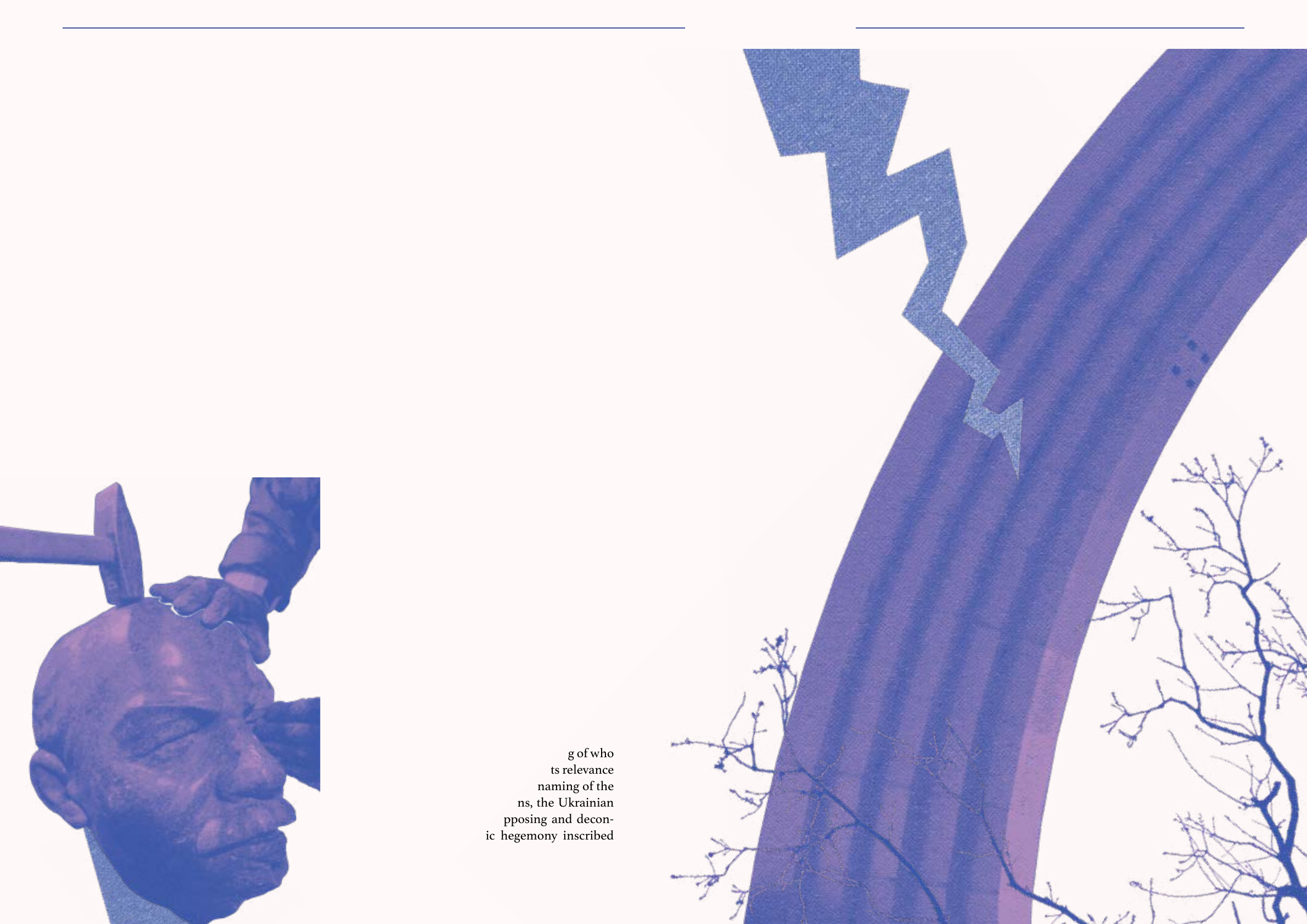
THE INTENSIFICATION OF THE
BATTLE: THE IMPACT OF THE 2022
FULL-SCALE INVASION
The full-scale Russian invasion in February 2022
drastically changed the mnemonic landscape,
heightening disputes over sites like the Arch. With
Russia’s open aggression and denial of Ukrainian
sovereignty, the Arch’s original meaning of ‘eternal
friendship’ became not only obsolete but oensive.
This crisis turned long-simmering tensions over
Soviet symbols into an urgent need for reinterpre-
tation. The invasion accelerated decommunisation
and derussication across Ukraine (Betlii, 2022;
Kovalchuk, 2024). Soviet-era monuments now stood
as intolerable reminders used to justify aggression.
In 2024, the УІHП (Ukrainian Institute of National
Memory) declared the Arch to be a symbol of Rus-
sian imperial policy, an example of growing public
recognition of the monument’s problematic history.
Now, the physical presence of the Arch, previously
a potentially ambiguous relic, became an essential
platform for expressing Ukraine’s determination to
control its own historical narrative and physically
depart from the past which Russia sought to exploit.
As a result, the invasion created a new, urgent imper-
ative for actively transforming the site, addressing
false narratives, and reconguring the power rela-
tions ingrained in the urban landscape.
Crucially, this period saw the formation of more
resistant pasts within Ukrainian collective mem-
ory and saw increasingly aggressive public action
against Soviet monuments, including vandalism (Li-
ubarets, 2017). These acts, which began with short-
term artistic installations and grew into more overt
visual protestations, were grassroots mnemonic bat-
tles. They mattered not only as acts of destruction
but also as intentional eorts to dispute the original
Soviet narrative of the monuments and oer alter-
native histories. These unoicial contests revealed
shifting power over memory control and interpre-
tation, leading the government to consider decisive
actions against the Arch.
The decades leading up to the full-scale invasion in
2022 were marked by a complex dynamic regarding
the legacy of Soviet monuments. While large scale,
state-driven decommunisation initiatives were not
always applied to symbols, places like the Arch be-
came sites for implicit and explicit contestation. The
monument’s continued physical presence empha-
sised the ongoing struggle between inherited Soviet
symbols and the emerging independent Ukrainian
historical consciousness.
POWER RELATIONS PRODUCED IN
THE PRESENT
The contestation and intentional re-recognition of
the Arch have radically transformed the dynamics
of power which surround this central site of memo-
ry in modern Ukraine. What was once a monument
meant to symbolise Soviet strength and a narrative
of Russian-Ukrainian unity is now a concrete sym-
bol of Ukrainian sovereignty and a site for asserting
a separate national identity.
This shift represents a substantial rethinking of who
has the authority to dene the past and its relevance
in the present. Through the oicial renaming of the
Arch and other visual interventions, the Ukrainian
state and society are actively opposing and decon-
structing Russian mnemonic hegemony inscribed
in the urban landscape.
48 49DЇASPORA JOURNAL
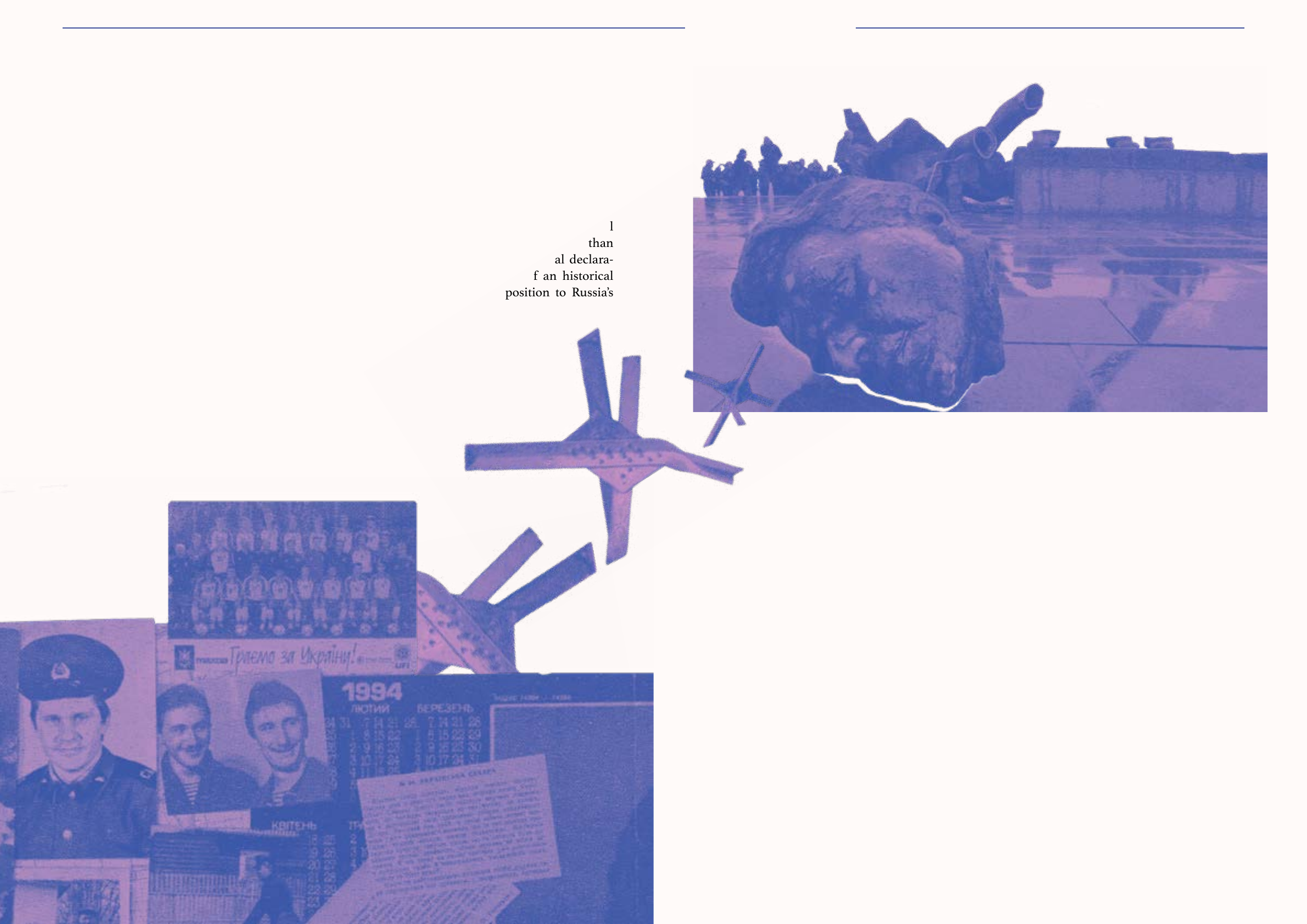
CONCLUSION
The Arka Svobody Ukrayins’koho Narodu provides
a compelling case study for the interaction between
collective memory and power dynamics. Original-
ly designed as an instrument of Soviet mnemonic
hegemony, the Arch became a focus for anti-So-
viet feelings after independence. The 2022 inva-
sion served as a catalyst, bringing the fallacy of the
original narrative to light and resulting in decisive
changes. Ukraine’s strategic changes, renaming and
redesigning the Arch, reect a powerful cultural
counter-oensive. These activities are more than
just decommunisation. They are political declara-
tions of sovereignty, the recovery of an historical
narrative, and a symbol of opposition to Russia’s
weaponisation of history.
By replacing the previous narrative of friendship
with one of freedom, Ukraine has seized the ability
to shape its collective memory independently. This
directly challenges Russia’s ambitions to preserve
its sphere of historical and cultural inuence. Thus,
the Arch’s transformation is more than just a simple
renaming, it is also about taking control of a part of
Ukraine’s national narrative which was previously
determined by Moscow.
The power relations which have resulted are com-
plex. First, the power to dene national identity has
shifted. The Arch, which now represents Ukrainian
freedom, contributes to a collective memory empha-
sising independence, resilience, and a distinct break
from the Soviet past. This reinforces Ukrainian na-
tional sovereignty, countering Russia’s notion of his-
torical unity. Second, the shift reinforces Ukraine’s
assumption of authority over its land and symbols.
Decisions about the Arch are now made in Kyiv,
with the interests of the Ukrainian public in mind.
Finally, the Arch becomes a visible marker of resis-
tance. Its altered state serves as a daily reminder of
the ongoing struggle against Russian aggression and
as a symbol of deance, shaping both internal and
international perspectives.
VIET MONUMENTAL HERITAGE (2009–2015)’,
Український історичний збірник, (19), pp. 324–333.
Availible at: https://d1wqtxts1xzle7.cloudfront.net.
(Accessed: 12 May 2025).
Molden, B. (2016) ‘Resistant pasts verses mne-
monic hegemony: On the power relations of collec-
tive Memory’, Memory Studies, 9(2), pp. 125-142.
Salo, E. (2023) ‘The Weaponization of Heritage:
The Examination of Protecting, Destroying, and As-
similating Heritage as a Weapon in Irregular War-
fare’, Texas Journal of Law and Political Science, 16,
pp. 708-. Available at: https://heinonline.org/HOL/
P?h=hein.journals/tjlpp16&i=708 (Accessed: 18 April
2025).
Sklokina, I. (2024) ‘World War II Monuments
in Ukraine: Protection, Dismantling, Reuse since
2022’, kunsttexte.de - Journal für Kunst- und Bild-
geschichte, (1), pp. 1–15. doi:https://doi.org/10.48633/
ksttx.2024.1.102638. (Accessed: 12 May 2025).
УІНП (Ukrainian Institute of National Memory).
(2024) Пояснюємо висновок Експертної комісії
УІНП про Арку дружби народів. Available at: uinp.
gov.ua/pres-centr/novyny/poyasnyuyemo-vysno-
vok-ekspertno… (Accessed: 12 May 2025).
BIBLIOGRAPHY
Assmann, A. (2008) ‘Transformations
between History and Memory’, Social Re-
search, 75(1), pp. 49-72.
Betlii, O. (2022) ‘The Identity Politics of Heritage:
Decommunization, Decolonization, and Derussi-
cation of Kyiv Monuments after Russia’s Full-Scale
Invasion of Ukraine’, Journal of Applied History,
4(1-2), pp. 149-169. https://doi.org/10.1163/25895893-
bja10031
Kotsur, Lesya. “Очищення публічного простору
України від російських ідеологем ‘братнього на-
роду’ та ‘возз’єднання’ після 24 лютого 2022 року.”
Kреативний Потенціал Економіки Культури у
Повоєнній Відбудові України, 2023, pp. 101–5, icr.
org.ua/wpcontent/uploads/2023/11/Book_2023_Con-
ference_15.06.2023.pdf#page=10 (Accessed: 12 May
2025).
Kovalchuk, T. (2024) ‘Derussication Of The
Public Space In Ukraine As Conditioned By The
Full-Scale Russian-Ukrainian War’, Intermarum
History Policy Culture, (14), pp. 144–159. https://doi.
org/10.35433/history.112074.
Liubarets, A. (2017) ‘VANDALISM as a TOOL
for UKRAINIAN POLITICS of MEMORY of SO-
50 51DЇASPORA JOURNAL

the burden in my chest,
when I speak my other half…
it wears me down —
I cannot rest,
but I can’t live without it.
where I belonged.
the wings I get,
when I speak the tongue of songs…
the longing feeling brings me back,
to the place
to bring about what’s inside.
the weight I lose,
when both my voices join in tune…
the chains around me loosen up,
the best of both
is just enough
JUST ENOUGH
KIR A SANTALOVA
52 53DЇASPORA JOURNAL
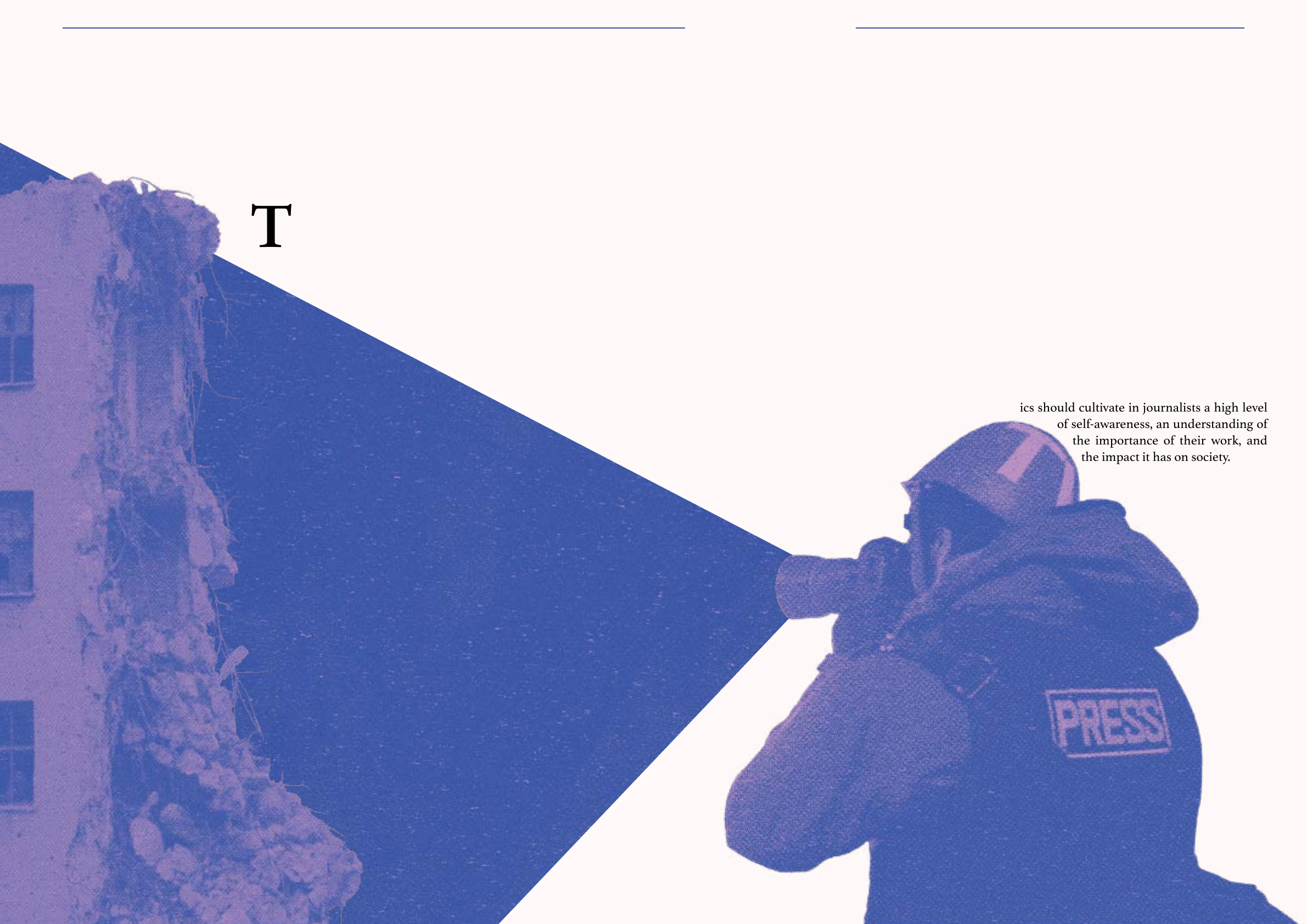
THE RIGHT TO
KNOW AND
THE DUTY
TO REMAIN
SILENT
Journalis
i Ties of War
ANASTASIIA HRYSHCHENKO
O
ne untimely published frame or sentence
within a news item can cost someone their
life, disrupt a military operation, or act as evidence.
Military journalism is one of the most important
and, simultaneously, dangerous professions in the
world. These people act as the eyes and ears of the
world, where chaos reigns, to provide society with
objective information. However, this duty is always
situated between physical and psychological surviv-
al, which places a broader range of tasks on media
workers that go far beyond the usual formulation of
a report.
Journalism is one of those professions in which eth-
ics play a key role. It is characterised by a high lev-
el of social responsibility, since the work inuences
public opinion, and the main focus of their material
is often the individual. The main goal of journalis-
tic ethics is to ensure the objective and comprehen-
sive distribution of information. It establishes rules
of professional conduct that help journalists act
in accordance with public interest, maintain trust,
and resolve ethical conicts that may arise. It is also
important to note that ethical norms should shape
responsibility towards the public and inuence the
internal convictions and moral principles of each
journalist (Ivanov 2006, 16-21). Thus, in general, eth-
ics should cultivate in journalists a high level
of self-awareness, an understanding of
the importance of their work, and
the impact it has on society.
54 55DЇASPORA JOURNAL
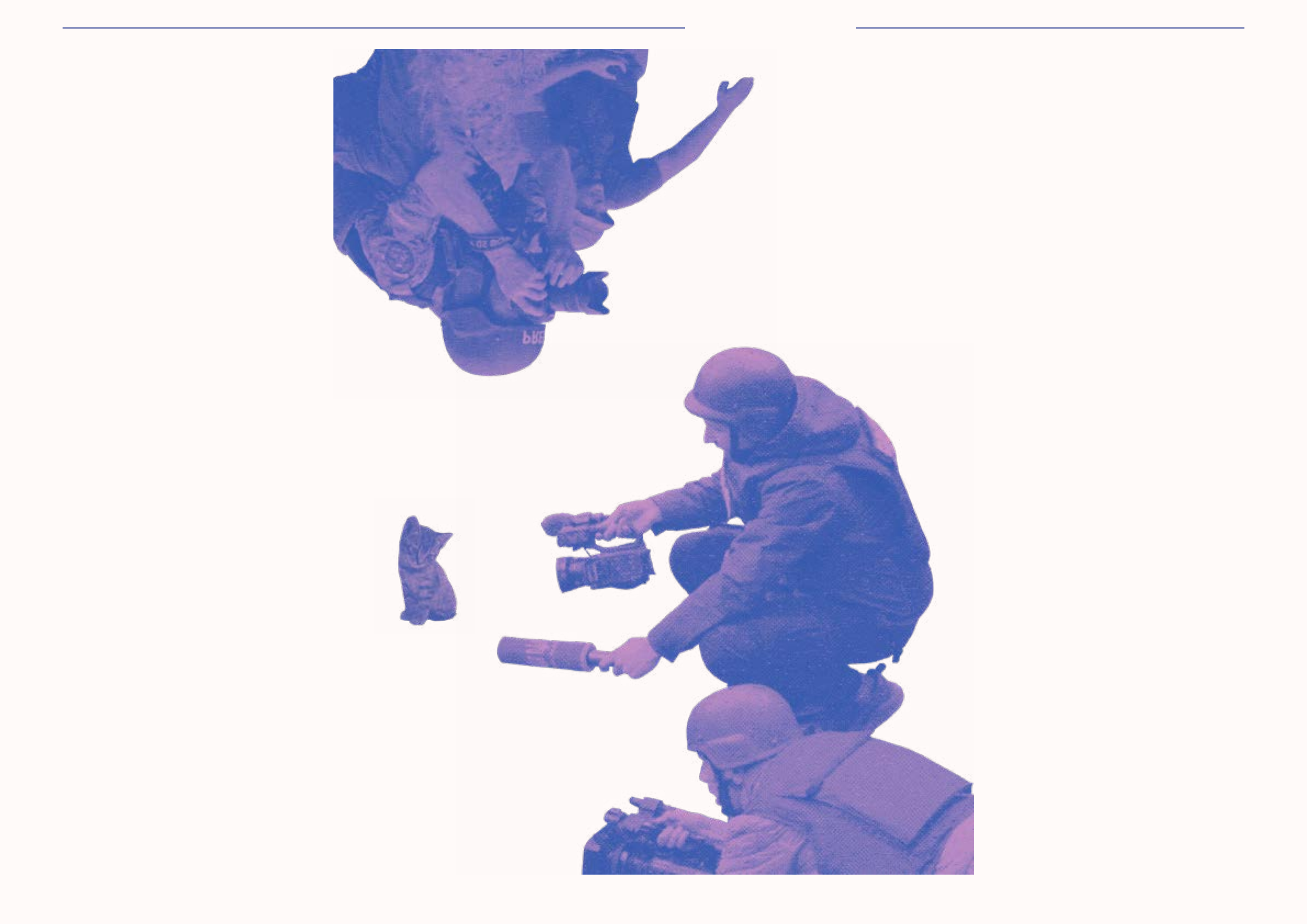
Armed Forces and the media under martial law
(Ministry of Defence of Ukraine 2022). It denes
what information must not be disseminated to pre-
vent the leaking of restricted-access data and ensure
the security of Ukraine. Some of these include:
1. Names, composition, and locations of military
units
2. Data on combat plans, losses, and movements
of equipment
3. Results of operations, if not oicially published
4. Photos and videos depicting equipment, ar-
ma-ment, and air defence positions
5. Data about special units and intelligence (Min-
istry of Defence of Ukraine 2022)
The order contains separate provisions that regulate
the work of journalists in the combat zone. Namely,
a journalist has the right to:
1. Receive, store, use, and disseminate general in-
formation about the preparation and actions of de-
fence forces
2. Cover the results of completed operations only
with the command’s approval (Ministry of Defence
of Ukraine 2022).
Additionally, the duties of a media representative
are as follows:
1. Acknowledge that they do not have the right to
disclose information that constitutes state or oicial
secrets
2. To move within the combat zone only by an
agreed route and for an agreed period
3. To carry a body armour vest, helmet, rst aid kit,
and know how to provide rst aid
4. To wear identication markings “PRESS”
5. To not perform actions incompatible with civil-
ian status
PROFESSIONAL STANDARDS
IN CONFLICT ZONES
Most states issue documents that set out standards
of ethical conduct for journalists. However, the basis
of journalistic regulation does not derive from legal
norms, but from professional and ethical self-reg-
ulation through recommendatory documents.
Among them is the Declaration of Principles on
the Conduct of Journalists, adopted at the Second
World Congress of the International Federation of
Journalists in 1954 (International Federation of Jour-
nalists (IFJ) 1954), which serves as an international
code for members of trade unions in more than 140
countries, including Ukraine (the National Union of
Journalists of Ukraine and the Independent Media
Trade Union of Ukraine are members of the Inter-
national Federation of Journalists).
At the same time, ethical principles enshrined in
international agreements acquire concrete meaning
only within national media systems, where they are
adapted to the political, legal, and social realities of
each country. It is therefore important to consider
how these norms function at the state level, par-
ticularly under conditions that radically change
the usual model of journalistic activity. In Ukraine,
journalistic ethical codes do not have legal force and
function as instruments of professional self-regula-
tion. Ethical codes are complicated during wartime,
as conict may arise between professional duty and
national interest. Amidst the conditions of war, rig-
id adherence to journalistic standards can pose a
threat to human life or national security, which, in
turn, calls into question the very possibility of carry-
ing out journalistic activity in such conditions, since
even a minor disclosure of operational information
may be used by the enemy. The state may apply
military censorship to mitigate these threats, signi-
cantly limiting the professional work of journalists.
Therefore, when covering events related to hostili-
ties, journalists must adhere to particular standards.
Under these conditions, abstract ethical principles
become increasingly practical and call for clear, con-
crete guidelines. That is why, during the rst month
of the full-scale war in Ukraine, several documents
appeared with practical recommendations regard-
ing journalistic activity. Order of the Command-
er-in-Chief of the Armed Forces of Ukraine No.73
of March 3, 2022, regulates interaction between the
56 57DЇASPORA JOURNAL
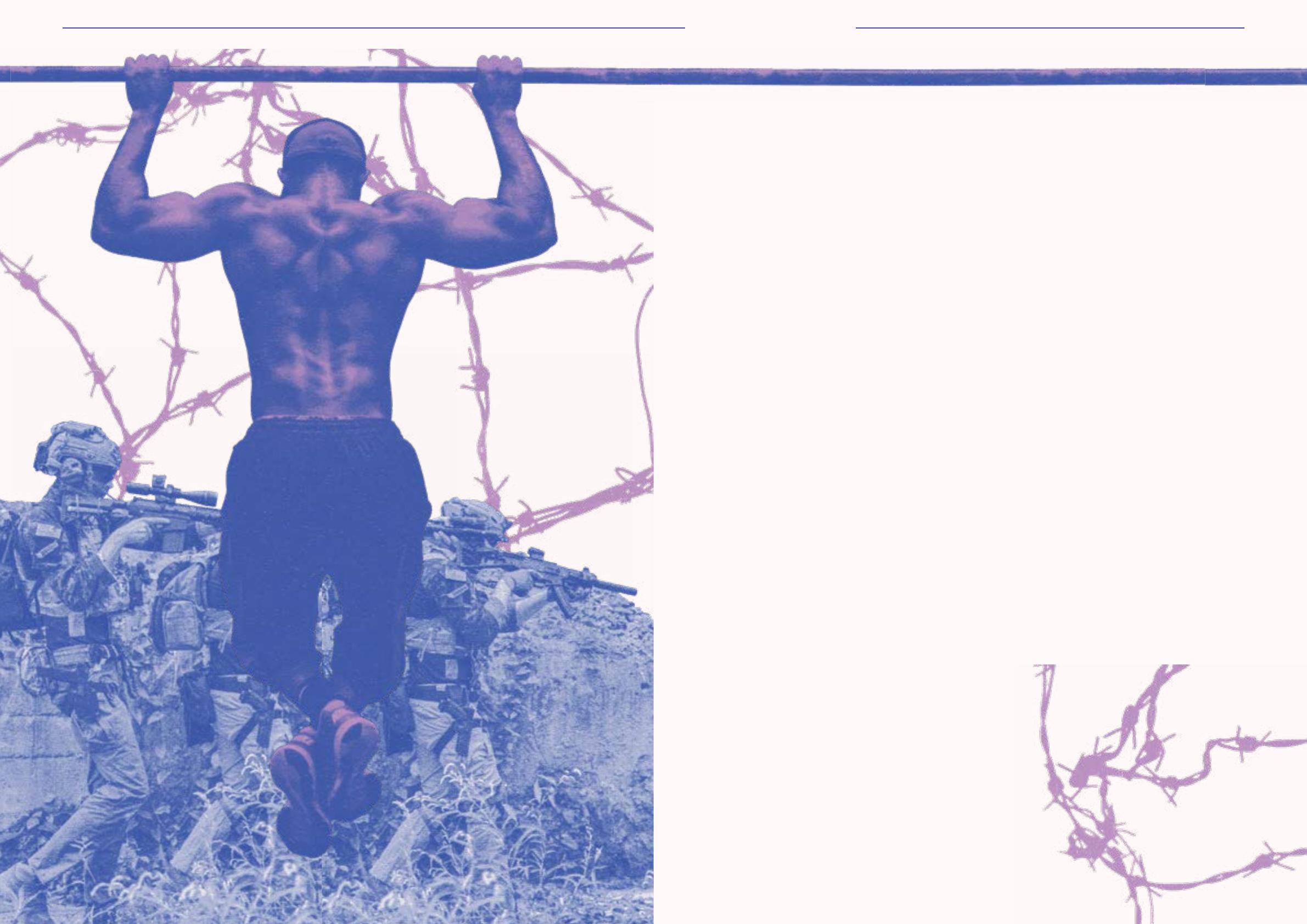
6. To submit materials for verication and remove
information prohibited from disclosure upon re-
quest
7. Acknowledge that the Armed Forces are not re-
sponsible for the safety or insurance of media rep-
resentatives (Ministry of Defence of Ukraine 2022).
It is also worth emphasising that the anonymity of
combatants and witnesses within the conict zone
is of critical importance, since the disclosure of iden-
tity may pose a threat. Identication of a person by
rst and last name is permissible only in the absence
of safety concerns. Thus, the priority for a journal-
ist in conditions of armed conict is personal safety
and the preservation of life.
THREAT AND PREPARATION
The threat faced by journalists in combat zones goes
far beyond moral responsibility and professional
limitations. The reality of war turns every careless
decision and violation of safety rules into a poten-
tially unavoidable risk. According to the Institute
of Mass Information, Russia committed 870 crimes
against journalists and media workers in Ukraine
from February 24, 2022, to October 2025, including
killings, abductions, shelling, holding in captivity,
damage to newsrooms as a result of military actions,
cyberattacks, blocking of the information space,
and attempts to impose propaganda (Sluga Narodu
2025). The total number of media workers killed up
until November 2025 amounts to 118 journalists, 15
of whom were killed while performing their profes-
sional duties (ibid.). In addition, about 29 Ukrainian
media workers are currently held in Russian captiv-
ity (ibid.).
Therefore, providing military journalists with ap-
propriate training is necessary to ensure safety
and reduce the risk for other individuals in combat
zones. Although documents regulating journalistic
activity under martial law do not provide security
guarantees, there are certain actions journalists can
take to enhance their safety.
PHYSICAL PREPARATION
In conict zones, journalists face the risk of physical
violence; therefore, in emergencies, it is necessary to
stop work in time and move to a safe place. Military
journalists must always be provided with protective
equipment and must understand the region that
they are in to develop an evacuation plan in advance.
It is advisable to undergo rst aid training and learn
to navigate using maps. Reporters are at especially
high risk of attack because combat conditions make
it very diicult to hold perpetrators accountable,
hindering the recording, collection, and documen-
tation of evidence and the identication of those re-
sponsible. Local networks of journalists, local com-
munities, and security experts help reduce danger
in such situations (Reporters Without Borders (RSF)
2015). In addition, many international organisa-
tions provide journalists with essential support and
equipment (personal protective equipment, satellite
phones, secure communication devices, specialized
GPS trackers), including Reporters Without Bor-
ders, Free Press Unlimited, and others.
It should be noted that despite the existence of cer-
tain educational initiatives, such as the Network for
Border Crossing Journalism programs (Network for
Border Crossing Journalism 2025), as well as UNES-
CO (2023) and IWPR training in security journalism,
Ukraine still lacks a systematic, structured, and in-
stitutionally guaranteed model of journalistic train-
ing for work in combat conditions.
58 59DЇASPORA JOURNAL

DIGITAL SECURITY
When working in conditions of armed conict, mil-
itary journalists need to have a clear plan for how to
maintain communication with the outside world. It
is essential to have several phones or satellite com-
munication devices and to ensure that all devices
have additional power sources (Committee to Pro-
tect Journalists 2012). It is also important to have a
trusted person outside the combat zone who is fa-
miliar with the area where the journalist is located
and monitors the situation (ibid.). Only encrypted
messengers should be used, and data storage should
be carried out in a secure environment using up-
to-date cryptographic protection tools and access
control (ibid.). Backup copies must be created, as
equipment can be lost (ibid.). It is imperative to store
sensitive data, such as source contacts or other in-
formation that could endanger others, in secure lo-
cations (ibid.). Journalists should prepare alternative
means of communication in case of internet or mo-
bile network shutdowns to restore contact with the
editorial oice more quickly and determine further
steps in an emergency (ibid.). All aspects of work
during war are dangerous, so the primary task is
to anticipate and, therefore, mitigate risk. Through
preparation, analysis of potential threats, and the
ability for quick decision-making when critical,
journalists can ensure their own safety and increase
eectiveness in uncertain conditions.
60 61DЇASPORA JOURNAL
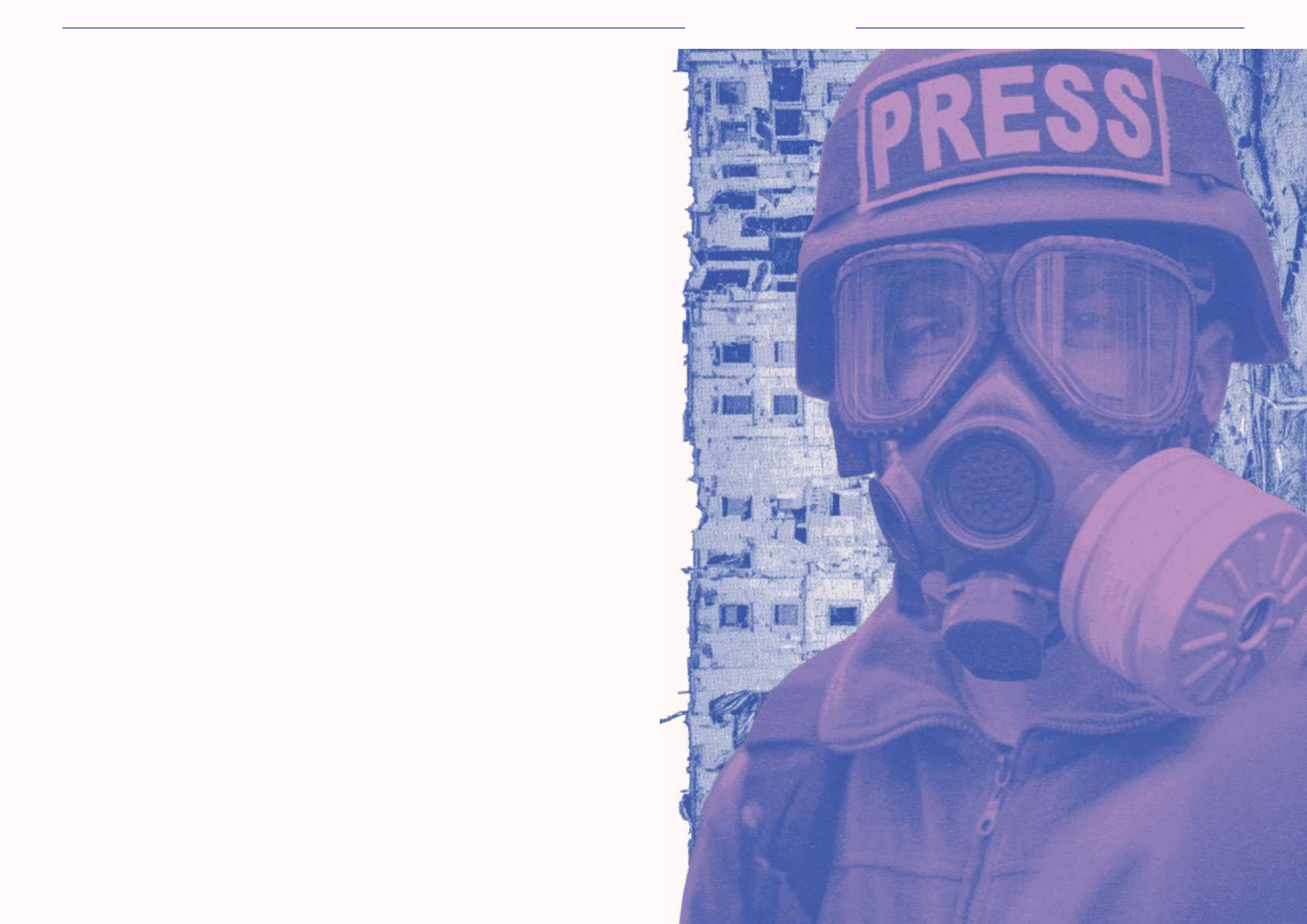
PSYCHOLOGICAL IMPACT
Even with proper physical and digital preparation,
journalists do not remain fully protected from the
consequences of war. Beyond physical threats lie
psychological consequences: fear, sadness, guilt,
nightmares, and anxiety, reecting a wide range of
work-related mental health issues experienced in
combat zones (Feinstein 2004). Journalists, unlike
police oicers or military personnel, do not under-
go systematic training to respond to violence. This
leads to heightened vulnerability to the psycholog-
ical impact of professional activity in conict zones.
Traumatic events can lead to clinically dened con-
ditions, the most common of which is post-trau-
matic stress disorder (PTSD) (ibid.). PTSD is often
accompanied by depression or substance abuse.
Studies in Iraq have shown no statistically signi-
cant dierence in PTSD and depression levels be-
tween journalists embedded within the military and
those working independently, as both groups were
frequently exposed to dangerous situations (ibid).
While many journalists demonstrate resilience in
the face of such challenges, a notable proportion
experience signicant psychological strain or burn-
out, highlighting the occupational risks inherent to
reporting in conict zones.
The duration, intensity, and nature of armed conict
directly aect the psycho-emotional state of journal-
ists. In this context, the psychological consequences
of the activity of media workers during the full-scale
war in Ukraine are marked. The 2402 Foundation
published a comprehensive study on mental health
and resilience among Ukrainian media workers
(Daily Humanity 2025). The most common reactions
to professional workload among journalists are
stress, anxiety, and burnout, indicating the intense
pressure experienced by media workers in their dai-
ly work (ibid.). This may be related to on-site safety
as well as information overload, deadlines, and au-
dience pressure (ibid.). In addition, depression, fear,
anger, and feelings of guilt are quite common prob-
lems associated with covering complex topics, indi-
cating chronic stress and burnout (ibid.).
It is appropriate to note that half of journalists do
not suiciently trust their newsroom managers to
discuss their mental health (Daily Humanity 2025).
In cases where support does exist, it is mostly pro-
vided irregularly and without a comprehensive ap-
proach. Overall, more than a third of journalists do
not feel safe in their newsrooms, and support from
management often depends on personal willing-
ness rather than oicial policy (ibid.). The absence
of appropriate procedures and unequal access to as-
sistance indicates the importance of implementing
unied comprehensive measures, such as formal
support procedures and training managers to work
with emotional stress and emotionally exhaust-
ed employees. Despite the growing interest of the
journalistic community in the topic of emotional
vulnerability, some journalists still do not seek sup-
port. This indicates many systemic problems — the
topic of mental health remains taboo, and access to
appropriate assistance is limited by nancial factors,
lack of time, and insuicient awareness (ibid.).
62 63DЇASPORA JOURNAL
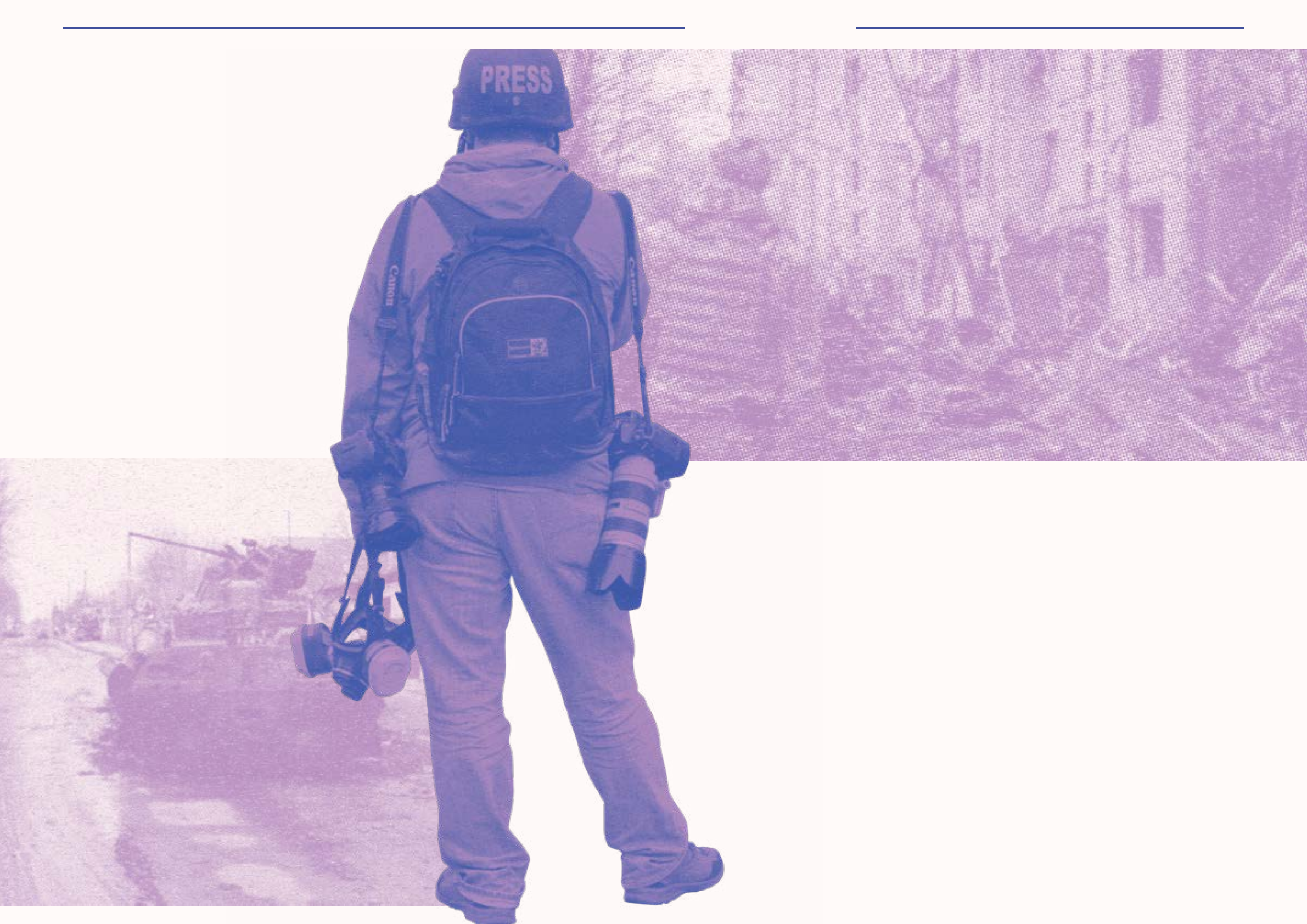
CONCLUSIONS
In the current context, it is necessary to prepare
journalists to work with violent material, as well
as for media organisations to develop eective sup-
port mechanisms. To prepare military journalists,
it is advisable to introduce more mandatory train-
ing programmes, namely, training in psychological
resilience and in conditions close to combat, regu-
lar consultations with psychologists, rehabilitation
measures, and peer support programmes.
Ethical, security, and psychological aspects deter-
mine the quality and safety of military journalism.
Adherence to ethical norms is complicated by mar-
tial law but remains critically important to prevent
harm to the military and the state. Journalists must
also undergo special training and have support, as
they constantly encounter traumatic events. There-
fore, the combination of ethical standards, security
requirements, and psychological resilience is one of
the main conditions for the professional activity of
military correspondents.
BIBLIOGRAPHY
Committee to Protect Journalists (CPJ). 2012. Jour-
nalist Security Guide: Reporting Safely in a Crisis.
New York: Committee to Protect Journalists. https://
cpj.org/wp-content/uploads/2020/05/guide.pdf
Daily Humanity Team. 2025. Mental Health and
Resilience among Journalists. Report. Authors: Olha
Khan, Kateryna Serhatskova, and Larysa Kalyk.
Feinstein, Anthony. 2004. “The Psychological Haz-
ards of War Journalism.” Nieman Reports. Accessed
January 9, 2026. https://niemanreports.org/app/up-
loads/2024/03/04summer.pdf
International Federation of Journalists (IFJ). 1954.
IFJ Declaration of Principles on the Conduct of Jour-
nalists. Accessed January 9, 2026. https://research.
tuni.fi/ethicnet/country/ifj-declaration-of-princi-
ples-on-the-conduct-of-journalists/
Ivanov, V. F. 2006. Journalist Ethics: Lecture
Course. Kyiv: Vyshcha Shkola. Ministry of Defence
of Ukraine. 2022. Order of the Commander-in-Chief
of the Armed Forces of Ukraine No. 73, March 3,
2022 (as amended). Accessed January 9, 2026.
https://mod.gov.ua/diyalnist/normativ-
no-pravova-baza/nakaz-golovnokomandu-
vacha-zsu-vid-03-03-2022-roku-73-zi-zminami
Network for Border Crossing Journalism. 2025.
“Media Camp on Frontline Reporting Takes Place
in Ukraine.” Accessed January 9, 2026. https://n-
ost.org/news/media-camp-on-frontline-reporting-
takes-place-in-ukraine
Reporters Without Borders (RSF). 2015. Safety
Guide for Journalists: A Handbook for Reporters
in High-Risk Environments. Paris: Reporters With-
out Borders. Sluga Narodu (Servant of the People).
2025. “Russia Must Be Held Accountable for Crimes
Against Ukrainian Journalists — the Verkhovna
Rada Addressed the World.” Accessed January 9,
2026. https://sluga-narodu.com/rosiia-maie-vidpo-
visty-za-zlochyny-proty-ukrainskykh-zhurnalis-
tiv-verkhovna-rada-zvernulas-do-svitu/
UNESCO and Institute for War & Peace Re-
porting (IWPR). 2023. “UNESCO and IWPR Train
Ukrainian Journalists in Conict Reporting.” Ac-
cessed January 9, 2026. https://www.unesco.org/en/
articles/unesco-and-iwpr-train-ukrainian-journal-
ists-conict-reporting
64 65DЇASPORA JOURNAL

T
THE TRANSFORMATION OF
PUBLIC SENTIMENT IN UKRAINE
AND ITS STRATEGIC IMPACT
ON THE WAR WITH RUSSIA
he Russian invasion of Ukraine in February 2022
triggered an unprecedented surge of patriotism
and social cohesion, which directly contributed
to the failure of Russia’s planned blitzkrieg and the
emergence of a protracted conict. Understanding
the behaviour of the Ukrainian state — its refusal
to capitulate, its pursuit of a Euro-Atlantic orienta-
tion, and its readiness for prolonged resistance —
requires more than a purely military perspective;
it is essential to consider the evolution of collective
perceptions, societal expectations, and the role of
public opinion.
From a theoretical standpoint, this situation can
be analysed through a combination of legitimacy
theory, social movement theory, and neoclassical
realism. Legitimacy theory explains how a gov-
ernment’s strategic exibility, including decisions
on mobilisation and negotiations, is constrained
by public approval and the need to maintain trust
and credibility (Albrow and Easton 1966; Linz 1978).
Social movement and framing theories highlight
the inuence of activists, independent media, and
public discourse in shaping perceptions of war and
inuencing state behaviour (McAdam and Tarrow
2013; Oberschall 1978). Neoclassical realism, in turn,
emphasises how asymmetric external pressures —
from allies such as the United States and adversaries
such as Russia — interact with internal legitimacy to
determine strategic choices and the scope of opera-
tional decisions (Ripsman et al. 2016).
In this context, public opinion in Ukraine func-
tioned simultaneously as a resource and a constraint
for state decisions. The rise of pro-Ukrainian senti-
ment created a sociocultural environment in which
maximalist rhetoric and demands for the full resto-
ration of territorial integrity became dominant. At
the same time, mobilisation policies and positions
on negotiation were shaped not only by the realities
of combat, but also by the imperative to preserve
societal legitimacy. Activists and independent me-
dia amplied public expectations, while external
political pressures, including unpredictable actions
by the United States and diplomatic tensions with
Donald Trump, compelled Kyiv to adjust its rhetoric
and strategic options.
Thus, Ukraine provides a clear example of how pub-
lic opinion, media inuence, and the external diplo-
matic context interact to create complex dynamics
that actively shape the strategic decisions and con-
duct of the state during wartime. This framework
allows for a comprehensive understanding of the in-
terplay between societal expectations, institutional
capacity, and international constraints in determin-
ing wartime policy.
LIUBOMYR SEMENIUK
66 67DЇASPORA JOURNAL
In the year before Russia’s full-scale invasion, the
Armed Forces of Ukraine numbered approximately
246,000 personnel (PIK 2025). This baseline is im-
portant, as it demonstrates the limited peacetime
size of the armed forces before the legitimacy shock
caused by the invasion. In 2022, following the decla-
ration of martial law and general mobilisation, the
number of Armed Forces personnel increased to
around 700,000 — almost three times higher than
during the period from 2014 to 2021 (PIK 2025). From
the perspective of legitimacy theory, this rapid ex-
pansion was made possible by an exceptional level
of societal consent, driven by the perception of an
existential threat and the consolidation of national
identity. This level of manpower remained largely
stable throughout 2023.
Debates on increasing the pace of conscription in-
tensied in December 2023, following public state-
ments by the then Commander-in-Chief Valerii
Zaluzhnyi regarding a new mobilisation law, which
included the gure of 400–500 thousand additional
conscripts (Radio Svoboda 2023). These statements
resonated strongly within the Oice of the President
amid an escalating institutional conict. Strength-
ening mobilisation measures was widely perceived
as politically costly and socially unpopular, despite
their military necessity. The Oice appears to have
adopted a strategy aimed at minimising political
costs by shifting responsibility for unpopular deci-
sions to the armed forces and the Ministry of De-
fence.
In January 2024, President Volodymyr Zelenskyy
stated in an interview with Channel 4 News that
there was no immediate need to mobilise 500,000
people, citing the lack of suiciently detailed justi-
cations:
‘Personally, I don’t see the need to mobilise half a
million people yet. I haven’t seen enough clear de-
tails today to say that we need to mobilise half a mil-
lion’, Zelenskyy said (Channel 4 News 2024).
This statement illustrates the gap between military
assessments and political communication, where
public messaging is shaped less by operational re-
quirements than by considerations of public accept-
ance and political legitimacy.
On May 18, 2024, the updated Mobilisation
Law No. 10449 entered into force. It introduced
mandatory updates of military registration data
within 60 days, lowered the draft age to 25, abol-
ished conscription, and expanded enforcement
powers for the police and military registration oic-
es (President of Ukraine 2022). While legally neces-
sary, these measures intensied societal tensions by
expanding coercive elements of mobilisation, there-
by testing the limits of wartime legitimacy.
MOBILISATION Mobilisation remains a highly contentious issue, po-
larising society, undermining trust between citizens
and the state, and serving as a lever of pressure both
domestically and externally. According to a Kyiv
International Institute of Sociology (2024) survey,
approximately 54% of respondents expressed read-
iness to mobilise if necessary. This apparent con-
tradiction — high abstract support for mobilisation
combined with resistance to concrete enforcement
mechanisms — highlights the distinction between
symbolic consent and practical compliance.
At the same time, public opinion data indicate grow-
ing fatigue and increasing openness to negotiations,
which further constrains the political space for co-
ercive mobilisation policies (Razumkov Centre 2024;
Ukrainska Pravda 2024). Although Ukraine retains
a mobilisable reserve, the political leadership has
so far perceived the situation as not enabling large-
scale operational breakthroughs by Russian forces.
Persistent problems such as ineective mobilisation
practices, the absence of clear service terms, contro-
versial military decisions, and managerial fragmen-
tation continue to undermine defensive eective-
ness. Well-known volunteers, bloggers, and military
gures — including Serhiy Sternenko, Taras Chmut,
Andriy Biletsky, and Yuriy Butusov — have publicly
articulated these shortcomings. From the perspec-
tive of social movement theory, such actors function
as informal accountability agents and frame entre-
preneurs, articulating grievances and mobilising
public pressure in the absence of institutionalised
opposition during wartime (McAdam and Tarrow
2013; Oberschall 1978).
Overall, this dynamic illustrates how legitimacy op-
erates not merely as passive public approval, but as
an active constraint shaping the timing, framing,
and institutional allocation of responsibility for mo-
bilisation decisions.
68 69DЇASPORA JOURNAL
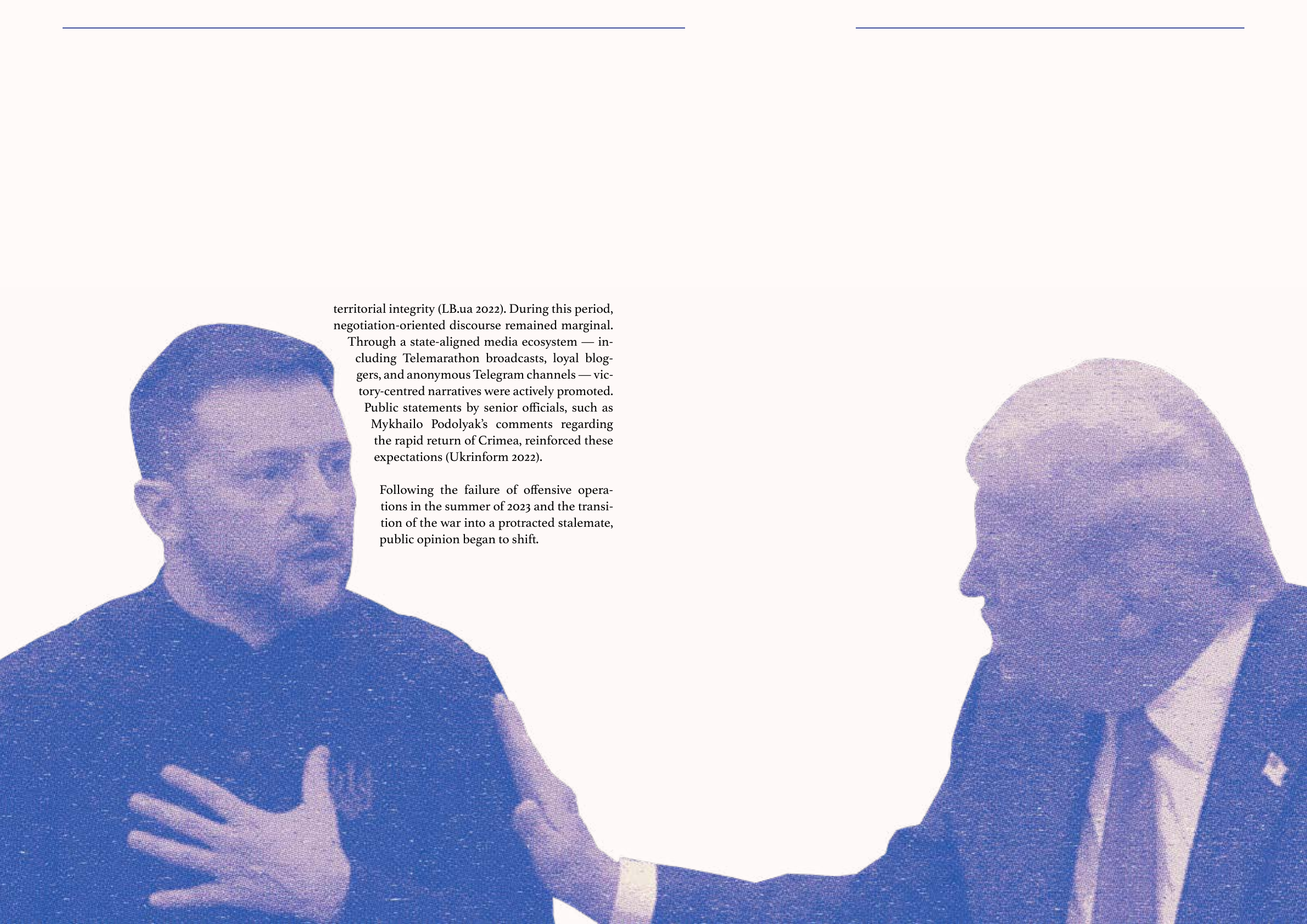
After halting Russian advances in the summer and
achieving successful counteroensives in Kherson,
Kharkiv, and parts of the Donetsk region in the fall
of 2022, public expectations increased substantially.
Ukrainian authorities responded by adopting and
amplifying maximalist rhetoric. A notable exam-
ple is the presidential decree of September 30, 2022,
which eectively prohibited direct negotiations with
the Russian president (President of Ukraine 2022).
At the end of 2022, a survey conducted by the
Kharkiv Institute for Social Research indicated that
76% of respondents opposed any compromises for
peace, while 95% supported the full restoration of
territorial integrity (LB.ua 2022). During this period,
negotiation-oriented discourse remained marginal.
Through a state-aligned media ecosystem — in-
cluding Telemarathon broadcasts, loyal blog-
gers, and anonymous Telegram channels — vic-
tory-centred narratives were actively promoted.
Public statements by senior oicials, such as
Mykhailo Podolyak’s comments regarding
the rapid return of Crimea, reinforced these
expectations (Ukrinform 2022).
Following the failure of oensive opera-
tions in the summer of 2023 and the transi-
tion of the war into a protracted stalemate,
public opinion began to shift.
NEGOTIATION PROCESS
The negotiation process became not only a foreign
policy instrument but also a signicant domestic
political factor contributing to societal polarisation.
Negotiations began in the early months of the in-
vasion and initially focused on humanitarian cor-
ridors and prisoner exchanges; however, no agree-
ment on ending the war was reached. Following the
liberation of northern Ukraine and the exposure of
Russian war crimes, Ukrainian public opinion shift-
ed decisively against negotiations. Moreover, the Is-
tanbul framework was widely perceived domestical-
ly as incompatible with prevailing notions of a just
peace.
Surveys conducted in September–October 2023
showed that 21% of respondents supported negoti-
ations as an immediate means of achieving peace,
while 63% opposed them (Ukrainska Pravda 2024).
The year 2024 marked a turning point in attitudes
toward negotiations. This shift illustrates a key
principle of legitimacy theory: a state’s negotiating
exibility is constrained not only by military reali-
ties but also by the need to maintain domestic legit-
imacy and public support (Albrow and Easton 1966;
Linz 1978).
According to a National Democratic Institute survey
in May 2024, 57% of respondents supported enter-
ing negotiations with Russia (KIIS 2024; Razumkov
Centre 2024). Nevertheless, the military and po-
litical leadership maintained a largely maximalist
position, as reected during the Global Summit on
Peace in Ukraine in 2024 — a largely symbolic initia-
tive with limited immediate political consequences.
In the same period, Vladimir Putin publicly articu-
lated his conditions for ending the war, including
Ukraine’s withdrawal from four regions (BBC
News Russian 2024).
The intensication of negotiation discourse
coincided with Donald Trump’s election as
U.S. president and the subsequent increase in
American pressure on Kyiv to initiate a peace
process. Given Ukraine’s asymmetric depend-
ence on U.S. support, the government gradu-
ally adjusted its rhetoric from the notion of
‘victory’ toward the concept of a ‘just peace’,
without abandoning its core demands.
Russia, however, rejected such framing and
continued to insist on ultimatum-based condi-
tions. This conguration of external pressure,
Ukraine’s limited internal exibility, and Rus-
sia’s rigid position demonstrates that strategic
decisions regarding negotiations are shaped
not only by battleeld dynamics but also by
the interaction between external constraints
and domestic legitimacy (Albrow and Eas-
ton 1966; Linz 1978; Ripsman et al. 2016).
Support for the Ukrainian authorities has been
closely associated with President Volodymyr Zelen-
skyy. Even before the full-scale invasion, power
within the executive branch was increasingly cen-
tralised, with the President’s Oice exerting a dom-
inant role in decision-making and placing pressure
on opposition actors (Albrow and Easton 1966; Linz
1978). Under martial law, and with overwhelming
popular backing, Zelenskyy’s approval rating in
May 2022 reached approximately 90%, reecting a
broad societal consensus to support the government
until the end of the war (KIIS 2025). In this context,
public criticism of the president was marginal and
politically costly.
GOVERNMENT SUPPORT
70 71DЇASPORA JOURNAL
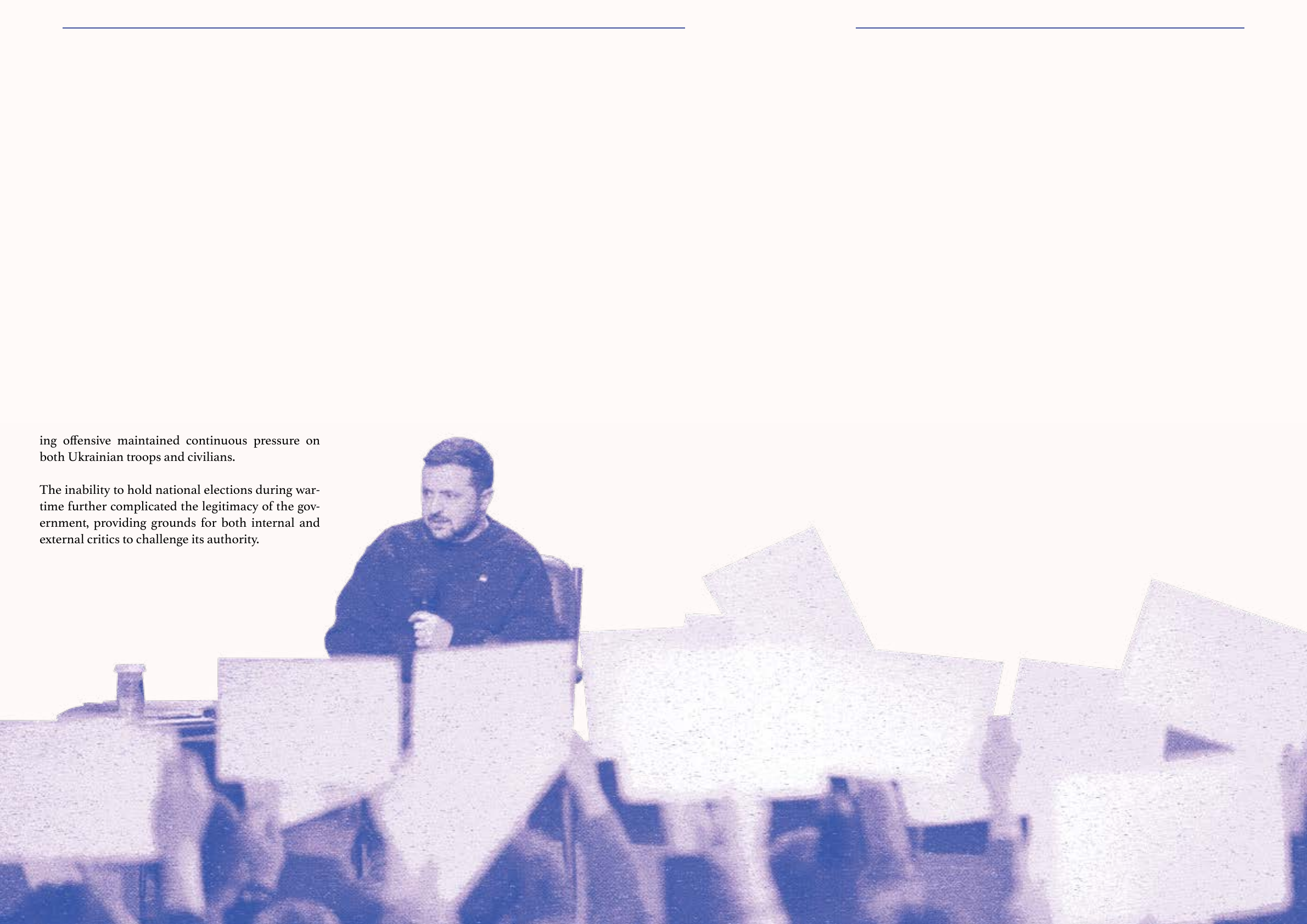
This high level of trust opened a political ‘window’
for the concentration of power, manifested in the
creation of military administrations directly sub-
ordinate to the President’s Oice, bypassing tradi-
tional civilian structures. Following the partial fail-
ure of the counteroensive in the summer of 2023,
Kyiv faced an urgent need to intensify mobilisation
to maintain the front against Russia’s gradual ad-
vance. Nevertheless, the authorities deliberately
avoided openly taking responsibility for unpopular
decisions, instead shifting the burden onto military
structures.
Over time, society exhibited growing fatigue from
the prolonged wartime conditions, and the absence
of clear conscription rules, chaotic management,
and contentious personnel decisions exacerbated
public strain. Mobilisation policy thus operated
within a constant tension between military necessi-
ty and the imperative to maintain public trust and
governmental legitimacy. Similar dynamics were
evident in negotiations with Russia and in broader
challenges of public administration. Russia’s creep-
ing oensive maintained continuous pressure on
both Ukrainian troops and civilians.
The inability to hold national elections during war-
time further complicated the legitimacy of the gov-
ernment, providing grounds for both internal and
external critics to challenge its authority.
Russian propaganda actively exploited these vul-
nerabilities, while diplomatic tensions with the
United States — particularly under President Don-
ald Trump — created both risks and opportunities
for Zelenskyy to bolster his domestic standing by
demonstrating resilience to external pressure.
Internal governance issues, including high-prole
corruption cases involving the National Anti-Cor-
ruption Bureau (NABU), the Specialised Anti-Cor-
ruption Prosecutor’s Oice (SAPO), and Operation
‘Midas’, contributed to growing public criticism of
the President’s Oice. Zelenskyy’s reliance on the
personal loyalty of key oicials, while consolidat-
ing decision-making power, introduced additional
challenges, as certain members of his team became
focal points of public distrust. Consequently, despite
periods of increased approval following high-prole
events, levels of public distrust remained signicant,
and the 61% approval rating largely reected trust in
the wartime state apparatus rather than Zelenskyy
personally (KIIS 2025).
Overall, the Ukrainian case illustrates the interplay
between concentrated executive authority, wartime
exigencies, and public legitimacy. While centralisa-
tion enabled rapid decision-making, it also required
careful management of societal expectations and
trust to maintain the authority’s perceived legitima-
cy during a protracted and high-stakes conict (Al-
brow and Easton 1966; Linz 1978).
The transformation of public sentiment in Ukraine
has had a decisive impact on the country’s strategic
choices, particularly regarding mobilisation and ne-
gotiations. Initially, the surge of patriotism and so-
cietal cohesion enabled the government to pursue
maximalist military objectives, reinforcing public
support for the defence eort (Albrow and Easton
1966; KIIS 2025). Over time, however, the active seg-
ment of society — though always a minority—has
consistently shaped the political mainstream (Ober-
schall 1978; McAdam and Tarrow 2013). The author-
ities respond to this dynamic with policies and deci-
sions, adjusting the pace and scope of mobilisation
(PIK 2025) or framing negotiation strategies in line
with perceived societal expectations.
Yet, the combination of managerial shortcomings,
centralised ‘handmade’ governance, and the desire
to maintain political authority into the post-war pe-
riod generates additional challenges, creating fric-
tion between operational needs on the frontlines
and political responsiveness to public sentiment
(Albrow and Easton 1966; Linz 1978).
Public attitudes have also inuenced domestic le-
gitimacy and Ukraine’s international position.
High-prole corruption scandals, the inability to
hold elections during wartime, and the reliance on
personal loyalty networks within the President’s Of-
ce constrain decision-making and complicate pub-
lic trust. These internal dynamics, combined with
external pressures from allies and adversaries, shape
both domestic credibility and diplomatic position-
ing. Ukrainian strategic decisions, whether in mo-
bilisation, negotiation, or governance, thus illustrate
that public sentiment is not merely a backdrop but
an active determinant of policy (Albrow and Easton
1966; Linz 1978). At the same time, the state’s reactive
approach, bounded by governance limitations and
political calculations, can generate new obstacles
and diiculties on both domestic and international
fronts (Oberschall 1978; McAdam and Tarrow 2013).
CONCLUSION
72 73DЇASPORA JOURNAL
At the same time, the active part of society can pro-
vide the state with an additional source of mobilisa-
tion potential, legitimacy, and stability, but this very
support can also narrow the government’s room for
manoeuvre, limiting strategic exibility, especially
in the negotiation process, when public expecta-
tions turn into political constraints.
Kyiv International Institute of Sociology. (2025).
“Динаміка довіри Президенту В. Зеленському в
2019–2025 роках”. https://kiis.com.ua/?lang=ukr&-
cat=reports&id=1542&page=1
LB.ua. 2022. “Українці вважатимуть пере-
могою…”. https://lb.ua/society/2022/12/23/540169_
ukraintsi_vvazhatimut_peremogoyu.html
Linz, J. J. 1978. The Breakdown of Democratic Re-
gimes: Crisis, Breakdown, & Re-equilibration. Johns
Hopkins University Press.
McAdam, D., and Tarrow, S. 2013. Social Move-
ments and Elections: Toward a Broader Under-
standing of the Political Context of Contention. Uni-
versity of Minnesota Press.
Oberschall, A. 1978. Theories of Social Conict.
Annual Review of Sociology, 4.
PIK. 2025. “Як змінювалася чисельність ЗСУ за
роки війни з Росією: статистика” https://pik.net.
ua/2025/10/02/yak-zminyuvalasya-chyselnist-zsu-za-
roky-vijny-z-rosiyeyu-statystyka/
President of Ukraine. 2022. “Decree No. 679/2022:
On Ukraine’s Response to the Russian Federation’s
Attempt to Annex the Territories of Ukraine”. https://
www.president.gov.ua/documents/6792022-44249
Albrow, M. C., & Easton, D. 1966. “A Systems
Analysis of Political Life”. British Journal of Sociol-
ogy, 17(2).
BBC News Russian. 2024. “Путин выдвинул
свои условия для прекращения войны в Украине
накануне саммита мира в Швейцарии”. https://
www.bbc.com/russian/articles/c9rre20dw7lo
Channel 4 News. 2024. “Zelenskyy on Trump, Pu-
tin and How the War Could End: Full Interview”.
https://www.channel4.com/news/zelenskyy-on-
trump-putin-and-how-the-war-could-end-full-in-
terview
Kyiv International Institute of Sociology. 2024.
“Opportunities and Challenges Facing Ukraine’s
Democratic Transition [National Democratic In-
stitute survey report]”. https://kiis.com.ua/ma-
terials/pr/20240801_n/May%202024%20Oppor-
tunities%20and%20Challenges%20Facing%20
Ukraine%E2%80%99s%20Democratic%20Transi-
tion%20%28English%29.pdf
BIBLIOGRAPHY
Radio Svoboda. 2023. “Залужний прокоментував
дані про мобілізацію 400-500 тисяч людей”. Ra-
dio Svoboda. https://www.radiosvoboda.org/a/
news-zaluzhyy-mobilizatsiya/32747967.html
Ripsman, N. M., Taliaferro, J. W., & Lobell, S. E.
2016. Neoclassical Realist Theory of International
Politics. Oxford University Press.
Razumkov Centre. 2024. “Підтримка гро-
мадянами вступу України до Європейського
Союзу та НАТО, ставлення до іноземних держав
та мирних переговорів”. https://razumkov.org.ua/
napriamky/sotsiologichni-doslidzhennia/pidtrym-
ka-gromadianamy-vstupu-ukrainy-do-yevropeisko-
go-soiuzu-ta-nato-stavlennia-do-inozemnykh-der-
zhav-stavlennia-do-myrnykh-peregovoriv-veresen-
2024r
Ukrainska Pravda. 2024. “Share of Ukrainians
who want Immediate Negotiations with Russia has
Risen to 35% – Poll”. https://www.pravda.com.ua/
eng/news/2024/10/24/7481192/
Ukrinform. 2022. “Є там у мене улюблене
місце”: Подоляк обіцяє через пів року розповісти
з Алти про вільний Крим”. https://www.ukrinform.
ua/rubric-crimea/3623657-e-tam-u-mene-ulublene-
misce-podolak-obicae-cerez-piv-roku-rozpovisti-z-
alti-pro-vilnij-krim.html
74 75DЇASPORA JOURNAL
IN UKRAINE
A Cautionary Tale for Deocracy
OLEKSANDR DIACHENKO
A
midst the ames of war and revolution,
Ukrainian society has demonstrated a sin-
gular resilience to outside threats. Going back
as far as 2004, civil society has been the last line
of defence for democracy and accountabili-
ty, counteracting the weakness of Ukraine’s own
governmental institutions. Moreover, society’s un-
precedented mobilisation in the face of the full-
scale invasion also demonstrated its ability to be
the ultimate guardian of the very existence of the
Ukrainian state. But it is the threats from within,
especially those that hide in the guise of domestic
politics, which constitute the ultimate test to stabili-
ty and security. This essay will demonstrate that the
crisis of political hegemony is one of these issues
and has been central to Ukraine’s political trajecto-
ry. In addition to being a compelling case study of
political hegemony, Ukraine also functions as a lens
through which the widening gap between politics
and lived experience can be examined.
As argued by Volodymyr Ishchenko, Ukraine’s
post-Soviet political instability can be understood in
terms of Gramscian terminology (2024). For the pur-
poses of this essay, Gramsci’s concept of hegemo-
ny is understood as domination through ‘consent’.
This consent is created by what is (and is not)
included in the discourses advanced by the
dominant classes in the cultural and political do-
mains — through the way in which reality is inter-
preted by the ‘mainstream’, dominant narratives
(Femia, 1986: 23-29).
These discourses determine and are themselves de-
termined by the socio-moral grammar or ‘modes of
thought’ in the society, leading to the lasting absence
of objective interests of the subaltern (‘invisible’)
groups from the society’s symbolic order. Understand-
ing the origins and composition of the Ukrainian
elites is thus indispensable for the account of the
hegemony in Ukraine.
The collapse of the USSR produced a class of ‘po-
litical capitalists’ who converted privileged access to
state power and resources into economic dominance
through patronage networks, drawing on assets accu-
mulated under state socialism (Hale, 2015; Gorbach,
2024: 43-45). To preserve this advantage, they had
strong incentives to block economic liberalisation
and resist competition from bigger and more ei-
cient Western capital. This conguration generated a
structural opposition between the political capitalists
on one side, and the emerging middle class aligned
with transnational enterprises who stood to gain
from Ukraine’s economic opening on the other side
(Ishchenko, 2024: 307).
Therefore, the two political blocs that came to
dominate Ukraine’s politics from the dawn of
the new millennium represented the higher stra-
ta of society. Their higher-class nature thus pre-
vented settling of the discursive eld in the ‘left-
right’ ideological axis. Rather, Ukrainian politics
were organised around the issues that got natu-
rally articulated in the elites’ eorts to keep (or
76 77DЇASPORA JOURNAL
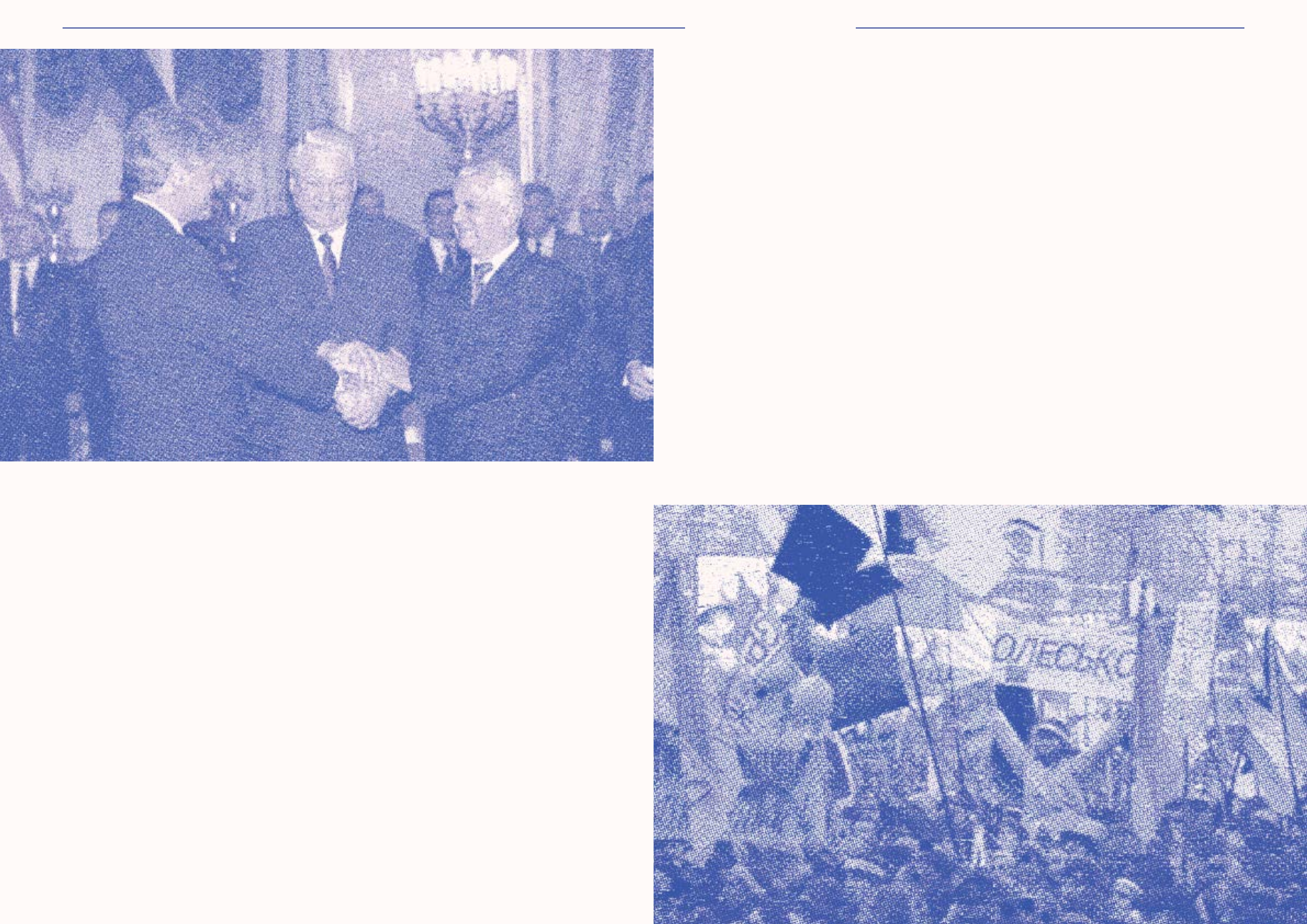
The peculiar hegemonic order of Ukrainian so-
ciety thus oers a valuable lesson for an attentive
observer. Because of these tendencies the griev-
ances of Ukraine’s lower class were systematically
overlooked, a class whose interests lacked an ‘in-
dependent ideological articulation and political
representation’ within the narratives of the two
tion, pro-European discursive expression, and large-
ly overlooked the material grievances of the lower
class. In this way the crisis of representation, pro-
voked by the highly non-representative hegemon-
ic order, deprived the protests of their potential to
highlight the grievances that were fundamental to
their very ignition and perpetuated the non-repre-
sentative character of the Ukrainian political main-
stream.
This crisis of representation, and its enduring na-
ture, is best understood through Claude Lefort’s
notion of the insurgent side of democracy, or what
he called ‘la démocratie sauvage’. Lefort’s frame-
work complements Gramsci’s concept of hegemony
by situating it within moments of social rupture. In
this line of thinking, signicant protest movements
are useful to the extent that they redraw the borders
of the existing symbolical order and its conventions
(what Lefort called ‘the political’), allowing for in-
clusion of the issues previously unlit by the light of
conventional discourses — usually, the very issues
that provoke the extra-institutional political act
of protest (Zicman de Barros, 2024: p. 8-9). In the
Ukrainian context, the combination of structural
factors of the post-communist political game dis-
make) the country suitable for their economic
interests by either liberalising, modernising, West-
ernising, or seeking economic and cultural stability
through unity with Russia (Ishchenko, 2024: 307-8).
This stands in contrast to both Western democracies
and some post-communist states in Central Europe,
where the ‘left-right’ axis remains signicant. From
this perspective, Ukraine’s political conguration
appears to be a rather post-modernist case: one
where the Lefortian ‘markers of certainty’ – or the
appeal to certainty, that the ‘meta-narratives’ that
the traditional ideologies oer in their claims to ul-
timate good (and which to this day, at least nominal-
ly, live on in the West) – were dissolved completely
(Zicman de Barros 2024, 4; Lyotard 1984, xxiv). The
post-communist disillusionment with ideology
as such, as well as the structure of its elites, made
Ukrainian society resilient to the moral and histori-
cal necessities of conventional ideologies, and made
its politics turn around the valence issues of the
economy, corruption, or quality of state services.
dominant political blocs (Ishchenko, 2024: 307).
The two Ukrainian revolutions of 2004 and 2014
illustrate this well. Both protests were to a great
extent products of long-term material anxiety, pro-
voked by economic insecurity, exposure to corrup-
tion, and hindered prospects for social mobility.
Disproportionately aecting the lower economic
strata, these issues constituted an important under-
lying driver of these protest movements. However,
since both movements were ignited and organised
by the ‘Western’ block of Ukrainian politics (the
one representing economic interests of the middle
class, allied with what Ishchenko calls ‘the transna-
tional capital’), they gained respective anti-corrup-
cussed above, as well as the post-Leninist lack of
ideological spectrum, produced a hegemony that
pushed the interests of Ukraine’s lower class to the
margins of the political discourse (Ishchenko, 2024:
307-311). In the absence of a traditional ideology, a
condition of epistemic injustice emerged, leaving
marginalised groups without the interpretive frame-
works required to understand their structural disad-
vantage or to articulate demands for change (Frick-
er, 2007). All of these factors allowed the revolutions
to remain embedded within a broader, post-materi-
alist ‘middle-class’ agenda, with the interests of the
lower classes largely subsumed into these narratives
rather than articulated explicitly despite the pro-
tests’ cross-class character and membership. Both
protests thus failed to ignite a truly revolutionary
change when it came to life conditions for most peo-
ple, but brought about a change in the political elites
that kept the redistribution issue largely untouched,
setting the trap that would lead both post-protest
governments to devastating defeat in the subse-
quent elections (Ishchenko, 2021).
Ukraine is thus a peculiar example of a society
where a large shake-up, which led to a landslide po-
litical change on the surface, failed to broaden the
78 79DЇASPORA JOURNAL
This metamorphosis pushed the left away from
representing the economic interests of the work-
ing and low-earning strata. Instead, it produced
a political system in which both sides represented
liberalism after 1980 led to a self-accelerating rise of
wealth inequality; one that, according to a consider-
able part of economic scholarship, inevitably leads
to deeper economic (and hence social) stratication
if not addressed. Particularly after 2008, growing
economic inequality started being noticeable ‘on
the ground’. The fact that some scholars started
noticing and studying the ‘losers of globalisation’
in the West, while the ‘cost of living crisis’ entered
the vocabulary of public discussions, shows that the
neoliberal model of development did not necessar-
ily elevate everybody in a tide-like fashion, and that
many were in fact left behind.
The issue stayed on the margins due to the fact that
the criticism of neoliberalism and austerity was ei-
ther absent or very weak. One cause of that was the
fading momentum of social-democratic and moder-
ate leftist economic thought in the political debate
of the end of the twentieth century, which further
contributed to the ‘subalternisation’ of the lower
economic stratum.
From this perspective, Margaret Thatcher famously
mentioning Tony Blair as her biggest achievement
is an ironic but quintessential event: it symbolised
naturalisation and universalisation of neoliberalism
as the convention across the political spectrum, and
the creative impotence of the centre-left at oering
economic alternatives. This way, the hegemony that
represented intellectual and economic elites with
neoliberalism as a largely undisputed convention
naturally left no space for the issues of economic in-
equality on either side of mainstream politics.
The decades following World War II can still be de-
scribed as a period of traditional ideological align-
ment: the less educated and poorer working classes
were represented by the left, while the more educat-
ed and aluent population aligned with the right.
Over time, however, various socio-economic and
socio-cultural processes (the discussion of which is
captivating but lies beyond the scope of this essay)
gradually reversed this tendency. As a result, what
Gethin, Martínez-Toledano and Piketty (2022) de-
scribe as ‘multi-elite party systems’ emerged, with
the left voicing the post-material narratives of intel-
lectual elites, and the right representing the materi-
al interests of economic elites.
dierent factions of the elite: one primarily intel-
lectual, the other primarily economic. Obvious-
ly, it was not due to the disappearance of the low-
er socio-economic class; in fact, the issues that
concerned this class the most started to reemerge
at the dawn of the millennium. Inequality was in-
deed addressed during the Trente Glorieuses, the
thirty-year economic boom which followed the Sec-
ond World War, for a number of reasons. However,
starting from the neoliberal turn of the 1980s,
through the Eurocrisis and nancial crisis of
2008, it signicantly intensied. As Piketty
(2014) discusses in his groundbreaking Cap-
ital in the Twenty-First Century, the fall of embedded
hegemonic agenda in a way that included one of
the root causes of the shake-up itself. However, as
I will attempt to demonstrate now, this case might
not be that unique: the awareness of the function-
ing of Ukrainian hegemony, and its crisis of repre-
sentation, has utility outside of the context of our
country, for what is true about the crisis of hege-
mony in Ukraine is also largely true in the West.
One could even argue that Ukraine has merely her-
alded the ‘vicious cycle’ that European democracies
entered roughly a decade ago. The crisis of hege-
mony in Europe, however, has deeper roots, tracing
back to the erosion of class-based politics in the sec-
ond half of the 20th century.
80 81DЇASPORA JOURNAL

As shown in the case of Ukraine, a hegemonic or-
der that does not address important issues has a
tendency to accumulate frustration. By the same
logic, the growing trend of falling support for
mainstream parties is often explained by their
failure to address the issue of inequality. Unable to
express itself among the mainstream political sup-
ply, the disappointment of the disadvantaged vents
through the only outlet that is available — in the
case of post-2008 Europe, such an outlet has been
consistently oered by the far-right.
These political forces base their rhetoric on feelings
of frustration and indignation, as well as perceptions
of a general decline in living standards. The fact that
they attract a large portion of the lower-class vot-
ers shows just how bad a job the mainstream does
at representing them. The growing support of the
far-right should thus primarily be seen as a mat-
ter of alienation from mainstream politics brought
about by the crisis of hegemony.
The solutions oered by the far-right are, however,
doomed to fail for the same reasons that those of-
fered by their mainstream opponents currently do.
Leaving the inhumane, xenophobic bigotries aside
and assuming a purely pragmatic lens, the crucial
thing that is absent in the rhetoric of the far-right
is tackling the root causes of frustration, which is
the growing wealth inequality resulting in a falling
quality of life.
Quite the opposite as for various reasons, these po-
litical forces usually adopt an even more extreme
neoliberal agenda. In a way suggested by Ishchenko
(2021) in his analysis of Ukraine’s political economy,
the ‘vicious cycle’ is thus propelled and perpetuat-
ed: non-addressed causes of subaltern frustrations
in the narratives of both the mainstream and rad-
ical parties are likely to lead to a cycle of upheav-
als and power turnaround, destabilising democ-
racies and alienating more and more people from
conventional politics.
Here again, the Lefortian perspective proves useful:
a shake-up that does not redraw the conventional
symbolic order to include the issues necessary for its
sustainability is doomed to amplify the frustration.
Similar to Ukraine, what has for a long time been
missing from any major political narrative in the
West is a coherent, inclusive progress project that
would oer a way forward while accounting for
the needs of various economic and social classes,
treating the material issues seriously and explicitly.
An additional but vital implication of this analy-
sis is the unstable grounds on which geographi-
cal cleavages often rely. What frequently reaches
public debate as ‘Polska A vs. Polska B’ or ‘West
vs. Ost Deutschland’ should be approached with
great caution, as it may be a disguised crisis of rep-
resentation that becomes more visible if one ac-
counts for all the inconsistencies of such a blunt
deterministic approach (Ishchenko, 2024 299-304).
Any distribution of meanings into narratives is a
result of a country’s own historical path, structur-
al particularities, and decisions of political actors.
The lesson that Ukraine, and in particu-
lar, its unity in the face of Russian threat and
overwhelming grassroots resistance in its East‚
oers to a broader public is to be cautious of
one’s own society’s “conventional” mental map-
ping. Oftentimes, such shortcuts oer no clarity
and little truth.
Ultimately, the case of Ukraine oers a valuable tes-
timony to the functioning of Gramsci’s hegemony in
the political domain; it shows how destabilising its
crises can be for a political system.
Its self-perpetuating nature, enabled by the installa-
tion of dominant interpretative frameworks in soci-
ety and politics that privilege a certain interpretative
framing, provides a basis for systematic overlooking
of vital societal issues.
What this essay demonstrates is how the roots of he-
gemonic order, and ultimately of what is included
and excluded from it, are to be sought in the struc-
ture and origins of the dominant elites. The pecu-
liar path of the Ukrainian elites and their impact
on the society’s modes of thinking and behaviour
is but one of the factors that make Ukraine such a
treasure trove for anybody interested in the topic of
political hegemony.
REFERENCES
Fricker, M. 2007. ‘Epistemic Injustice: Power and
the Ethics of Knowing’. Oxford: Oxford University
Press.
Femia, J.V. 1987. ‘The Concept of Hegemony’
in Gramsci’s Political Thought: Hegemony,
Consciousness, and the Revolutionary Process’.
Oxford: Oxford University Press.
Gethin, A, Martínez-Toledano, C. & Piketty, T. 2022.
‘Brahmin Left Versus Merchant Right: Changing
Political Cleavages in 21 Western Democracies, 1948–
2020’, The Quarterly Journal of Economics, 137(1).
Gorbach, D. 2024. ‘Ukrainian Political Economy’,
in The Making and Unmaking of the Ukrainian
Working Class: Everyday Politics and Moral
Economy in a Post-Soviet City, Berghahn Books,
New York.
Hale, H.E. 2015. ‘Patronal Politics and the Great
Power of Expectations’, in Patronal Politics: Eurasian
Regime Dynamics in Comparative Perspective.
Problems of International Politics. Cambridge
University Press.
Ishchenko, V. 2021. ‘Ukraine in the Vicious Circle
of the Post-Soviet Crisis of Hegemony’. LeftEast.
(Accessed: December 29, 2025). https://lefteast.org/
ukraine-in-the-vicious-circle-of-the-post-soviet-
crisis-of-hegemony/
Ishchenko, V. 2024. ‘Class or Regional Cleavage?
The Russian Invasion and Ukraine’s ‘East/West’
Divide’, European Societies, 26(2).
Lyotard, J.F. (1984 [1979]), ‘The Postmodern
Condition: a Report on Knowledge, Theory and
History of Literature’, vol. 10. University of Minnesota
Press.
Piketty, T. 2014. ‘Capital in the Twenty-First
Century: A Multidimensional Approach to the
History of Capital and Social Classes’, The British
Journal of Sociology, 65(4).
82 83DЇASPORA JOURNAL
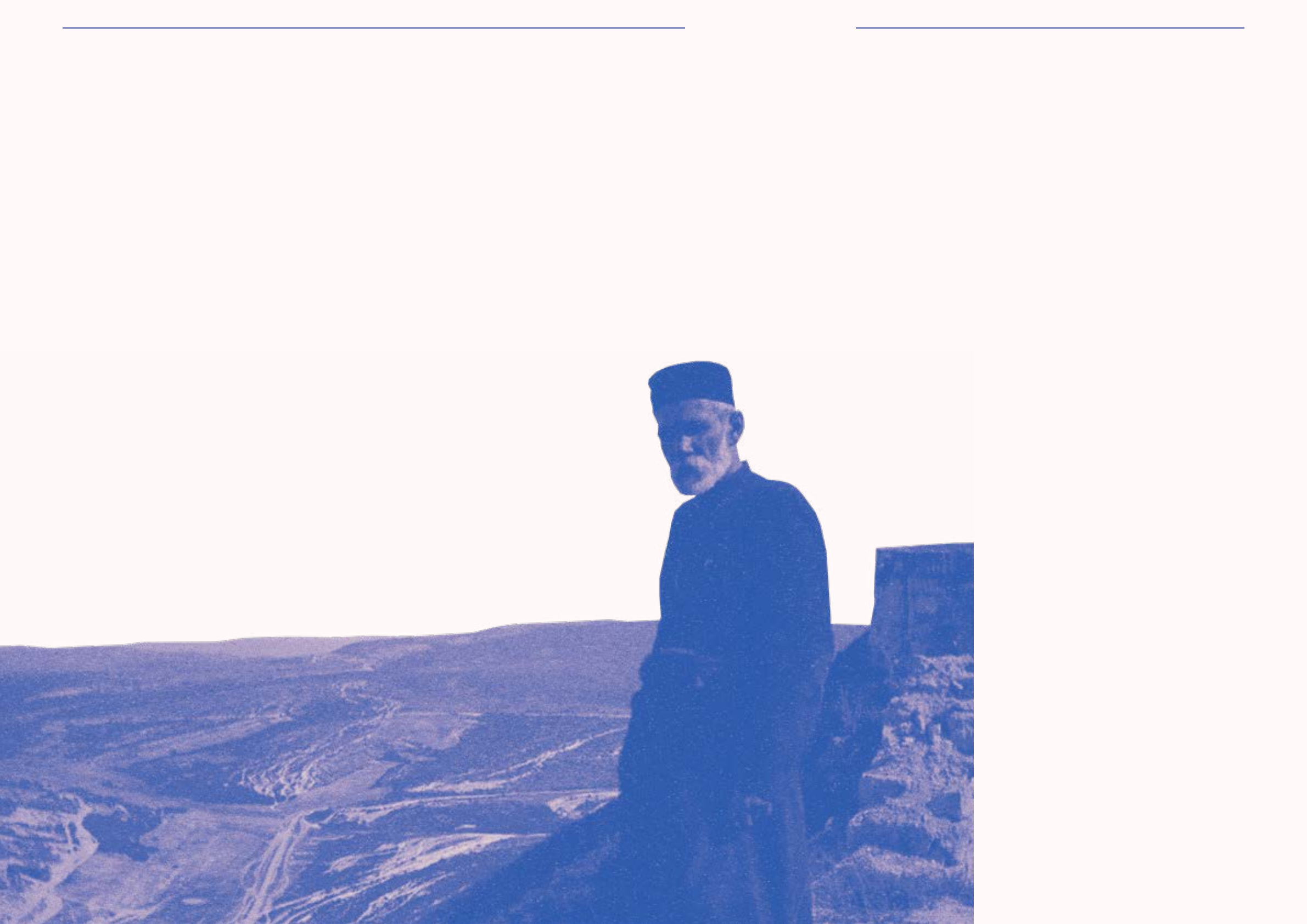
THE CRIMEAN
TATAR S A Unique Idigeous
Comunity i Ukraie’s
Past, Preset ad Future
ANDRII KUZMA
rimea’s complex history is a representation of
competing imperial interests, ranging from
Their distinctiveness is reected in their historical
continuity, political organisation, and demographic
presence. Through their study, we can trace not only
the history of Crimea itself but also broader regional
power shifts and evolving social sentiments. The
Crimean Tatars are a unique, predominantly
Muslim people who have maintained their identity
despite centuries of Orthodox imperial rule and the
atheistic policies of the Soviet Union.
To this day, research on this community remains
limited, largely as a result of systematic policies
pursued by the Russian Empire and later the Soviet
Union that aimed to suppress and erase the nation.
This legacy of neglect persisted into the early years
of Ukrainian independence, when the signicance
and distinctiveness of the Crimean Tatars were not
yet fully recognised. Consequently, this essay aims
to deepen the understanding of the Crimean Tatars
by familiarising a wider audience with their history
and contemporary situation. To achieve this, I will
begin by dening the Crimean Tatar identity, decon-
structing the prevailing Russian myths regarding
their Golden Horde origins and the alleged ‘betray-
al’ of the Cossacks. The analysis will then examine
the two historical occupations of Crimea, with par-
ticular attention given to the events of 1944, widely
regarded as the darkest chapter in the history of the
Crimean Tatars. Subsequently, I will examine the
dynamics of Crimean Tatar autonomy within sover-
eign Ukraine, covering the rst 23 years of indepen-
dence and the period from 2014 to the pres-
ent. Finally, I will oer reections on the
future of the Crimean Tatars, addressing
critical issues that, despite their plausi-
bility in the event of a prolonged Rus-
sian occupation, remain overlooked in
oicial state discourse.
CRIMEAN TATARS: IDENTITY AND
ORIGINS
The Crimean Tatars (Qırımtatarlar) are the largest
of Ukraine’s indigenous peoples of Turkic origin,
having formed on the Crimean Peninsula and in the
Ukrainian steppe, with their own language (Horban
2019/2025). The Crimean Tatar language has experi-
enced a few alphabetical shifts, from Arabic script
to Latin, then forcibly under the Soviet Union, to
Cyrillic (Beketova 2025). Their language is Turkic,
included in the Altai family of languages within
the Kipchak-Polovtsian subgroup, and recognised
by UNESCO as a language in danger of extinction
(United Nations n.d).
A persistent Russian narrative, emerging under
Catherine II, claimed that the Crimean Tatars were
merely descendants of the Golden Horde, specif-
ically Tatars from Central Asia. While this inter-
pretation may hold relevance in terms of historical
statehood, it fundamentally misrepresents and over-
simplies the distinct ethnic identity of the Crime-
an Tatar people. Russia constructed this myth to
portray the population as non-historical migrants,
thereby undermining their indigenous status and
territorial rights. However, contemporary scholar-
ship demonstrates that the Crimean Tatar ethnos
began forming as early as the 11th century, rooted
in the Turkic peoples already present in the region
(Bekirova et. al. 2020, 35). Although ancient tribes
are not direct relatives of the modern Crimean Ta-
tars, archaeological nds of Cimmerians, Taurians,
Scythians, and Huns, along with Greek and Italian
settlements, underscore the diversity of Crimean
life long before any Mongol arrival (ibid., 17-31). This
evidence suggests that while the Golden Horde in-
uenced Crimean statehood, ethnic Crimean Ta-
tars inhabited the peninsula for centuries prior. The
term ‘Tatar’ served as an external label for Eastern
nomads rather than a precise ethnic descriptor.
Today, three main sub-ethnic groups of Crimean
Tatars are recognised: the highlanders (Orta Yu-
lak), the steppe dwellers (Nogays), and the southern
coast population (Yali-Boylu) (Abdulaieva 2025). Ac-
cording to a 2015 census conducted after the occupa-
tion began, over 275,000 Crimean Tatars remained
in Crimea, while a signicant portion had already
been displaced to mainland Ukraine (Dostim 2015).
C
the Golden Horde to the Soviet Union. Today, the
peninsula remains under illegal occupation, having
initiated the 2014 military confrontation between
Ukraine and Russia, which eventually escalated
into the largest European war since World War II.
Crimea holds both immense strategic importance,
due to its military assets and bases, and profound
symbolic value as a historical resort destination
dating back to the Russian Empire. Crimean Tatars
constitute one of the most distinctive indigenous
communities preserved on the Crimean Peninsula.
84 85DЇASPORA JOURNAL
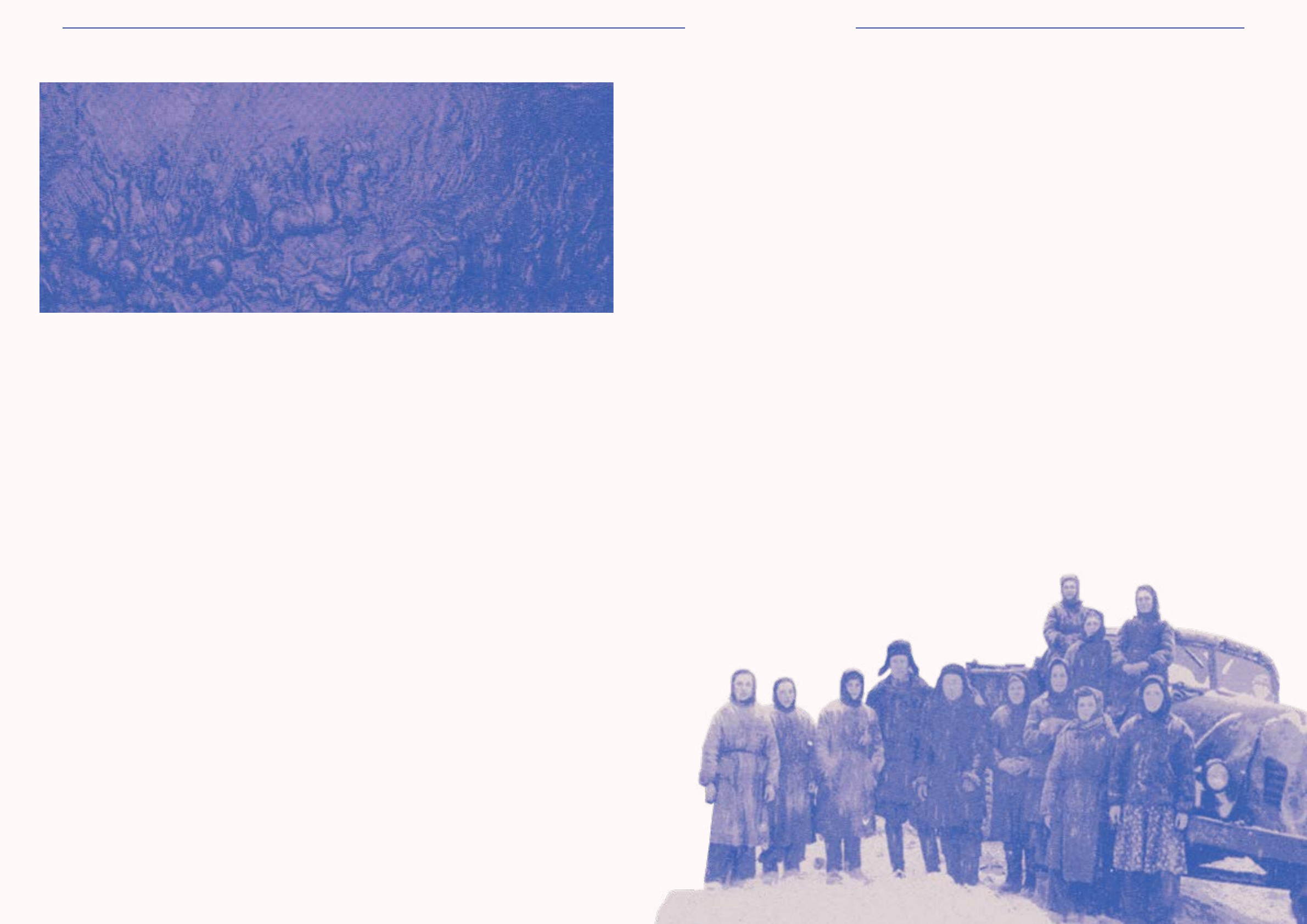
THE CRIMEAN KHANATE AND THE
FIRST OCCUPATION
The Crimean Khanate emerged as an independent
state following the fragmentation of the Golden
Horde in 1441, established under the leadership of
Haci Giray and other prominent Crimean clans (Ab-
dulaieva 2025). In 1475, after the Ottoman conquest
of Genoese colonies in the Northern Black Sea re-
gion, the Turkish Sultan gained inuence over the
Khanate’s leadership, establishing a vassal status
under the Ottoman Empire, headed by Meñli I Gi-
ray as commander of the eet and army (Sizarev
2020, 85). The debate surrounding Crimea’s status
over the following centuries is particularly com-
pelling; as Roman Pochekaev notes, the Khanate
functioned as a ‘privileged’ vassal of the Ottoman
Empire, retaining substantial political autonomy
(2019, 77). Because the rights and obligations of the
‘contracting parties’ were never clearly codied, the
level of dependency often uctuated based on the
personal relationship between the rulers in Istanbul
and Crimea (ibid.).
During this era, Ukrainian Cossacks frequently
interacted with the Khanate. The relationship be-
tween Bohdan Khmelnytsky and Islam III Giray is
concealed in myths, especially regarding the alleged
‘betrayal’ in 1651 (Shurkhalo 2021). While Cossacks
and Tatars launched numerous successful joint cam-
paigns against the Poles in the mid-17th century, the
Tatar withdrawal during the Battle of Berestechko
followed devastating elite losses in combat, which
shows a military defeat of Cossacks and Crimean
Tatars (Pilipchuk 2015, 137). Russian historiography
later reframed this event as a betrayal to align with
imperial designs on Crimea.
In 1768, the Ottoman Empire and the Khanate, as a
vassal, went to war with Russia, resulting in the 1774
Treaty of Kuchuk-Kainarji. Under this treaty, the Rus-
sian Empire was mandated to withdraw its troops,
and both Russia and Turkey recognised Crimean
independence (Hrabovskyi 2006). However, Russia
violated the agreement, continuing military-politi-
cal interference until it eectively annexed Crimea
in 1783 (ibid.). By 1791, following another conict, the
Treaty of Jassy saw Turkey formalise its recognition
of Crimea’s incorporation into the Russian Empire
(Hrabovskyi 2006). From the late 18th century on-
ward, Crimean Tatars faced systemic oppression,
including the destruction of mosques, the renaming
of historical sites, the introduction of serfdom, and
the alienation of local lands managed personally by
Prince Potemkin (Abdulaieva 2025).
POST-IMPERIAL TRANSITIONS AND
THE SECOND OCCUPATION
The collapse of Russian Tsarism oered the Crime-
an Tatars a brief window of freedom. During this
period, the rst political party, Milli Firka (National
Party), was established, and the Kurultai (national
assembly) was convened. On December 13, 1917 the
Crimean People’s Republic was proclaimed under
the leadership of Noman Çelebicihan (Abdulaie-
va 2025). However, by December, Bolshevik control
over the Crimean eet rendered the republic large-
ly symbolic (Gabrielyan et. al. 1998, 33). By 1921, the
Crimean Autonomous Soviet Socialist Republic
(ASSR) was established within the Russian SFSR
(Abdulaieva 2025). The later period of relative devel-
opment ended on April 17, 1938 — a dark day when
Stalinist terror resulted in the execution of dozens of
cultural and political gures on fabricated charges
of ‘bourgeois nationalism’, following arbitrary,
20-minute trials (ibid).
1944: THE YEAR OF GENOCIDE
The harrowing brutality of 1944 remains a global
historical tragedy, oicially recognised as geno-
cide in many countries (Richardson 2024). In May
of that year, just one week after liberating Crimea
from German forces, Soviet authorities orchestrat-
ed the forced deportation of the Crimean Tatar
population to Central Asia (Hamarniuk 2015). The
operation was conducted with extreme speed using
overcrowded cattle cars, lacked adequate provisions,
and resulted in the forced separation of families
(Abdulaieva 2025). According to the Crimean Tatar
National Movement, 238,500 people were deported,
86.4% of whom were women and children (Consul-
ate of Ukraine in Edinburgh 2016). Up to 46% of the
population perished during the deportation and
subsequent years of exile (Abdulaieva 2025). It was
not until 1989 that the Supreme Soviet of the USSR
recognised the deportation as illegal and criminal
(ibid.). In the following years, Moscow encouraged
the resettlement of nearly 30,000 Russian (73%) and
Ukrainian (26%) households to replace the indige-
nous population (Kononirenko 2017, p.58-62).
86 87DЇASPORA JOURNAL
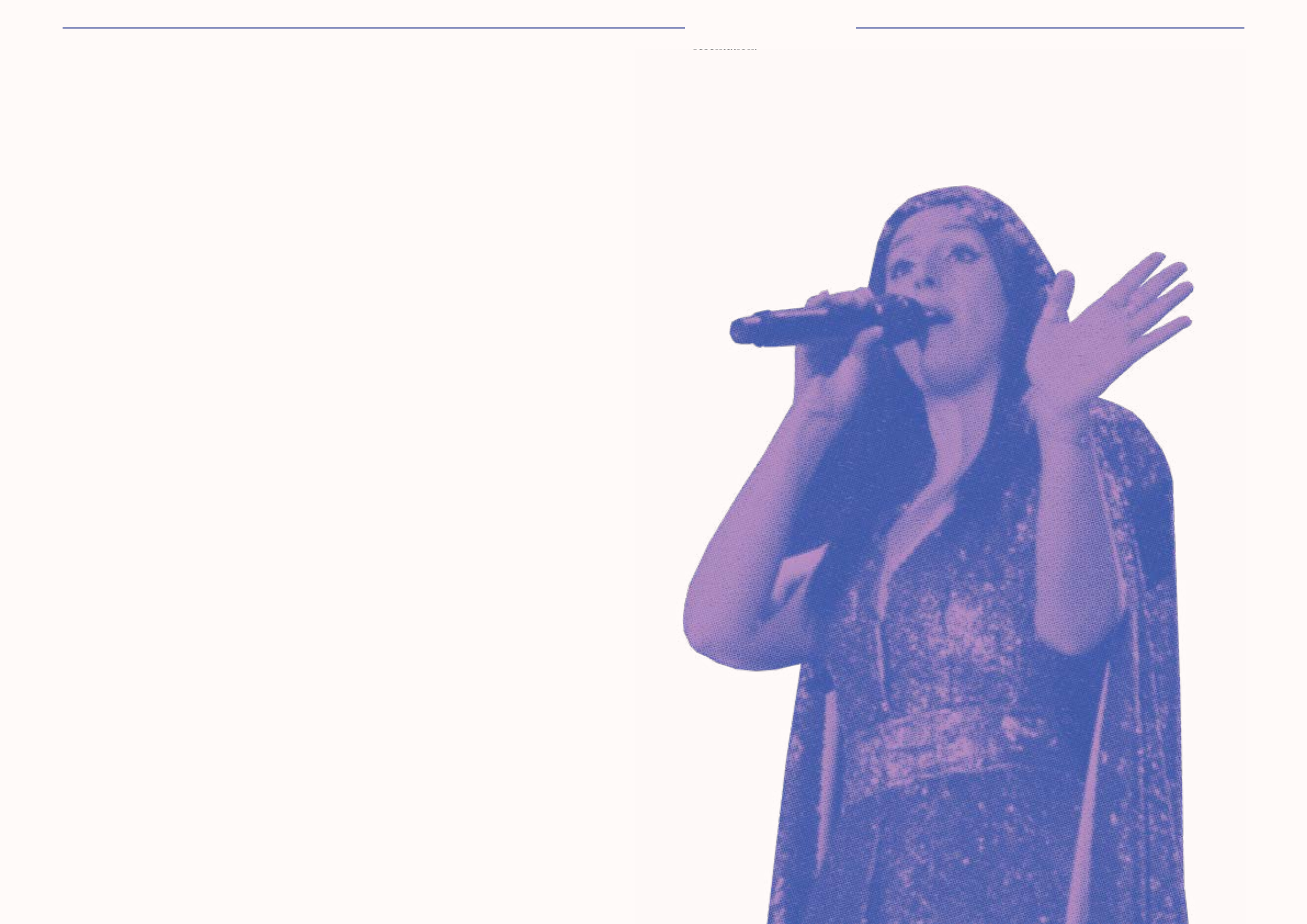
23 YEARS OF INDEPENDENCE
While the rst Kurultai took place in 1917, the second
assembly was held on June 26, 1991, shortly before
the Soviet collapse (Abdulaieva 2025). Two months
later, following Ukraine’s independence on August
24, over 200,000 Crimean Tatars returned home in
one of the community’s largest waves of repatriation
(OSCE 2013, 11). Since then, Ukrainian interaction
with the Tatars has been split between two funda-
mentally dierent eras: pre-2014 and post-2014.
In the years following independence, Ukraine’s po-
litical elite largely ignored the Crimean issue and
thus failed to see the emerging collision of Russian
and Ukrainian cultures (Kravets 2024). Ukraine re-
mained politically and value-dependent on Russia,
leading to inadequate policies toward the Crimean
Tatars. A rare positive development was President
Kuchma’s 2003 initiative to prepare for the 60th
anniversary of the genocide (Radio Svoboda 2003).
While Kuchma was later remembered as a ‘friend of
the Tatars’ (Obozrevatel 2010), relations shifted un-
der Viktor Yushchenko and worsened signicantly
under Yanukovych, whose administration conduct-
ed ethnic purges within local governments (Osman
2014).
TURNING POINT: THE 2014 OCCU-
PATION AND MODERN RESISTANCE
On February 20, 2014, Russia began its occupation of
Crimea (Krukovska et al 2023/2025). In response, the
Ukrainian Parliament passed a 2014 resolution guar-
anteeing the rights of the Crimean Tatars, recognis-
ing the Mejlis (parliament analogue) and Kurultai
as representative bodies, and protecting their right
to self-determination within Ukraine (Belitser 2016,
86). Further legislation restored the rights of deport-
ed persons and oicially recognised the genocide,
a strategic response to the renewed repressions of
Russia in Crimea against the indigenous population
(Belitser 2016, 87).
The mass repression since 2014, particularly fol-
lowing the 2022 invasion, is extensively document-
ed (Belitser 2016, 93-99; Solomko 2024; Kotovych
2024/2025; Abdulaieva 2025). Approximately 50,000
Crimean Tatars have ed the peninsula due to re-
ligious persecution and disproportionate conscrip-
tion; in some villages, up to 70% of men received
summons (Solomko 2024). PACE (2016) Resolution
2112 recognised these systematic violations of rights.
Between February and September 2022 alone, Rus-
sian forces conducted 25 searches and 108 deten-
tions, with Crimean Tatars making up 104 of the 138
individuals arrested for opposing the occupation
(Abdulaieva 2025).
In contrast, on mainland Ukraine, the community
thrives. Jamala’s 2016 Eurovision victory brought
their culture to a global stage (Horban 2019/2025).
Today, Crimean Tatars freely practice their culture,
language, and religion, and open businesses that in-
troduce Ukrainians to their heritage (ibid.). The 2021
Law on Indigenous Peoples oicially recognised
them alongside Karaites and Krymchaks (Verkhov-
na Rada of Ukraine 2021). High-prole gures such
as Tamila Tasheva, who represents the Crimean Ta-
tar community at the presidential level (Kotovych
2024/2025), and Rustem Umerov, former Minister of
Defence of Ukraine (2023–2025), illustrate this rep-
resentation.
Initiatives like the Crimea Platform (Abdulaieva
2025) and the 2025 Congress of Indigenous Peoples
serve as critical tools for policy planning for after
de-occupation (Yanko & Chornovalova 2025). Fur-
thermore, Crimean Tatars serve in the Ukrainian
Defence Forces (Solomko 2024), and international
conferences highlight the connection be-
tween Ukraine and the Global South
through Crimea’s Islamic heritage
(Kotovych 2024/2025).
88 89DЇASPORA JOURNAL
FUTURE PERSPECTIVES
It is diicult to speak with any certainty about the
future in Ukraine, including the prospects for the
Crimean Tatars, due to the war. Global experience
regarding interaction with indigenous populations
is extensively diverse (Belitser 2016, 45-53), and
should be drawn upon by Ukraine, as such a status
requires signicant state protection. A great exam-
ple of this preservation could be the creation of ad-
equate state-funded representative bodies that can
inuence local decision-making.
Presently, various scenarios exist for nal peace
agreements, in which the question of Crimea is
especially sensitive. In a scenario of prolonged oc-
cupation of Crimea, or a US-pushed propos-
al regarding Ukraine’s oicial renunciation
of Crimea (Sabbagh and Savage 2025), the
Crimean Tatars would lose a range of op-
portunities. This is because the Ukrainian
law on indigenous peoples denes certain
advantages that can only be realised on the
Crimean Peninsula, or specically in Sevasto-
pol (Verkhovna Rada of Ukraine 2021, 1-2).
Now, there are no such discussions
within Ukrainian society, as they
would contradict the widely accepted
understanding of Ukraine’s state sover-
eignty. While ideas regarding actions fol-
lowing de-occupation are being explored,
alternative scenarios are currently not under
consideration. However, establishing such a
dialogue would carry practical value for de-
veloping future internal policies concerning
Crimean Tatars already on Ukrainian territory,
as well as the potential repatriation of the pen-
insular population to the mainland should such
a request arise. Ukraine, recognising the Crimean
Tatars as its indigenous people, must consider pro-
tection options even following a potential loss of ter-
ritory, as this is the only way to ensure the preserva-
tion of this community.
CONCLUSION
Historically, Russia has fabricated myths about
Crimean Tatar origins and their relations with
Ukrainian Cossacks, using the Khmelnytsky case
to serve imperial interests. At the same time, the
Crimean Tatars’ history, status, and future remain
highly politicised. Having survived multiple occu-
pations, the 1944 genocide, and prolonged exile, the
Crimean Tatars preserved a unique Muslim culture
and are now oicially recognised by Ukraine as an
Indigenous people, which entails specic state ob-
ligations. Since 2014, Ukraine has adopted a val-
ue-based approach to protecting Crimean Tatar BIBLIOGRAPHY
Abdulaieva, G. 2025. “The Deportation of the
Crimean Tatars: A Crime That Continues”. https://
www.ukrainer.net/deportatsiia-krymskykh-tatar/
Beketova, E. 2025. “Behind the Lines: Crimean
Tatars Battle to Save Their Centre for Europe-
an Policy Analysis”. https://cepa.org/article/
behind-the-lines-crimean-tatars-battle-
to-save-their-language/
Bekirova, G., Ivanets, A., Tyshchen-
ko, Y., Hromenko, S., & Ablaiev, B. 2020.
“History of Crimea and the Crimean
Tatar People”. Krymska Rodyna; Mais-
ter Knyh. https://shron1.chtyvo.org.
ua_Bekirova_HulnaraIstoriia_Kry-
mu_ta_krymskotatarskoho_narodu.
pdf
Belitser, N. 2016. “The Crimean Ta-
tars as an Indigenous People: History
of the Issue and Contemporary Reali-
ties”. Pylyp Orlyk Institute of Democ-
racy. https://idpo.org.ua/wp-content/up-
loads/2017/ct-book.pdf
Consulate of Ukraine in Edinburgh.
2016. “72nd Anniversary of the Deporta-
tion of the Crimean Tatars”. Ministry of
Foreign Aairs of Ukraine. https://edin-
burgh.mfa.gov.ua/news/47478-72-a-richni-
cya-deportaciji-krimsykih-tatar
Dostim, E. 2015. “Population Cen-
sus in Crimea: Why the Number of
Russians Increased, and Ukraini-
ans Decreased”. Radio Free Eu-
rope/Radio Liberty. https://
ua.krymr.com/a/26918423.
html
rights and culture, in stark contrast to Russian re-
pression. Given ongoing discussions about potential
war settlements and the possibility of prolonged oc-
cupation, Ukraine must develop a long-term strat-
egy to protect the Crimean Tatars and ensure their
survival and political representation under any fu-
ture scenario.
90 91DЇASPORA JOURNAL

Gabrielyan, O. A., Emov, S. A., Zarubin, V. G.,
Kislyi, A. E., Malgin, A. V., Nikiforov, A. R., Pavlov, V.
M., & Petrov, V. P. 1998. Crimean Repatriates: Depor-
tation, Return, and Resettlement. Amena Publish-
ing House.
Hamarniuk, N. 2015. “The Deportation of the
Crimean Tatars in the Memories and Diary En-
tries of Eyewitnesses”. Military-Historical Meridian.
Electronic Scientic Professional Journal, Issue 3 (9).
Horban, D. 2019, 2025. “Crimean Tatars: Who are
They?” Ukraїner. https://www.ukrainer.net/kryms-
ki-tatary/
Hrabovskyi, S. 2006. “The Küçük Kaynarca Peace
Treaty: Myths and Realities”. Radio Free Europe/Ra-
dio Liberty. https://www.radiosvoboda.org/a/946300.
html
Kononirenko, V. A. 2017. “The Removal of Col-
lective Farmers from Russia and Ukraine to the
Post-Deportation Territory of Crimea in 1944–1953”.
Izvestiya of Saratov University, Series: History. Inter-
national Relations, 17(1).
Kotovych, D. 2024, 2025. “Tamila Tasheva.
Pravozakhysnytsia, Yaka Stala Holosom Krymu”
(“Tamila Tasheva. The Human Rights Activist who
Became the Voice of Crimea”). Ukraїner. https://
www.ukrainer.net/tamila-tasheva/
Kravets, I. 2024. “Crimean Tatars Understood
Ukraine Before Ukraine Understood Itself”. Zaxid.
net. https://zaxid.netkrimski_tatari_zrozumili_ukra-
yinu_ranishe_nizh_vona_sama_zrozumila_sebe_
n1586307
Krukovska, I., Yabluchna, A., & Ponedilok, N.
2023, 2025. How Russia Captured Crimea. Ukrainer.
https://www.ukrainer.net/rosia-krym/
Obozrevatel. 2010. “The Greatest Friend of the
Crimean Tatars was Kuchma”. https://www.oboz-
revatel.com/ukr/culture/64731-najbilshim-drugom-
krimskih-tatar-buv-kuchma.htm
Organisation for Security and Co-operation in
Europe (OSCE). 2013. “Integration of Previously De-
ported Persons in Crimea, Ukraine”. https://www.
osce.org/sites/default/les/f/documents/c/c/104418.
pdf
Osman, D. 2014. “Crimean Tatars and Ukraine:
Working on Mistakes”. Krymr.com. https://ua.kry-
mr.com/a/26529110.html
Parliamentary Assembly of the Council of Europe
(PACE). 2016. “The Humanitarian Concerns with re-
gard to People Captured During the War in Ukraine
(Resolution 2112)”. https://pace.coe.int/en/les/22750/
html
Pilipchuk, Y. 2015. “The Crimean Khanate and
Europe in the Period 1648–1682”. Crimean Historical
Review, 2.
Pochekaev, R. 2019. “Legal Aspects of Relations
Between the Crimean Khanate and the Ottoman
Empire Through the Eyes of European Contempo-
raries”. Crimean Historical Review, 2.
Radio Svoboda 2003. “President of Ukraine Leo-
nid Kuchma Signed the Decree ‘On the 60th Anni-
versary of the Deportation of Crimean Tatars and
Persons of other Nationalities from Crimea’”. https://
www.radiosvoboda.org/a/907711.html
Richardson, J. 2024. “Time to Recognise the
Crimean Tatar Genocide”. Lowy Institute. https://
www.lowyinstitute.org/the-interpreter/time-recog-
nise-crimean-tatar-genocide
Sabbagh, D., & Savage, C. 2025. “Zelenskyy says
Ukraine cannot accept US recognition of Crimea as
Russian”. The Guardian. https://www.theguardian.
com/world/2025/apr/24/zelenskyy-says-ukraine-can-
not-accept-us-recognition-of-crimea-as-russian
Shurkhalo, D. 2021. “370 years ago: The ‘Battle
of Nations’ near Berestechko”. Radio Free Europe/
Radio Liberty. https://www.radiosvoboda.org/a/byt-
va-pid-berestechkom/31353925.html
Sizarev, K. 2020. “The Formation of a System of
Power and Administration in the Crimean Khanate
During the 15th–18th centuries”. Crimean Historical
Review.
Solomko, V. 2024. “Now We are Fighting Not Just
for Territory, but for the Right to Live on Our Land”
– Interview with Refat Chubarov. Holos Ameryky.
https://www.holosameryky.com/a/interview_chu-
barov_crimea_tatar/7586702.html
United Nations. n.d.. “Universal Declaration of
Human Rights - Crimean Tatar”. OHCHR. https://
www.ohchr.org/en/human-rights/universal-declara-
tion/translations/crimean-tatar
Verkhovna Rada of Ukraine. 2021. “On the Indig-
enous Peoples of Ukraine (Law No.1616-IX)”. https://
zakon.rada.gov.ua/laws/show/1616-20
Yanko, H., & Chornovalova, V. 2025. “The Con-
gress of Indigenous Peoples has Started in Kyiv:
Occupation, Rights, Resistance, and the Future of
Crimea”. Suspilne Crimea. https://suspilne.media/
crimea/1178804-u-kievi-startuvav-kongres-korinnih-
narodiv-okupacia-prava-sprotiv-i-majbutne-krimu/
92 93DЇASPORA JOURNAL

Моєю мовою говорять птахи,
від неї світиться сонце.
Ластівки літають у вишині —
і я знаю, що буде сонячно.
Моєю мовою лунають пісні,
що грають роками на телебаченні.
Той самий гурт уже побачив цілий світ,
та лиш в одному місці їм було затишно.
Моєю мовою пишуться вірші
від найпрекрасніших поетів.
Моя мова має тисячі слів,
що складають сотні сюжетів.
Моя мова — це про волю,
це про стійкість духу, як палаючого вогню.
Вона — як прихід весни після зливи і туги,
вона — як ліки від сердечних мук.
Вона незламна, вона вистоїть усе,
і розповість ще безліч історій у майбутньому.
Вона — ніби теплий та лагідний день —
ти тільки до неї прислухайся.
MY LANGUAGE
MARYNA SANTALOVA
My language is sung by birds,
and it’s from her that the sun shines.
Swallows soar high above —
and from this, I know, the clouds are scoured.
Her words form many songs
that are played over, and over;
by that same band that has seen the whole world,
yet, has only one place they want to call home.
My language writes poetry
through the most talented poets;
She has countless words,
that form countless stories.
My language — she’s freedom,
resilience of the soul — on re.
She is — like spring after winter cruel and dull;
She is — what soothes an aching heart.
She’s unbreakable, she’ll withstand all
and she’ll live on to tell many more stories, new and old.
She is — as if a day, gentle and warm —
you just have to see what she holds.
94 95DЇASPORA JOURNAL

WHERE THE
RIGHT DOOR
LEADS
Learning
Ukrainia i
Cabridge
DIANA SHYPOVYCH
Every day, students walk, run, or, as I
have witnessed on at least one mem-
orable occasion, crawl through this
corridor, committing themselves to
a particular worldview by opening
one door or another.
n the long corridor of the Mod-
ern and Medieval Languages De-I
partment of the University of Cam-
bridge, I stand between two doors.
From the right comes the Ukrainian
language; from the left — Russian.
Further along the corridor, there
are numerous other doors through
which I can hear many languages of
the world.
What makes someone turn right and join the
Ukrainian language lesson? I am here to nd out.
The door opens, and Andrii, the Ukrainian language
teacher, ushers me in for the nal fteen minutes of
his beginner’s class. I give a very insightful introduc-
tion to the students — ‘Я дівчинка’ (I am a girl). ‘В
мене є собака’ (I have a dog). ‘Я люблю блакитний
колір’ (I love the colour blue). After delivering these
essential biographical details, I nally ask the ques-
tion I came for: ‘Why study Ukrainian?’
I am hit with a long, uncomfortable
cinematic silence — the type of si-
lence often reserved for existential
crises, major plot twists or, in my
case, potentially unsuccessful arti-
cle interviews. I’d like to think that
it was my commanding presence
rather than Andrii’s authoritative
encouragement which nally set o
the discussion.
This article is the outcome of many
intrusions into Ukrainian language
lessons. From speaking with An-
drii’s students, I learned that each
had a unique story behind their
decision to take the class. None-
theless, patterns emerged: some
see the Ukrainian language as a
form of solidarity and resistance.
For others, it is a tool for bonding
with important people in their lives
or a stepping stone for their profes-
sional future. And some nd sim-
ple academic pleasure in learning
Ukrainian.
96 97DЇASPORA JOURNAL
Beyond solidarity and resistance, many students
learned Ukrainian for a simpler reason: to connect
with the people around them. A boy from London
and a girl from the Czech Republic both began
studying Ukrainian while volunteering at welcome
centres for Ukrainian refugees in 2022. A practical
necessity gradually evolved into a long-term com-
mitment to maintain the relationships they had
built.
For the Ukrainian refugees themselves, their na-
tive language is a source of comfort. Through their
earnest eorts and battles with grammatical cases,
they signal to Ukrainians that someone is there to
acknowledge their culture far away from home. To
me, this is one of the most humane acts possible —
an attempt to speak the native language of another
person.
Some students had Ukrainian family connections: a
Ukrainian parent, grandparent or cousin. For them,
learning Ukrainian was a way to access a heritage
that had always felt slightly out of reach. Language
can unlock histories, stories, and relationships that
were previously inaccessible.
Many students framed learning Ukrainian as a ges-
ture of solidarity with a nation under attack. My
friend from Hong Kong explained that, coming from
a place that has also faced repression by a physically
larger power, he understands the urgency of protect-
ing cultural identity. For him, learning and speak-
ing Ukrainian is a way to stand in solidarity with his
friends, along with joining the ‘Слава Україні!’ (Sla-
va Ukraini) salute during protests. A student from
Sakartvelo in another class echoed his reasoning,
telling me that she wanted to contribute to the pres-
ervation of Ukraine’s identity and learn more about
how Ukraine’s history of struggle parallels that of
her own country.
From the perspective of these students, language
emerges as an instrument of power, where such an
everyday practice as language choice can be a subtle
but potent act of resistance, and mark one’s belong-
ing to a group which refuses to submit. I do agree
with these students — the best way to understand
fundamental events such as the Orange Revolution,
the Revolution of Dignity, and the current full-scale
war against Russia is through the language which
conveys the values Ukrainians continue to stand
for: ‘незалежність’ (independence), ‘свобода’ (free-
dom), and ‘гідність’ (dignity).
Beyond collective resistance and expressions of soli-
darity, language is also a tool for personal decoloni-
sation. A woman in her thirties told me she began
learning Ukrainian only after she left Mariupol and
came to Cambridge in 2022. She is determined to
pass this language on to her young children and end
the cycle of Russication. This story emphasises the
importance of language in preserving national iden-
tity and political community throughout the gen-
erations. The choice to reimagine oneself within a
Ukrainian cultural and national community can be
made at any point in one’s life.
CONNECTING THE DOTS
(AND THE PEOPLE)
LEARNING THE NATION
However, not all choices to join the Ukrainian
class seemed entirely voluntary. Several students
admitted they were ‘strongly encouraged’ by their
Ukrainian partners to learn the language to speak
with their parents or grandparents. As the saying
goes (that Machiavelli denitely never said), ‘the
end justies the means’, and I strongly believe that
in the grand project of Ukrainization, every tool is
acceptable.
While I am not advocating fear or intimidation as
motivational methods, one must recognise that they
can be remarkably eective in specic interpersonal
contexts.
When one class spoke enthusiastically about the
iconic ‘Львівський метрополітен імені Степана
Бандери’ (Stepan Bandera Lviv Metro Station)
meme, I understood that Andrii is giving his
students the best Ukrainian online culture has
to oer. And, of course, I eagerly await their
progression to the category of political memes
— the true window into the inner workings of
the Ukrainian soul. Some students confessed
to giving in to peer pressure exercised by their
Ukrainian friends. At stake was the understand-
ing of Ukrainian memes.
98 99DЇASPORA JOURNAL
And, of course, Cambridge would not be Cambridge
if people weren’t learning something simply because
it is intellectually stimulating. Many linguists across
dierent classes were drawn to Ukrainian as a mem-
ber of the Slavic language family. It was useful for
them to broaden their linguistic horizons and un-
derstand the broader picture of language evolution.
There was also one student who described the sheer
pleasure of discovering grammar patterns and per-
fecting his pronunciation, treating Ukrainian like a
nely crafted object to be studied and admired.
I strongly believe that such an approach matters.
Enjoying Ukrainian beyond the war, beyond trage-
dy, beyond narratives of victimhood is an essential
act in itself. Curiosity is a form of respect. When
learners treat Ukrainian as an academic delight, it
restores a sense of normality to a language too often
discussed only in the context of conict. In this sense,
Ukrainian gains ontological power: it becomes part
of the academic body, transforming from a language
of crisis to a language of ideas.
For some learners, Ukrainian was not just a mat-
ter of solidarity or emotional connection. Rather,
it was a professional asset. A priest in the class was
learning Ukrainian to communicate with members
of his parish. Another person, responsible for the
Ukrainian section of the Modern and Medieval Lan-
guages Department Library, needed the language
to avoid the hazard of shelving books upside down
or misidentifying grammar guides as poetry collec-
tions.
Then there was the woman who had spent thir-
ty-three years working as a Russian-English trans-
lator, only to retire and take up Ukrainian. Her
Ukrainian was, frankly, impeccable. As one of her
retirement hobbies, she is assisting a Cambridge re-
searcher with translating Cossack manuscripts.
I also spoke to two students who are undertaking a
module on Ukrainian language and culture as part
of their degree. Their approach was noticeably more
serious, and their Ukrainian was strong. Our con-
versations were in Ukrainian, and we even emailed
each other in the language. I believe that installing
a Cyrillic keyboard is a signicant milestone in one’s
language learning path. One of these students had
lived in Ukraine before the full-scale invasion and
hoped to return there to work and live. The other
aimed to work in defence and security, fully aware
that Ukraine now plays a central role in Europe’s
evolving security landscape.
In many students’ stories, Ukrainian emerges as a
language of the future — useful in diplomacy, re-
search, security, and cultural work. Through learn-
ing it, people fall in love with the country, its history,
and its resilience, and many begin imagining futures
that lead back to Ukraine itself.
THE CAMBRIDGE WAY
MONETISING SUCCESS
In the end, every student I spoke to had a unique
story — a personal reason for turning right and
opening the door to the Ukrainian class. Some did
so to stand with a nation under attack, treating the
Ukrainian language as a political act. Others came
in to better understand their loved ones — partners,
friends or family. Knowledge of Ukrainian was also
sought by some as a professional asset, a language of
one’s future. And many simply came for the linguis-
tic challenge and intellectual enjoyment.
TAKING THE RIGHT TURN
‘Why study Ukrainian?’ had a dierent answer for
each person that I spoke with. Yet, consciously or not,
each person who opens the door to the Ukrainian
class participates in shaping the cultural and po-
litical future of a country currently ghting for its
existence. In that corridor, turning right could be
just a direction. But for many who make the choice,
turning right also becomes exactly that — the right
choice.
100 101DЇASPORA JOURNAL
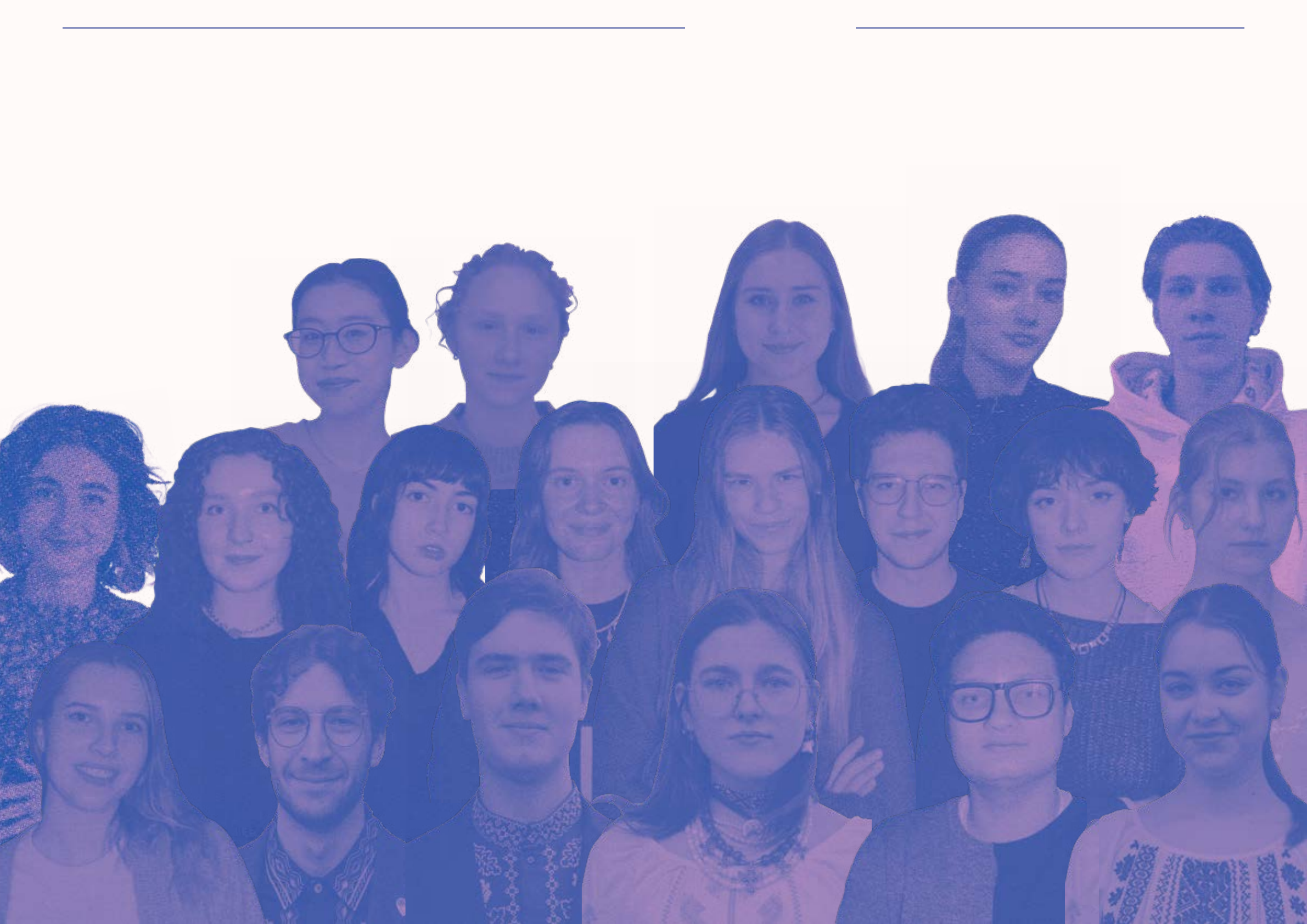
OUR TEAM
ADMINISTRATIVE
EDITORIAL
DESIGN
1. Ulrich Poehlmann
2. Dariia Hryshchenko
3. Benya Pyatski
Editor-in-Chief
Artistic Director
Operations Director
7. Rowan Soeiro
8. Matilda Molodynski Stokes
9. Aneliya Stanislavova
10. Iona Henderson
15. Jaylyn Wong
16. Maryna Santalova
11. Anastasiia Turkot
12.Dmytro Strilets
13. Al Wood
14. Ginevra March
17. Jane Bielasheva
18. Viktoriia Pavlenko
19. Yurii Voloshchenko
Editorial Assistant
Copy Editor
Copy Editor
Copy Editor
Copy Editor
Editorial Assistant
Graphic Designer
Graphic Designer
Graphic Designer
Graphic Designer
Graphic Designer
Graphic Designer
Web Designer
4. Daniil Malitskyy
5. Aleksandra Butkovska
6. Anna Kondratenko
Production Manager
Circulation Manager
Recruitment Manager
1 2 4
35
6
7
8
9
10
11
12
13
14
1817
1615
19
102 103DЇASPORA JOURNAL

IMAGE CREDITS
Cover
2-3
4
4-5
14
15
16
18-19
20-21
22-23
26
Anastasiia Turkot
gailhampshire on Flickr, CC BY 2.0, https:
//creativecommons.org/licenses/by/2.0/
deed.en
Benya Pyatski
Ozzy Delaney on Flickr, CC BY 2.0, https://
creativecommons.org/licenses/by/2.0/deed.
en
adohnes on Flickr, CC BY 2.0, https://cre-
ativecommons.org/licenses/by/2.0/deed.en
Glen Dahlman on Flickr, CC BY-SA 2.0
https://creativecommons.org/licenses/by-
sa/2.0/deed.en
Edgar Degas, Wikipedia Commons, CC BY-
SA 4.0, https://creativecommons.org/licens-
es/by-sa/4.0/deed.en
Mark Peters on Flickr, CC BY 2.0 https://cre-
ativecommons.org/licenses/by/2.0/deed.en
Ilya Kuzniatsou on Flickr, CC BY 2.0 https://
creativecommons.org/licenses/by/2.0/deed.
en
Lisa Garcia on Flickr, CC BY 2.0 https://cre-
ativecommons.org/licenses/by/2.0/deed.en
Glen Dahlman on Flickr, CC BY-SA 2.0
https://creativecommons.org/licenses/by-
sa/2.0/deed.en
Oleksandr Kravchuk on Flickr, CC BY 2.0
https://creativecommons.org/licenses/
by/2.0/deed.en
Adam Jones on Flickr, CC BY 2.0, https://cre-
ativecommons.org/licenses/by/2.0/deed.en
t_y_l on Flickr, CC BY-SA 2.0, https://cre-
ativecommons.org/licenses/by-sa/2.0/deed.
en
All images are used in collages and/or processed by Dїaspora graphic design team
26
30-31
32
33
40-41
42-43
44-45
46-47
48
jans canon, CC BY 2.0, https://creativecom-
mons.org/licenses/by/2.0/deed.en
OSCE Parliamentary Assembly on Flickr,
CC BY-SA 4.0, https://creativecommons.org/
licenses/by-sa/4.0/deed.en
Alexbarbershop on Wikipedia Commons,
CC BY-SA 4.0, https://creativecommons.org/
licenses/by-sa/4.0/deed.en
Ввласенко on Wikipedia Commons, CC BY-
SA 3.0, https://creativecommons.org/licens-
es/by-sa/3.0/deed.en
Leibniz-Institut für Ost- und Südosteuropa-
forschung (Regensburg) on Wikipedia Com-
mons, CC BY-SA 4.0, https://creativecom-
mons.org/licenses/by-sa/4.0/deed.en
Andreeva Aliona01 on Wikipedia Com-
mons, CC BY-SA 4.0, https://creativecom-
mons.org/licenses/by-sa/4.0/deed.en
Руслан Шухров on Wikipedia Commons,
CC BY-SA 4.0, https://creativecommons.org/
licenses/by-sa/4.0/deed.en
Andriy155 on Wikipedia Commons, CC BY
3.0, https://creativecommons.org/licenses/
by/3.0/deed.en
Hodja on Flickr, CC BY-NC 2.0, https://cre-
ativecommons.org/licenses/by-nc/2.0/
Jorge Láscar on Flickr, CC BY 2.0 https://cre-
ativecommons.org/licenses/by/2.0/deed.en
Грибюк Руслан Володимирович on Wiki-
pedia Commons, CC BY-SA 4.0, https://cre-
ativecommons.org/licenses/by-sa/4.0/deed.
en
Mstyslav Chernov/Unframe on Wikipedia
Commons, CC BY-SA 3.0, https://creative-
commons.org/licenses/by-sa/3.0/deed.en
50
51
55
56-57
60
74-75
76
82-83
olavXO on Flickr, CC BY 2.0 https://creative-
commons.org/licenses/by/2.0/deed.en
Rasal Hague on Wikipedia Commons, CC
BY-SA 3.0, https://creativecommons.org/li-
censes/by-sa/3.0/deed.en
Mstyslav Chernov/Unframe/http://www.un-
frame.com/ on Wikipedia Commons, CC
BY-SA 3.0, https://creativecommons.org/li-
censes/by-sa/3.0/deed.en
100 OMBr ZSU on Wikipedia Commons,
CC BY 4.0, https://creativecommons.org/li-
censes/by/4.0/deed.en
ВО «Свобода» on Wikipedia Commons, CC
BY 3.0, https://creativecommons.org/licens-
es/by/3.0/deed.en
Sasha Gulich on on Wikipedia Commons,
CC BY-SA 4.0, https://creativecommons.org/
licenses/by-sa/4.0/deed.en
Дніпровська районна в місті Києві дер-
жавна адміністрація, CC BY 4.0 https://cre-
ativecommons.org/licenses/by/4.0/
Fir0002 on Wikipedia Commons, CC BY-NC
3.0, https://creativecommons.org/licenses/
by-nc/3.0/
Fir0002 on Wikipedia Commons, CC BY-NC
3.0, https://creativecommons.org/licenses/
by-nc/3.0/
86
87
89
90
90-91
105
106
Jean Thibaut (French): Battle of Beresteczko
1651, relief at Abbaye de Saint-Germain-des-
Prés in Paris on Wikipedia Commons, CC
BY 3.0, https://creativecommons.org/licens-
es/by/3.0/deed.en
www.memory.gov.ua on Wikipedia Com-
mons, CC BY-SA 4.0, https://creativecom-
mons.org/licenses/by-sa/4.0/deed.en
Alina Vozna on Wikipedia Commons, CC
BY-SA 4.0, https://creativecommons.org/li-
censes/by-sa/4.0/deed.en
president.gov.ua on Wikipedia Commons,
CC BY 4.0, https://creativecommons.org/li-
censes/by/4.0/deed.en
Ministry of Defense of Ukraine on Wikipe-
dia Commons, CC BY 4.0, https://creative-
commons.org/licenses/by/4.0/deed.en
Benya Pyatski
Dave Proer on Flickr, CC BY 2.0, https://
creativecommons.org/licenses/by/2.0/deed.
en
104 105DЇASPORA JOURNAL

There are over fty Ukrainian student societies
across the UK, but the University of Edinburgh’s
Ukrainian Society stands out. What began with a
small group of friends organising a few fundraisers
has grown into a diverse community of over two
hundred people who are dedicated to the spread of
Ukrainian culture abroad.
Everything written in this and all subsequent issues
of Dїaspora is the product of many generations of
Ukrainians. Through repression, occupation, and
enslavement, our culture has persisted and it is now
ready to bloom again.
Our mission is to preserve and carry on the
knowledge of ourselves and our country as we know
it. My grandfather Petro passed away during the
creation of this issue. His teachings made me the
man that I am today, and he and all those who came
before us deserve the credit for our achievements.
Heritage is our backbone; unity and will are our
strengths.
LETTER FROM
THE EDINBURGH
UNIVERSITY
UKRAINIAN
SOCIETY
TARAS HARASYM
PRESIDENT
SPONSORS
To submit to future issues, lear about future
Daspora evets, or just keep up with us, view
our website or follow us o Instagra!
@diiaspora.journalwww.ediua.org
PARTNERS
THE POEHLMANN
FOUNDATION
AUGB
EDINBURGH
UKRAINIAN
STUDENT UNION
Dïaspora would not exist without the generous support of our sponsors and partners. Their backing has
allowed us to develop and print this journal, and in so doing bring the joy and high scholarship of Ukrainian
Studies home to readers across the UK and the world. For this, we oer our heartfelt thanks to Joanna
Szostek, Maksym Safronov, Svitlana Selman, the Poehlmann Foundation, AUGB Edinburgh, the Ukrainian
Student Union, the Ukrainian Politics Network, the Scottish Parliament (Cross Party Group on Ukraine),
Edinburgh Diamond, and the University of Edinburgh.
106 107DЇASPORA JOURNAL
