ISSUE 1

22
A LETTER FROM
THE EDITOR
When Ukraine is discussed on the news or even in standard conversation,
it’s often as a ‘country at war’; somewhere abstract and distant, reduced to
anonymous statistics. As a Ukrainian raised in the U.S., I have repeatedly
witnessed the ignorance regarding Ukraine and Ukrainians within the
Western world. Even after russia’s full-scale invasion and Ukraine’s
increased mention in the media, I continue to be asked whether the
national language of Ukraine is russian, I frown as ‘borscht’ is labelled
as a russian dish, and I observe how the Ukrainian literature and culture
that shaped my upbringing remains unheard of in English-speaking
classrooms.
At its heart, ‘Dїaspora’ seeks to showcase this vibrant culture and present
it as accessible and compelling to English-speaking audiences. The pieces
in this collection are raw, honest, and deeply human—they dismantle
‘Ukraine’ as a distant entity and illuminate the lived and nuanced
experiences of Ukrainian diasporas globally.
Both an act of resistance and a narrative of resilience, ‘Dїaspora’ strays
away from the headlines which portray a war-torn and one-dimensional
Ukraine. Rather, it aims to showcase Ukraine from closer to the ground; to
humanize Ukrainians, dismantle stereotypes, and reframe understandings
of Ukrainian life directly through a Ukrainian lens, rather than through
the colonial narratives which consume political discussion.
Donate to support
our future issues!
Editor-in-Chief
ELIZABETH MALONE
Editorial Tea
Elizabeth Maloe
Editor-in-Chief
Beya Pyatski
Project Manager
Ulrich Poehlman
Soerled Hederso
Alisa Bystrytska
Kira Satalova
Maryna Satalova
Anna Kozachuk
Anna Ko
Ruby Gad Seidita
Mae Lai
Editor
Desig Team
Kai Smolin
Head of Design
Anastasiia Turkot
Graphic Designer
Mae Lai
Graphic Designer
Dariia Hryschenko
Graphic Designer
3
5
9
11
13
15
17
23
25
31
51
29
4
45
3
63
5
57
3
37
FEELS LIKE
Kira Santalova
‘WHERE DO THE CHILDREN PLAY?’
Valeria Gerus
THE SECOND FRONT: UKRANIAN
JOURNALISM IN A TIME OF WAR
Anastasiia Hryschenko
HOW TO STAY ALIVE AFTER
WORKING IN THE CHORNOBYL
POWER PLANT
Anna Kozachuk
TOADS, NATIONALISTS,
MANKURTS, AND THE QUESTION
OF CAN I LOVE UKRAINE?
Oleksandr Kobzar
U
SIL
Maryna Santalova
M
THE SCARS ARE SHOWING THE
HISTORY
aryna Santalova
LY DREAM
NT
Anna Ko
ITLED
UKRAINE’S MOST UKRAINIAN
ARCHITECTURE
Dan Malitskyy
AN ODE TO AN AUTUMN AMONG
THE BIRCHES
Benya Pyatski
WHITE HOUSE
Anna Ko
FATHERLAND
Pavlo Dyachenko
WHAT IS LIKE, YOUR
S
Andrii Kuzma
OFT POWER: AN OPPORTUNITY
TO ENGAGE FROM ABROAD
UKRANIAN LIFE
Kira Santalova
Matild
EXECUTED RENAISSANCE: THE
GENERATION OF TALENTS KILLED
BY THE SOVIET REGIME
a Molodynski Stokes
A
H
Artem Pishel
anna H
RESILIENCE IN RIFFS: TELEMA
AND THE RISE OF UKRAINE’S
WARTIME METAL SCENE
umenchuk
l
THE WAR DOESN’T RIDE THE
RAILS
isa Bystrytska
Fall 2025
CONTEST
IMAGE CREDITS
ED REMEMBRANCE:
CHALLENGES IN ACKNOWLEDGING
THE HOLODOMOR
39
3 4DIAS’PORA MAGAZINE
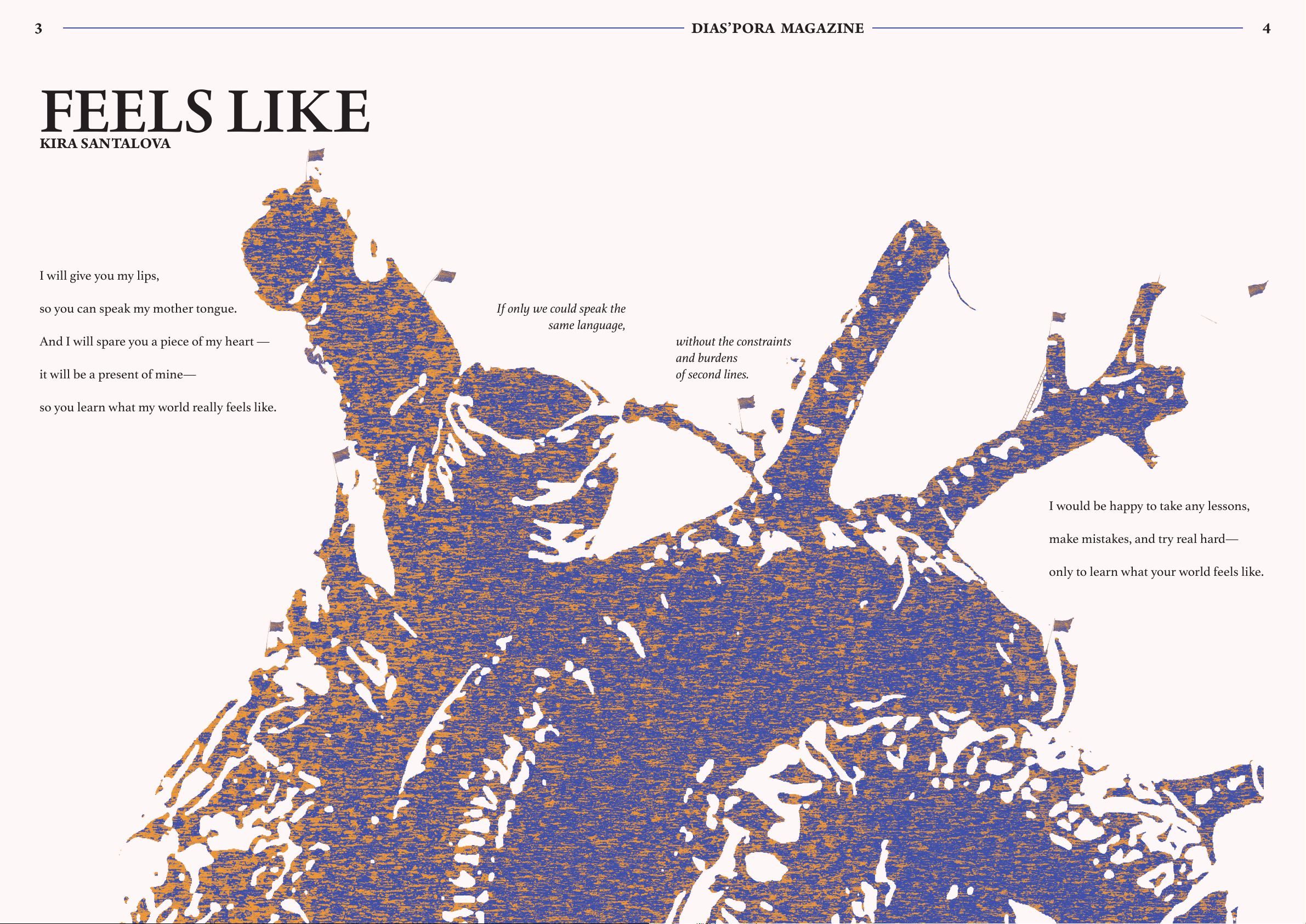
FEELS LIKE
KIRA SANTALOVA
I will give you my lips,
so you can speak my mother tongue.
And I will spare you a piece of my heart —
it will be a present of mine—
so you learn what my world really feels like.
If only we could speak the
same language,
I would be happy to take any lessons,
make mistakes, and try real hard—
only to learn what your world feels like.
without the constraints
and burdens
of second lines.
UKRAINE’S
MOST UKRAINIAN
ARCHITECTURE
Soviet modernism. Imperial classicism. French
Renaissance facades. These styles (borrowed,
imposed, adapted) form the urban face of Ukraine.
But is there anything beneath them? Something
unique; something unmistakably our own?
Ukrainian Architectural Modern (Ukrainian Art
Nouveau or UAM) is that something. A style that
prevailed briey and brilliantly in the early 20th
century. It is rooted in folk traditions and shaped
by national aspiration and identity. Unfortunately,
it is little known even within Ukraine. But it should
be. These buildings do not merely stand – they tell
a story. And what they say is both beautiful and
indispensable.
Across Europe, the early 1900s were a time of stylistic
rebellion. Art Nouveau, Secession, Jugendstil...each
region invented its own modern identity, rejecting
classical uniformity. In Ukraine, this artistic wave
collided with a deeper current: the search for
cultural sovereignty.
But what could a modern Ukrainian city look like?
Not one made in the image of Paris or Vienna, but
in the image of Ukraine itself. Not imitation, but
reinterpretation. Not nostalgia, but transformation.
Ukrainian Architectural Modern drew from the
vernacular: countryside homes (haty) with thick
white walls and thatched roofs, wooden churches
with tiered silhouettes, and national art. These
elements were not pasted on, they were woven into
the logic of design. This was architecture grown
from folklore.
Unlike the palaces of empires, these buildings were
lled with light and humility. Take, for instance, the
rural schools designed by Opanas Slastion, where
rooftop towers symbolised that ‘a school is a temple
of knowledge,’ and brick ornamentation resembled
woven embroidery (vyshyvanka). A national style,
carved from memory and thorough research.
Poltava, more than any other city, became the soul of
this movement. Vasyl Krychevsky’s masterpiece, the
Regional Studies Museum (formerly the Zemstvo
Building), is often seen as the birth of the style.
But the movement stretched far beyond: to Kyiv, to
Kharkiv, to Chernihiv, even as far as Kuban.
Across all these regions, a kind of architectural
dialect began to form – a visual grammar of
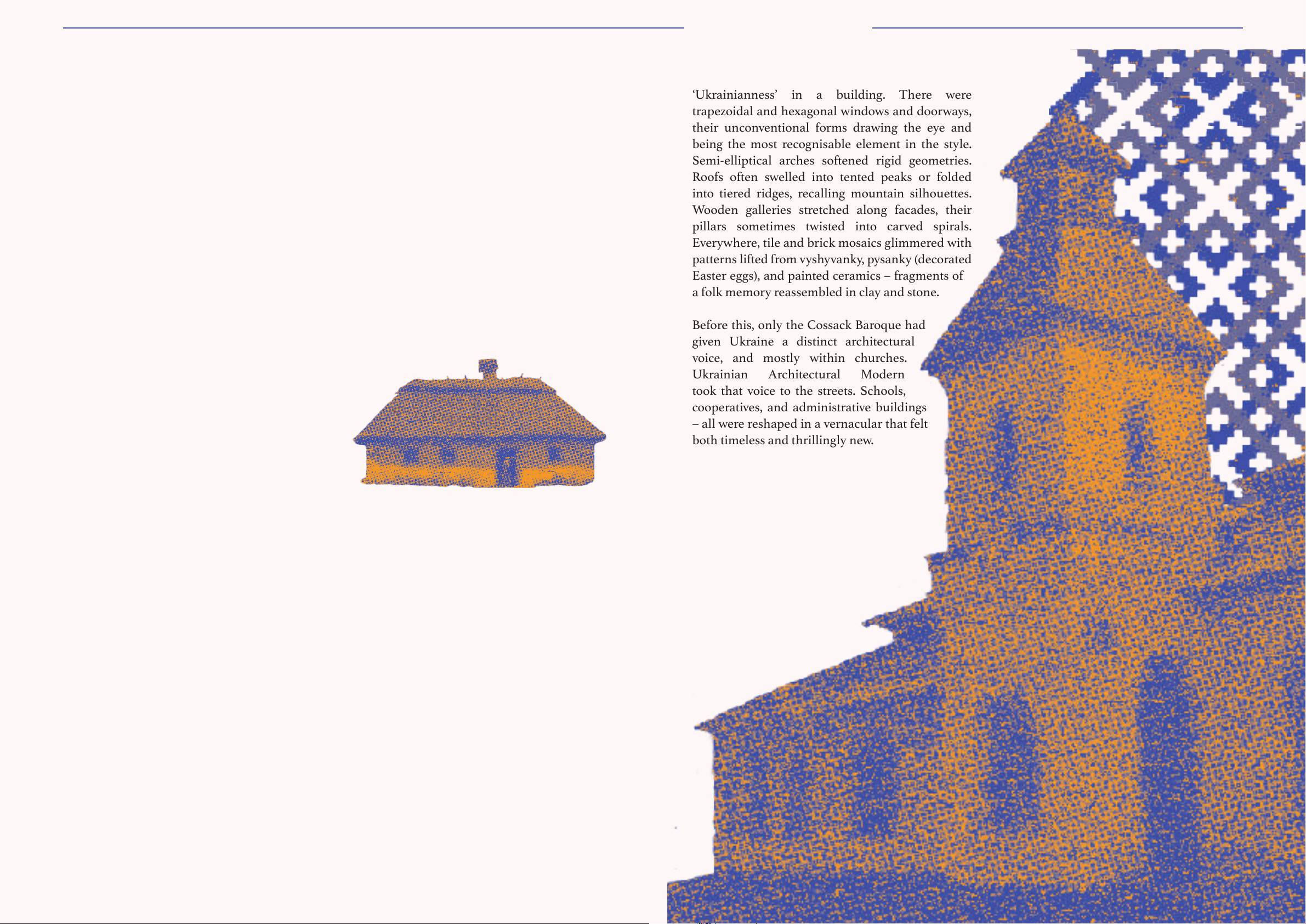
‘Ukrainianness’ in a building. There were
trapezoidal and hexagonal windows and doorways,
their unconventional forms drawing the eye and
being the most recognisable element in the style.
Semi-elliptical arches softened rigid geometries.
Roofs often swelled into tented peaks or folded
into tiered ridges, recalling mountain silhouettes.
Wooden galleries stretched along facades, their
pillars sometimes twisted into carved spirals.
Everywhere, tile and brick mosaics glimmered with
patterns lifted from vyshyvanky, pysanky (decorated
Easter eggs), and painted ceramics – fragments of
a folk memory reassembled in clay and stone.
Before this, only the Cossack Baroque had
given Ukraine a distinct architectural
voice, and mostly within churches.
Ukrainian Architectural Modern
took that voice to the streets. Schools,
cooperatives, and administrative buildings
– all were reshaped in a vernacular that felt
both timeless and thrillingly new.
DAN MALITSKYY
What do we see when we look at Ukrainian
cities?
5 6DIAS’PORA MAGAZINE
But we can, and must, learn from it. Preserve what
we have. Celebrate what survives. Not just physically,
but intellectually and emotionally. Because it is
not only the most Ukrainian architectural style
ever created, it is one of the most vivid expressions
of Art Nouveau anywhere in the world. And it is
vanishing. Too many buildings have fallen into
decay – their tiles cracked, their paint peeling, roofs
collapsing, and their meaning forgotten. Few people
(even among Ukrainians) know these names: Vasyl
Krychevsky, Opanas Slastion, Johann Levynsky.
Fewer still recognise the buildings that stand quietly
on our streets as historical artefacts.
UAM emerged at a time of radical social
transformation. It lived through (and barely
survived) the collapse of the russian empire, World
War I, Ukraine’s brief independence, and the rise
of Bolshevism. In those short years, dozens of
masterpieces were built. And then, suddenly, they
were not. The style was too national; too proud; too
rooted. Under the Soviets, it was branded ‘formalism’
or even ‘exoticism.’ The Zemstvo building was
called ‘pseudo-Moorish’ by oicials unfamiliar
with Ukrainian traditions. By the 1930s, Ukrainian
Architectural Modern was eectively dead, buried
under the concrete slabs of socialist realism and the
silence of censorship.
What made UAM remarkable was not just its form,
but its devotion to synthesis. Architecture became a
vessel for the applied arts.
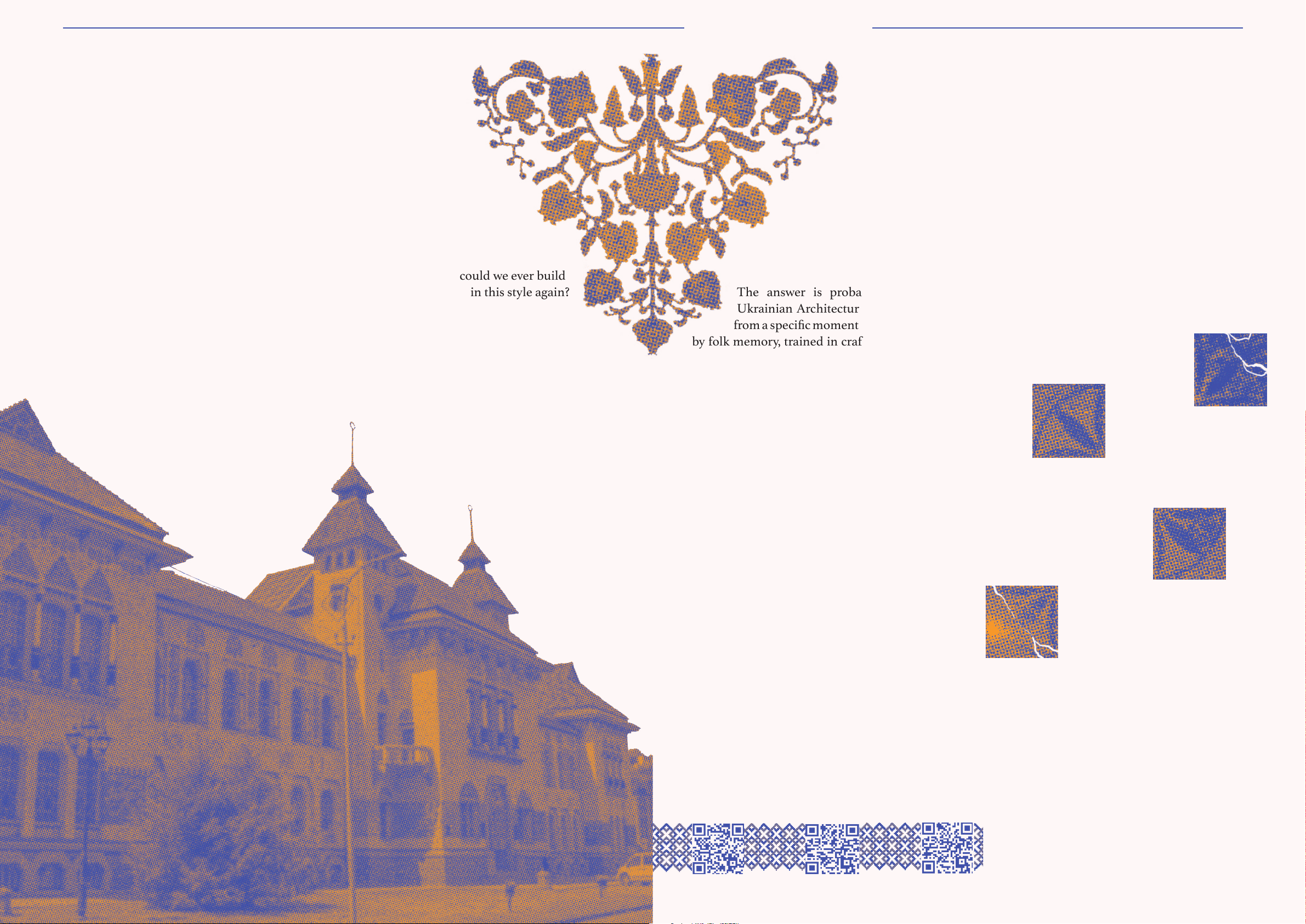
For those who wonder: could we ever build
‘Український архітектурний модерн. Коротка
історія втраченої естетики.’
[‘Ukrainian Architectual Modernism. A Brief History of a
Lost Aesthetic’].
Texty.org.ua, 5 June 2013, texty.org.ua
articles/46453/Ukrajinskyj_arkhitekturnyj_modern_
Korotka_istorija_vtrachenoji_ jestetyky-46453/
Works Cited:
If you have never heard of UAM before, you’re not
alone. But now you have. If you want to go further,
here are a few starting points:
Ukrainian Architectural Modern is not just a
historical curiosity. It is a testimony. It is the voice of
great individuals who dared to speak and craft for
Ukraine and Ukrainians.
It is also fragile. Fewer than a hundred signicant
buildings survive in relatively good condition. Some
have been restored. Many are crumbling. And yet,
each is a museum in itself – not only of objects and
craftsmanship, but of ideas.
Look closer, ask questions, and remember. Because
sometimes, the most powerful act of cultural
memory is simply to notice.
The answer is probably no. Not really.
Ukrainian Architectural Modern was born
from a specic moment – from artists shaped
by folk memory, trained in craft schools, struggling
under the empire, and dreaming of a free culture.
Any ‘neo-UAM’ we might construct today would be
a well-meant imitation ‘inspired by,’ but not of the
original spirit.
in this style again?
7 8DIAS’PORA MAGAZINE
WHERE DO THE
CHILDREN PLAY?
VALERIA GERUS
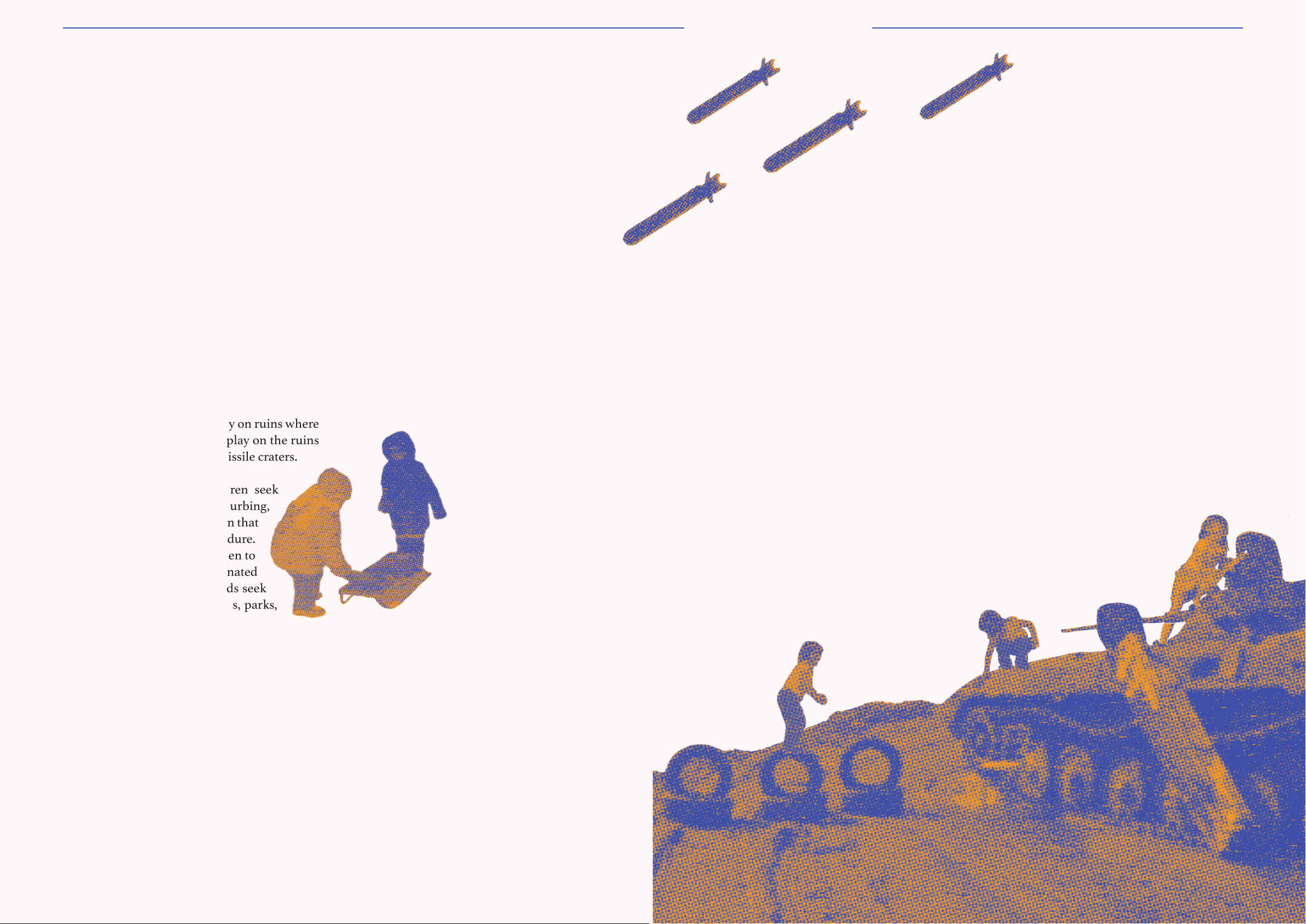
hildren play on playgrounds, in parks, and
in gardens. Children play at home, in their
backyards, and in playrooms. Children play in
schools with their classmates and teachers, at home
with their parents and siblings, and in kindergarten
with their peers and nannies. Children play on
abandoned buildings. Children play on ruins where
their schools used to be. Children play on the ruins
of their houses. Children play in missile craters.
The last four places where children seek
amusement are hauntingly disturbing,
marked by the echoes of destruction that
no child should ever have to endure.
Parents do not wish for their children to
play in locations other than designated
safe areas. Yet, nowadays, when kids seek
entertainment, there are no gardens, parks,
or playgrounds available – they are ruined.
Ukraine is at war. My country is at war. Many other
countries all around the world are at war. Children
all around the globe play on craters, ruins, and
abandoned buildings, seeking entertainment to
forget about the horrors around them, just for a
brief moment. I look at all of the photos and videos
of destruction in the news, I read Ukrainian media
outlets that report on current events around the
world, and I see how people suer. I see the economy
being ruined, lives being destroyed, and buildings
becoming rubble.
During the rst month of the war, my
family and I moved to the central part of Ukraine,
in fear that the capital, where we lived, would be
the main target. We feared that the bridges would
be bombed and that we wouldn’t be able to escape
to the right bank of Kyiv. On our way, we heard
military jets ying by and missiles being red. I had
a feeling that they were chasing us. But even when
we arrived, jets would y above the house we stayed
in almost every night. My parents told me they
were Ukrainian planes patrolling, but I still wonder
whether it was indeed patrols, or if they told me that
to calm me down.
My classmates who stayed in Kyiv tell
me about air raid alerts, school being interrupted
because of them, and learning time being wasted
while they are hiding in a bomb shelter or
underground parking. Their siblings are afraid
of the sounds every night. If this is happening in
the capital, presumably the most defended part of
Ukraine, I can’t imagine the terror people endure in
the Eastern part of my country.
There are a lot of international organisations that
help children live through this war, such as UNICEF
and Save the Children, as well as Ukrainian
funds like the Rinat Akhmetov Foundation.
These organisations often collaborate with local
communities, governments, and other NGOs to
provide comprehensive support. They work to
create safe spaces for children, oer counselling and
mental health services, distribute essential supplies
like food, clean water, and medical care, and focus
on educational initiatives to help rebuild shattered
lives and futures. Their eorts not only address
immediate needs but also aim to build resilience
among children and communities, helping them
recover from the psychological scars of conict.
They help children nd hope in the demoralised
world we live in.
Children get torn away from their parents, parents
torn away from their children. Whether through
bombings shattering homes, or the heart-wrenching
act of children being snatched away, and taken far
from their loved ones by russian occupants – the
pain is unbearable. Imagine the terror in a child’s
eyes as they’re forcibly separated and the despair
of parents watching helplessly as their children
are torn away. It’s a gut-wrenching assault on love
and safety, leaving wounds that may never heal.
Innocence is shattered and replaced by fear and
unllable voids.
I don’t want my future kids and grandkids to
experience this ‘amusement’ of playing on ruins. I
don’t want them to suer from trauma after hearing
bombs falling from the sky, or drones and jets ying
right above their heads. I don’t want them to need
these foundations. I want them to have a better
childhood. I want them to feel safe and happy.
I want children to play on a playground.
C
910DIAS’PORA MAGAZINE
AN ODE TO AN
AUTUMN A MONG
THE BIRCHES BENYA PYATSKI
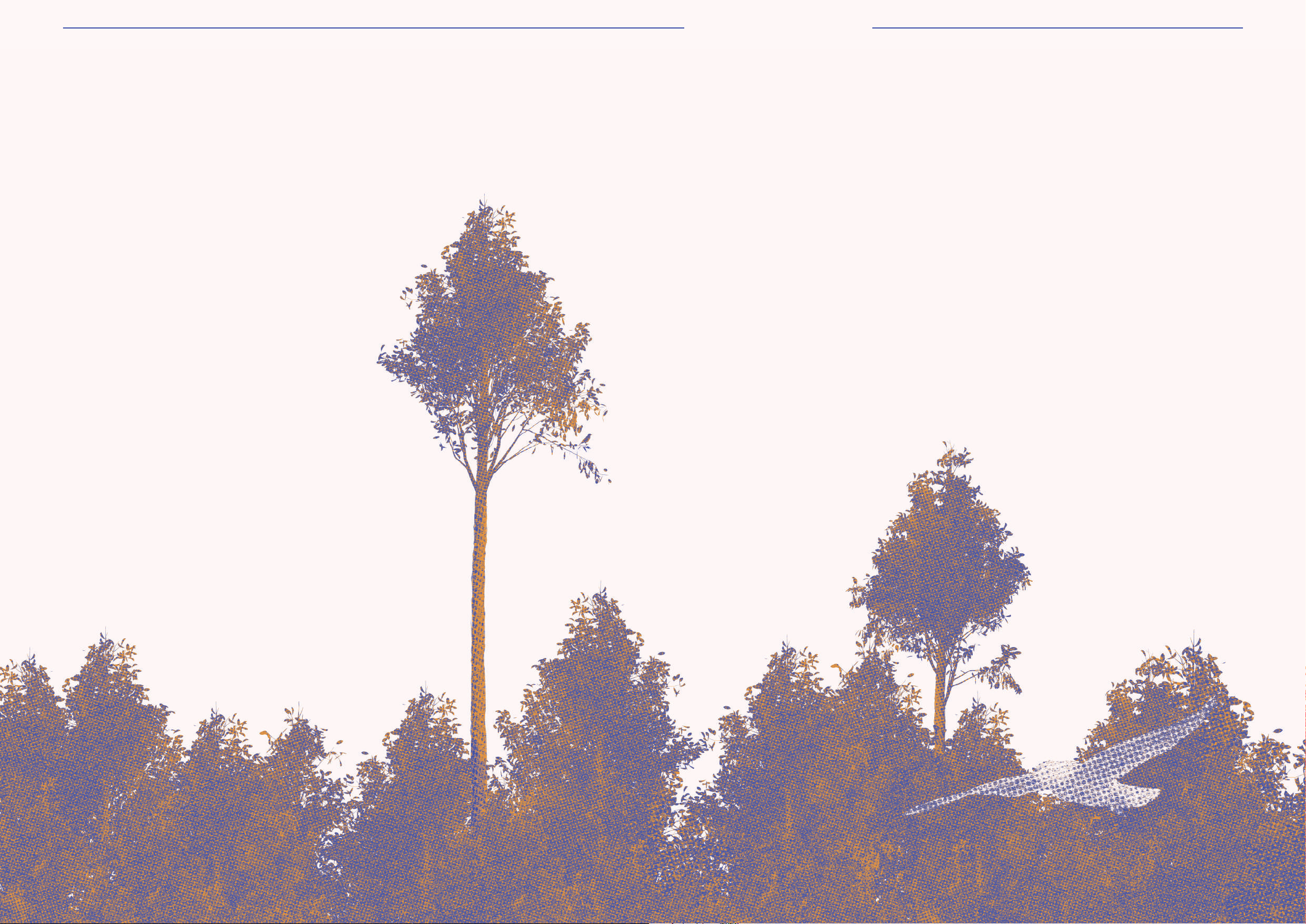
It’s autumn among the birches, or so I’m told–
I haven’t yet seen the leaves turn and fall.
It’s cold, but I missed the waves of
pink,
brown,
yellow,
red,
that should’ve come crashing down all over me.
If the leaves haven’t yet turned, then there’s still time–
time to prepare for my long, dark slumber
in the bowels of the caves of my daydreams.
Time to sing,
to dance,
to cry,
before the eternal dark of night.
Autumn among the birches reminds me that time is all eeting after
the long, warm bliss of summer.
Autumn among the birches gives me a new lease on life:
With every layer I put on–
With every breath of cold air–
A gi I could never repay.
It was in dreams that I danced in my garden–for my awe may cloud me.
But beauty may bloom bitter dandelions–for she opened herself to me, yet her name I did not know,
as death’s breath chanted nevermore–for the elds are under the watch of storms.
From kisses delirious,
to faces frantic-
elaborate are dreams;
wandering thoughts.
Pounding sleep,
lovely language.
Sometimes, in rest,
I prick myself–
I can’t control me.
And it’s funny–I imagine she can’t too.
11 12DIAS’PORA MAGAZINE
SECOND FRONT
Ukrainia Journalis i a Tie of War
ANASTASIIA HRYSHCHENKO
On February 24, 2022, Ukraine entered a new
reality: full-scale war. Russia’s attack on
Ukraine fundamentally changed Ukrainian society,
aecting every individual and bringing lasting socio-
political and economic consequences. Journalism,
in particular, has changed dramatically during
wartime, as it plays a crucial role in covering events
that inuence how Ukraine and Ukrainians are
perceived both domestically and globally. Journalists
have had to adapt to these new conditions and form
a ‘second front’ — an informational one, behind the
lines of armed confrontation.
Journalists now have an even greater
social obligation than at any time in the
recent past, and changes in the standards
of reportage have become evident.
Reporting from the front lines has always
come with a tremendous responsibility,
but acquiring new and unique skills
is now essential for every journalist
working in the midst of war.
They must learn to distinguish what can and cannot
be reported and how to communicate with soldiers
respectfully. This process of understanding is key
to journalism in modern Ukraine. New laws also
reect journalists’ increased social responsibility.
Journalism has always been vital in shaping public
opinion, but today this role has become even more
critical. Media workers are under special scrutiny
because they shape how the majority of people see
the world. During the publication process, editors
must fully understand the implications that their
content will have for society and national security.
In this new reality, the rhetoric used by Ukrainian
journalists has also changed. The formal and
oicial tone used in the past has become more
conversational, with slang and neologisms now
commonplace. Despite deviating from traditional
journalistic standards, this new language appeals
to audiences by building trust and making the
information more accessible. Great responsibility
remains with the journalist, however, whose choices
dene the structure of a narrative presented to a wide
audience. Furthermore, nding eyewitness accounts
and consulting experts is of paramount importance,
considering that people are often biased.
One of the most pressing challenges Ukrainian
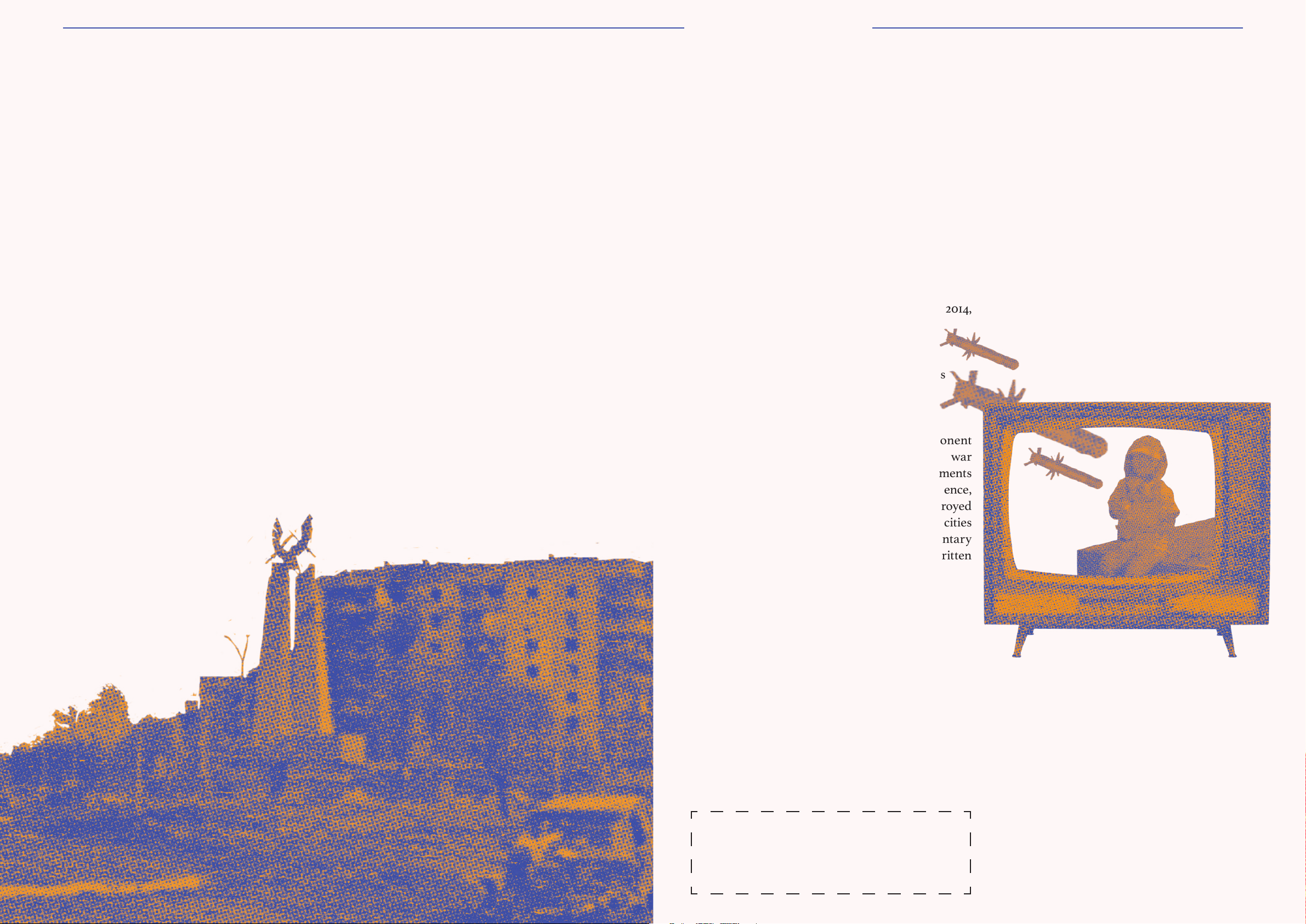
journalists face is the information war. Since 2014,
the media space has become a massive
battleground. While traditional propaganda
seeks to capture public consciousness,
Ukraine’s modern information campaign aims
not only to inuence the domestic audience
but to win the support of international
partners. The core goal of this eort is to
undermine the political strength of the opponent
and weaken its regime. In this way, the war
correspondent becomes an agent who documents
crimes, provides photo and video evidence,
sometimes exposing horrifying scenes — destroyed
buildings, mutilated bodies, and other atrocities
of war. War journalists become documentary
witnesses to ensure that history cannot be rewritten
by those for whom the truth is inconvenient.
Ukraine is enduring the most diicult period in its
modern history. In recent years, Ukrainians have
fought ercely for freedom against russia. How
journalists record and represent reality is of great
importance, as their reports can inuence, educate,
and inform the world about what is happening in
Ukraine. It is due to Ukrainian journalists that the
world knows the truth about what is happening in
Ukraine and the horrendous crimes committed by
russia. It is essential to acknowledge the work of
these correspondents who have become the world’s
eyes into the brutality of war.
As of September 15th, 2023, the The National Commission
for State Language Standards of Ukraine has allowed
for all letters in “Russia,” “Russian Federation,” “Russian
Empire,” “Moscow,” and other related words to be
written in lowercase. Diiaspora has chosen to follow this
convention throughout.
13 14DIAS’PORA MAGAZINE
WHITE HOUSE
ANNA KO
You know, you’re not grateful enough.
Mr. President, you’ve got to be tough!
You make it hard to do business,
Why don’t you want your country in pieces?
Mr. President, we’re playing cards,
It’s not my problem you’ve not got enough guards.
I do see the war, from my bed.
I just count the numbers of the dead.
I am the hero, I will enforce peace,
You’ll pay me back with a minerals lease.
Mr. President, you should thank me again.
You just surrender – that’s my perfect plan.
15 16DIAS’PORA MAGAZINE
17 18DIAS’PORA MAGAZINE
HOW TO STAY
ALIVE Aer Working at the
Chorobyl Nuclear Power Plat
ANNA KOZACHUK
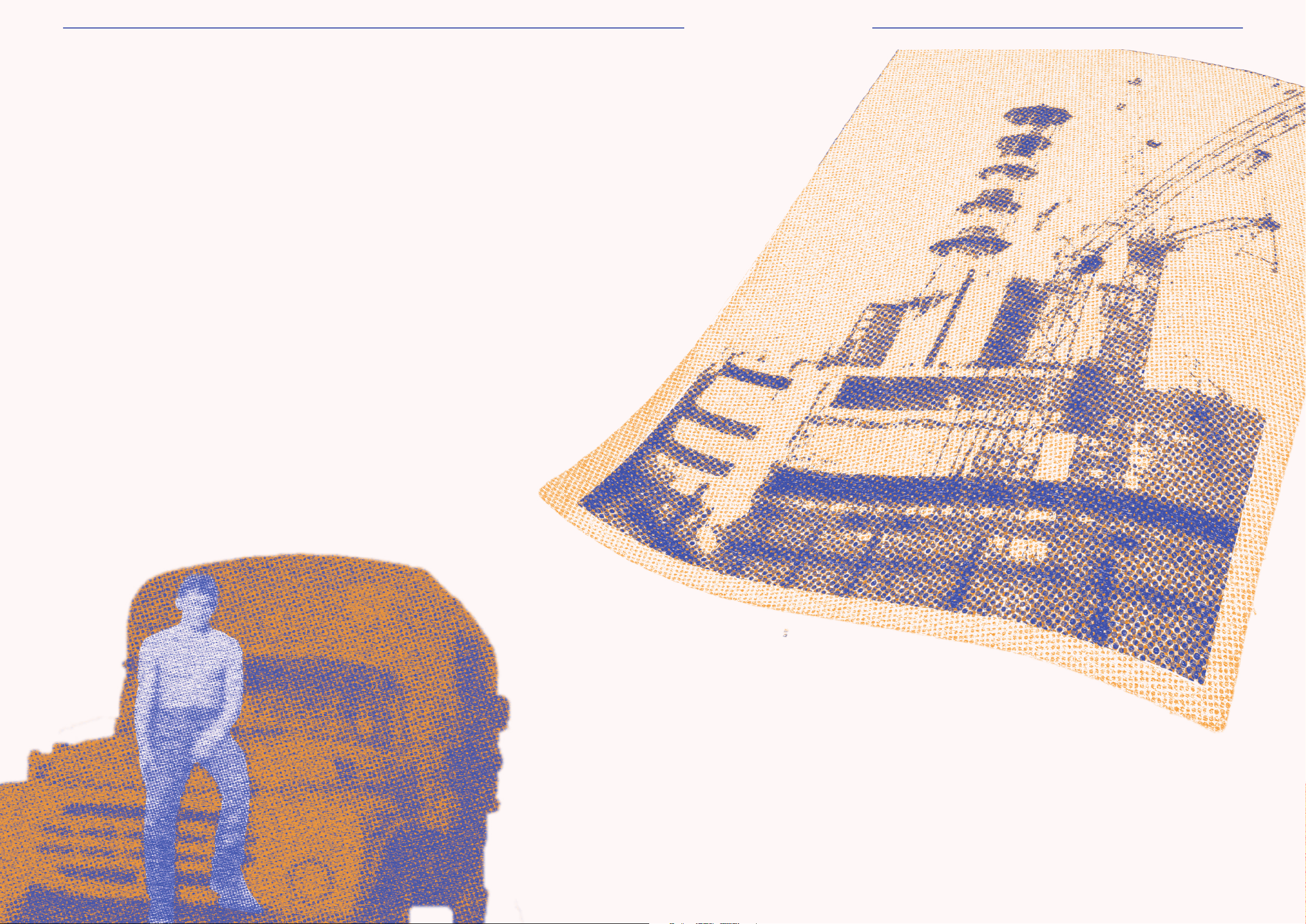
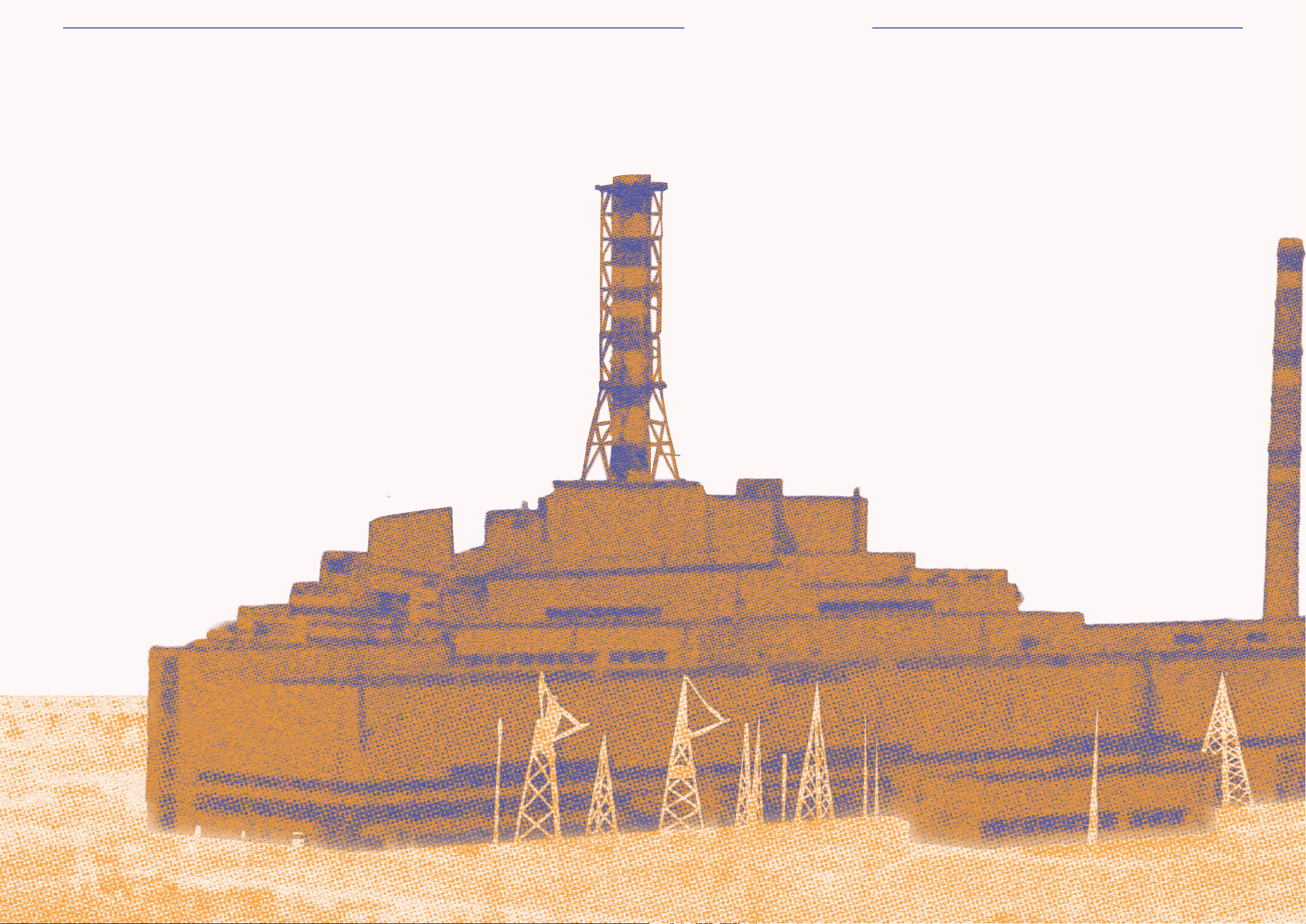
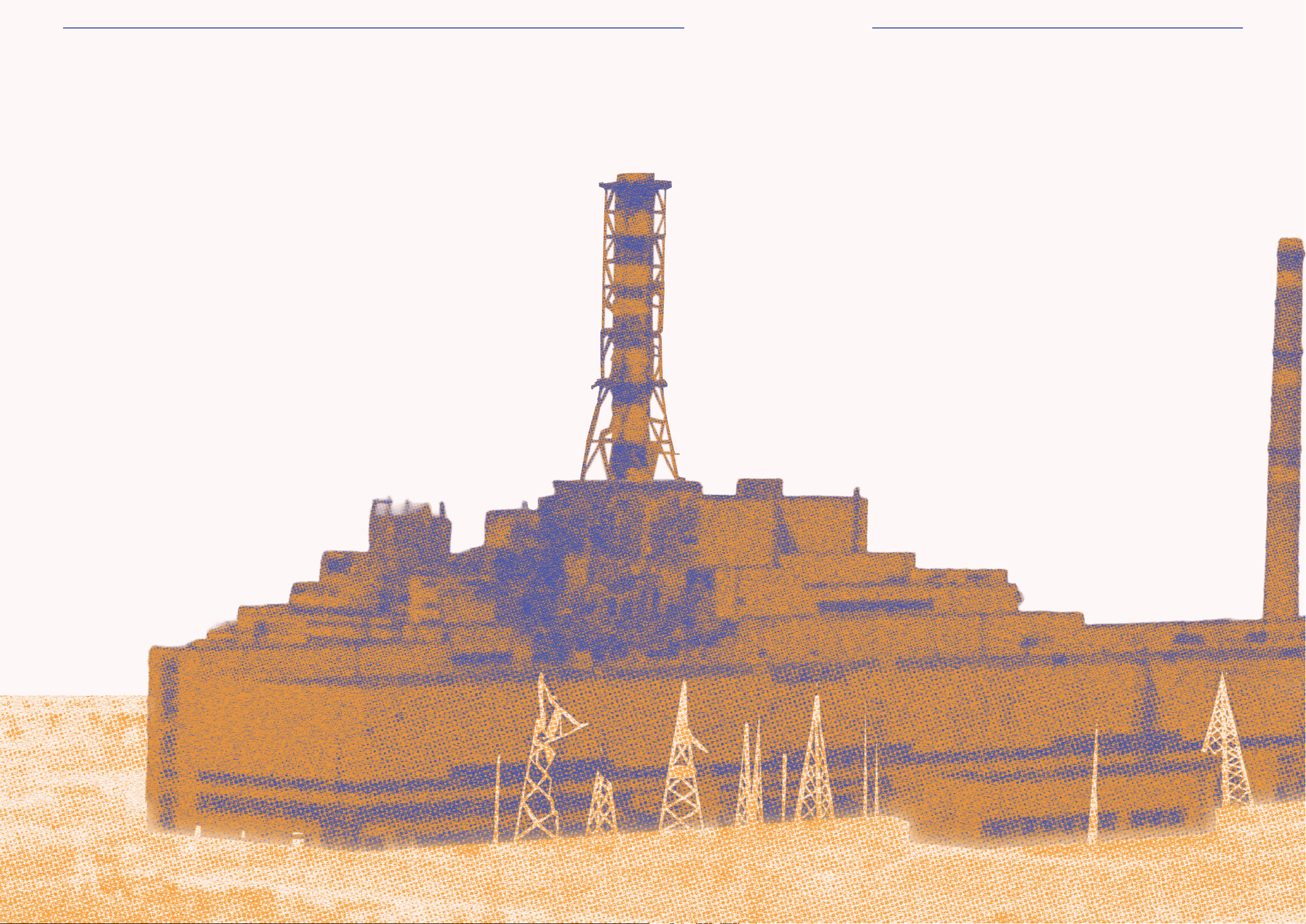
r. Tsvirkun became a ‘walking reactor’ at
the age of 22 as he was sent to work at the
Chornobyl nuclear power plant, where his radiation
dose went o the scale.
Now Yuriy Tsvirkun is a 60-year-old man who lives in
the small Ukrainian village Kyryivka, 312 kilometers
away from Chornobyl. He continues to live his life
happily despite the hard times spent at the nuclear
power plant.
In 2022, radiation almost caught him twice. Ukraine,
his homeland, has been suering at the hands of
russian soldiers, who attacked two nuclear power
Mplants on the 24th of February, one of which was
Chornobyl. Since the russian occupation continues,
the radiation continues to increase. If the russian
troops carry on targeting nuclear facilities, the
consequences may become terrifying for the whole
of Europe.
‘They are wacky. They don’t understand that if it
explodes, the wind could blow in their direction,’ he
said.
Since the infamous Chornobyl disaster on the 26th
of April 1986, when the fourth energy block blew
up, the cancer rate in Ukraine has increased eight-
fold.. Moreover, the amount of isotope radiation
released into the atmosphere after the explosion
in Chornobyl was forty times higher than after the
USA’s bombing of Hiroshima and Nagasaki in Japan
during World War II.
‘I got to know about the explosion of the Chornobyl
nuclear power plant only one or two months after it
happened,’ he said.
At that time Yuriy was a soldier in the Samara region,
russia, about 1800 kilometers away from Chornobyl.
So, the news about the disaster found him far from
home. Soldiers who returned back from Chornobyl
personally told Mr. Tsvirkun about what had
happened, because the Soviet Union made eorts to
conceal this information from the mass media.
19 20DIAS’PORA MAGAZINE
Ukrainian historian Ivan Kostenko, whose grandfather was also a Chornobyl liquidator—one of
the people who removed the remains of the explosion—shared his opinion on why the Soviet
government did not want anyone, especially abroad, to know about the tragedy on the power plant.
‘If the Soviet party says that the Soviet Union is a progressive country that builds its own
communism, there could not be any problems,’ Mr Kostenko said. So, the best way to ght the
problem was to conceal it.
In 1987, the year when Yuriy returned to Ukraine, he was drafted to work at the Chornobyl power
plant. ‘I would never think that I could take part in the liquidation of the accident as I was only 22,’
Yuriy said. ‘I thought they would take some old people.’
He knew where he was going to go, but his thoughts were the same as those of other young boys
at that age. For the rst 3 days he was staying in Korosten, 159 kilometers away from Chornobyl, to
help him acclimate to the radiation. He felt dizzy and had an unquenchable thirst. Then he moved
to Radcha, which is 60 km closer.
There were around 500 people in the state. Every morning at 4 a.m., the squad went to the nuclear
power plant. Their path was poured over with a special solution to catch the radiation dust. When
the liquidators had to work in dangerous conditions, they were given special military protective
suits with the respirators ‘Lepestok’ (a Petal).
‘There were tons of them. We had to change them very often but, to be honest, nobody even paid
attention to that,’ he recalled. Yuriy’s job was to take out the graphite from the concrete fragments as
they radiated. The radiation was so high that he only worked for 3 minutes at a time.
‘You can not even eat ice cream for that time, you know,’ he said. After work like that, all of them
had to take a cold shower for 10 minutes as hot water would expand their pores and accumulate
more radiation. Then, everyone was checked with the Geiger counter, which was an electronic
instrument for measuring ionizing radiation. During the working day, everybody had to have a
special accumulator of radiation which helped the supervisors record the workerʼs dose per day.
‘They denitely wrote down the lower dose. I think I have much more than what was written in
a document. Nobody would jot you down the truth. I had 8,036 Ber (unit of measurement of an
equivalent radiation dose) per 96 days oicially, but for real we could get 250 Ber per hour,’ Mr
Tsvirkyn said.
The norm for people who work with radiation is 0,5 Ber per 96 days. Yuriy’s dose was 16 times higher
than it should be, not even considering the fact that his reported dosage was still understated. Yuriy’s
other task was washing the 3D engine room with a powder that he also used to wash out the radiation
from his uniform. Later, he cleaned the roof of the 4th energy block when the robots that were there
broke down from the eects of the radiation.
21 22DIAS’PORA MAGAZINE
‘Those robots just died. We put them aside and worked instead. They could not work in those
conditions, but we, humans, worked,’ he said. Nevertheless, this dangerous job was well paid. Yuriy
Tsvirkun got a vefold increased salary. Unfortunately, he did not remember the exact number.
As for the food there, Mr Tsvirkun recalls it positively. There were lots of dierent delicacies like
salmon, cod liver, condensed and chocolate milk, chocolate, and fresh fruits. At that time, all the
mentioned food was a pure luxury that the average Ukrainian could not aord.
On weekends, Yuriy always had some kind of entertainment, like listening to the choir or watching
lm demonstrations, so that he didn’t feel as much tension, despite the unusual conditions. Yuriy
also mentioned that there was a doctor, who supported him, saying the needed phrase for that
moment: ‘Think less, live a life as you did it before.’
Now, Yuriy is a pensioner. He receives 250 Hryvnias (5 Є) a month for being a former Chornobyl
liquidator. ‘It won’t be so oensive to me if they don’t give it at all,’ he said.
It was diicult for Mr Tsvirkun to prove that he was a Chornobyl liquidator during his registration
at the pensioner oice, because at that time they were forbidden from telling anyone what they
did there and most of documents that conrmed their relation to the Chornobyl power plant were
demolished . ‘All the archives were destroyed,’ he said.
Yuriy remains positive. After he endured Chornobyl, he started to appreciate his life, friendship
and supportive family more than ever. ‘When everybody at school was asking me if my dad was a
liquidator, I replied “yes,” being so proud of my father,’ his daughter Juliana said. ‘Sometimes I can
see a pain in his eyes, but he tries to stay happy,’ she added.
His wife Tetyana described Mr Tsvirkun as a reliable friend who would always support her when she
needed help. Tetyana shared a story of their marriage at the time when everyone in her village was
spreading rumours about them.
‘They were saying that he could not have children as there was an assumption that he had leukemia,
cancer of the body’s blood-forming tissues. I set a goal and said that he could manage everything
together with me. Now we have two children, one 35-year-old son, who already has his own kid, and
one 31-year-old married daughter,’ she said. Both the son and the daughter’s husband are ghting
for Ukraine now.
All of Yuriy’s life the number 22 has followed him, Tetyana says. It was the number of his house, the
age and the day when he was sent to the nuclear power plant, his birth date, and the number of the
car in Chornobyl. ‘Thank God our wedding was on the 26th of February,’ he said.
Війна мені замінила батька.
Ну, якщо батько вчить мати серйозне обличчя,
тримати сльози на мертвому параді січня,
тримати не святкову свічку на девʼятиріччя.
Батько новий мій доволі суворий.
Розкаже про смерть. Вижене з дому.
Розтроще етап, почавши новий.
Каратиме знову і знову, за покоління мого
народу.
Батько розкаже про друзів своїх минулих
благально,
про ворогів розповість тривога.
Батько навчить розмовляти правильно,
навіть якщо все життя я розмовляв мовою ворога.
War became my father.
If a father is the one
who teaches you
how to hold your face still,
to ght tears
at a dead January parade,
to carry a candle,
not for birthday cake
but for the ninth year of grief.
My new father is stern.
He speaks of death.
He kicks you out of the house
Destroying the era, building a new one
He punishes us, over and over,
For the legacy of our forefathers
The father enticingly tells me of his old mates
The air raid will tell me about enemies
Father will teach me to speak correctly
Even if my whole life I spoke my enemy’s tongue
23 24DIAS’PORA MAGAZINE
FATHER
LAND
PAVLO DYACHENKO

krainians have, perhaps more than any other
people, become keen observers of European
based on their shared ideology of transnational
cooperation. But the emergence of an organised
right-wing nationalist international (a transnational
organisation of political parties/movements with a
shared ideology), with a common vocabulary of anti-
globalism, anti-Europeanism, and anti-liberalism,
is more counter-intuitive. These international
nationalists also tend to partake in culture war
issues that originate in the West, regardless of the
local relevance of these issues. Anti-globalism is now
global, and nationalists kiss the rings of national
enemies as long as they share a similar ideology.
What gives?
A clue may be their incessant references to ‘globalists’
and ‘globalism.’ Every time I hear the word I’m
reminded of Stalin’s ‘rootless cosmopolitanism’ – a
similar slur he directed at intellectuals (most often
Jews) he saw as harbouring ‘un-Soviet’ attitudes
and inuenced by western ideas. The Stalinist term
and the modern term make essentially the same
accusation: that the subjects of their insults are ‘un-
rooted’ from their origins, nations, and societies.
The accusers in turn brand themselves as the most
‘rooted’ and national, and thus the only ones t
to take the reins of power on behalf of the people.
There may be a kernel of truth in the nationalist’s
argument that unproductive attitudes of self-hatred
and self-abasement do abound in Eastern European
society, but the irony is that these accusers are
themselves ‘rootless’, in that they fail to accept and
politics since the beginning of the full-scale invasion.
Every election in Europe has direct consequences
for Ukraine in terms of the support it receives, so
Ukrainians feel the developments in regional and
global politics particularly acutely — often painfully.
Recent presidential elections in Poland and Romania
proved to be a mixed bag for Ukraine, with unfriendly
right-wing populists securing a victory in Poland
while losing in Romania. In many ways, these two
elections were international events. After winning
the presidency in Romania, centrist politician
Nicușor Dan travelled to Poland to campaign for
Rafał Trzakowski of the governing centrist coalition,
while the loser George Simion did the same for
Karol Nawrocki of the national conservative PiS
party. The government of Hungary also involved
itself in both elections, backing Nawrocki at the
Conservative Political Action Conference, organised
by the US Republican Party in Budapest. Even more
curiously, the former football hooligan Simion,
whose illustrious CV includes the infamous
desecration of a cemetery of the Székely Magyars
(ethnic Hungarians) in Romanian Transylvania,
received cautious boosts from Viktor Orbán, the
toad in Budapest, and Simion returned the favour.
It isn’t strange for pro-Europeans in dierent
countries to collaborate across national borders
U
TOADS, NATIONALISTS, MANKURTS, AND
THE QUESTION OF CAN I LOVE UKRAINE?
OLEKSANDR KOBZAR
25 26DIAS’PORA MAGAZINE
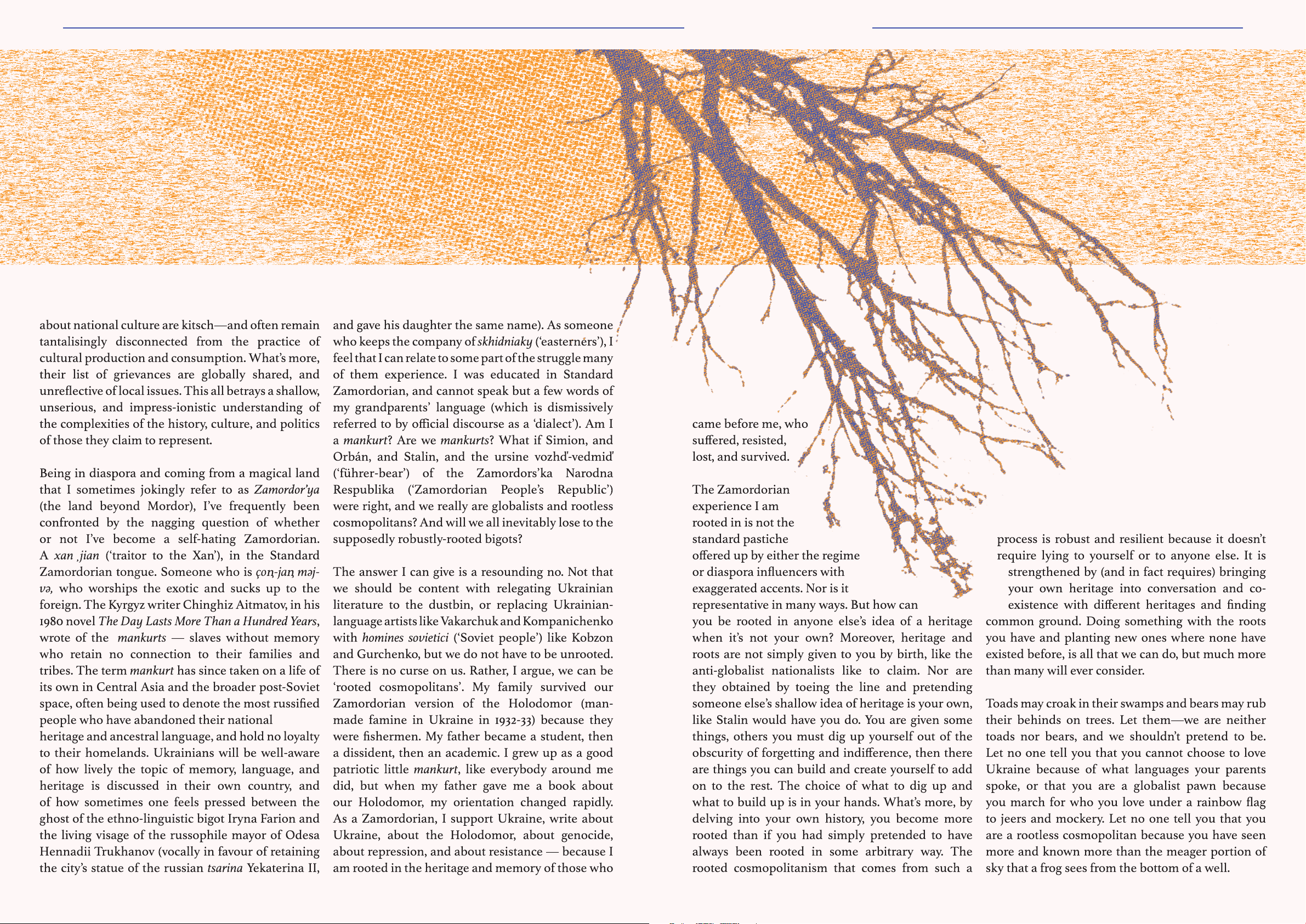
z
27 28DIAS’PORA MAGAZINE

WHAT IS IT LIKE,
YOUR UKRAINIAN
LIFE? KIRA SANTALOVA
It’s waking up at 6.30,
to go swim in the lake, just nearby.
It’s drinking tea from a big metal bottle,
and it tastes slightly like coee.
It’s celebrating kids who were born the same month,
baking a cake and sharing it in class.
It’s doing assigned reading on a summer vacation,
wondering what has been lost in translation.
It’s making a batch of Easter buns with your grandma, and bringing them to the family table.
It’s watering your growing strawberries,
picking cherries, and making jams.
It’s getting tanned by the summer sun,
just laying in your backyard.
It’s drinking more cups of tea
than you could’ve drank water.
It’s going out to meet with your friend
When you have no money to spend
It’s when your cousin is just ‘a sister’ —
and it isn’t wrong — it’s our way of thinking.
It’s so many things
— some of them silly, some might seem odd —
and no dictionary will ever have enough words.
It’s so many things,
and so many more.
29 30DIAS’PORA MAGAZINE
It’s buying a cake on a random Tuesday,
Sitting on the grass, letting the fresh air fill your lungs.
CONTESTED
REMEMBANCE
Legal ad Political Challenges i Ackowledging
the Holodoor
MATILDA MOLODYNSKI STOKES
the recognition of the Holodomor as genocide.
Nearly a century later, the famine of 1932-33 remains
a highly contested subject, both within Ukraine and
internationally. The legal and political interpretation
of the Holodomor has always been conducted under
the inuence of past or present russian aggression,
whether during the early 2000s, when the rst
memorial was established, or in the present day.
I rst came across the Holodomor during my
studies at the University of Warsaw. After enrolling
on a course that promised to guide us through the
complex eld of both historical and contemporary
Ukrainian politics, I logged on every week to a
lecture delivered by a fantastic professor who,
still teaching from Kyiv, had taken up a temporary
position in Poland due to the invasion. As we were
taken through Ukraine’s long history of erasure
and subjugation by its neighbours — and, most
importantly, due to the professor’s insistence on
highlighting this point — I began to realise the
parallels between historical injustice and russia’s
war in Ukraine today. It is because of historical and
contemporary eorts to minimise and suppress the
Ukrainian language, culture and national identity
that the writing of Ukraine’s history is vital in
ensuring these aims of erasure do not succeed. I
therefore hope to make a small contribution to this
eort here, with a discussion of how denial has
functioned as a barrier to the recognition of the
Holodomor as an act of genocide.
The key aspect of the Holodomor period (1932-1933)
that sets it apart from the earlier (1921-1923) and later
(1946-1947) famines is its articial and intentional
nature. Marc Jansen (2017), among others, addresses
this in his scholarship, asserting that although many
claim that poor harvests and weather conditions
played a role in the famine, the primary cause
was ‘chaos following the forced collectivisation of
agriculture,’ a policy implemented by the Soviet
regime. Moscow had rejected requests from
Ukrainian oicials to reduce grain quotas and
instead pursued a policy of searching Ukrainian
collectivised farms, conscating any last ‘hidden’
remnants of grain that had been kept for survival
(Jansen, 2017). The level of starvation reached by
May 1933, the time when ‘little help’ had arrived, had
driven people to desperation (Jansen, 2017).
Whether in the context of recognition of the
genocidal nature of the Holodomor by the
EU or the refusal of its recognition by the
UN, the debate surrounding the legal
categorisation of the Holodomor
under the Genocide Convention has
stood under the shadow of russian
dominance over international
political, legal and academic
spheres.
In Ukraine, memory is political. Nowhere is this
more apparent than in the ongoing debate over
DIAS’PORA MAGAZINE 32
31
Recognition of the genocidal nature of the
Holodomor by Ukrainian political actors preceded
international recognition of the severity of the
event. In her scholarship, Tatiana Zhurzhenko (2014)
describes the year 2006, in which the Ukrainian
parliament passed the ‘Law on the Holodomor of
1932-33 in Ukraine’, declaring the Holodomor as an
act of genocide against Ukrainian civilians. The move
was opposed by the Party of Regions, which proposed
to replace the word ‘genocide’ with ‘crime against
humanity,’ and the Communist Party, which denied
that the famine was articially created (Zhurzhenko,
2014). To curb dissent to the classication by the
government as a genocide, Yushchenko, in 2007,
proposed a new law criminalising the ‘denial of the
Holodomor as a Genocide’, although the law was
not supported by parliament (Zhurzhenko, 2014).
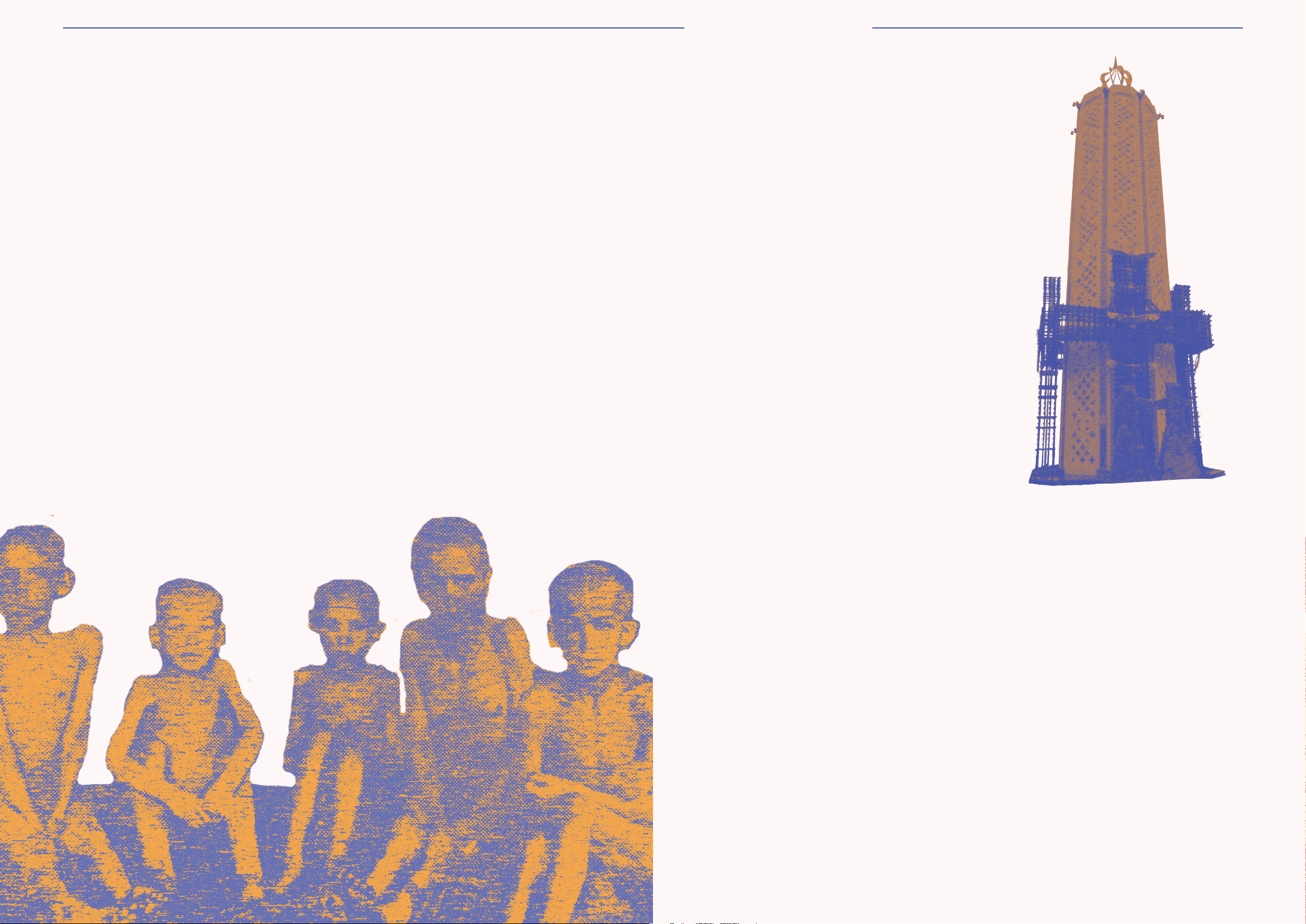
In November 2008, a national monument to the
victims of the Holodomor, known as the ‘Candle
of Memory,’ was unveiled in Kyiv as part of an
oicial commemoration of the Holodomor’s
75th anniversary. This ceremony included the
establishment of The Memorial in Commemoration
of Famine Victims in Ukraine, which, as its name
suggests, did not commit to naming the Holodomor
as a genocide (Zhurzhenko, 2014). In 2019, the
museum was renamed the National Museum of the
Holodomor Genocide in recognition of its genocidal
nature (Holodomor Museum Kyiv, 2023). Although
this form of memorial was successful in Kyiv, a
‘major conict’ between the regional administration
and the mayor emerged in 2007 regarding the
memorialisation of victims in the Kharkiv region
(Zhurzhenko, 2014). There were disagreements
in the Kharkiv regional assembly regarding the
memorial, with the most signicant obstacle being
that the majority of the assembly (aligned with the
Party of Regions) oicially rejected the denition of
the Holodomor as a genocide (Zhurzhenko, 2014).
The intention of the Soviet authorities regarding the
Holodomor has been identied by many scholars
as being to nally ‘crush the peasants’ resistance’
to collectivisation (Khiterer, 2020). In 1930,
approximately 6,000 peasant revolts occurred in
the Soviet Union, with nearly 2,000 of these taking
place in Ukraine (Khiterer, 2020). It is due to this,
and the later policies of conscation and refusal of
aid to certain Ukrainian regions, that led scholars
to conclude that the famine was a targeted event
against Ukrainian peasants. The Soviet authorities
were intent on isolating and containing famine
within Ukraine, such as with Stalin personally
drafting a letter demanding the closure of borders
to prevent victims of starvation from entering more
prosperous regions in 1933 (Kulchytskyi, 2012). It is
clear from this that ethnicity and nationality, based
on the frequency of dissent, were the criteria against
which the Soviet authorities determined the extent
of aid distribution.
There are those scholars and those within the
political eld who reject the categorisation of the
Holodomor as a genocide. Often, this view is held
by those within the modern russian political sphere.
This piece will primarily focus on examples of the
denial of the event’s genocidal character within
the international legal sphere. To thoroughly
discuss the role the Soviet government played in
exacerbating the famine and the extent to which its
intent can be proven, we must analyse the context in
which the Holodomor famine occurred. Mark Von
Hagen (2013) asserts that during the 1910s in Ukraine
numerous instances of violence had occurred
against Ukrainian intellectuals, that russian military
forces would often persecute those who were heard
speaking the Ukrainian language, and that a policy
of annihilation of the Ukrainian intelligentsia,
including the abolition of Ukrainian language
education, had been pursued in the region. This
demonstrates a similar policy of eliminating specic
groups within Ukrainian society. Additionally,
Von Hagen (2016) analyses the policy of forced
collectivisation, and the ‘famines that accompanied
it,’ in terms of its links with the rise of the NKVD
and the Gulag, linking Holodomor and other tools
of violent oppression.
DIAS’PORA MAGAZINE 3
334
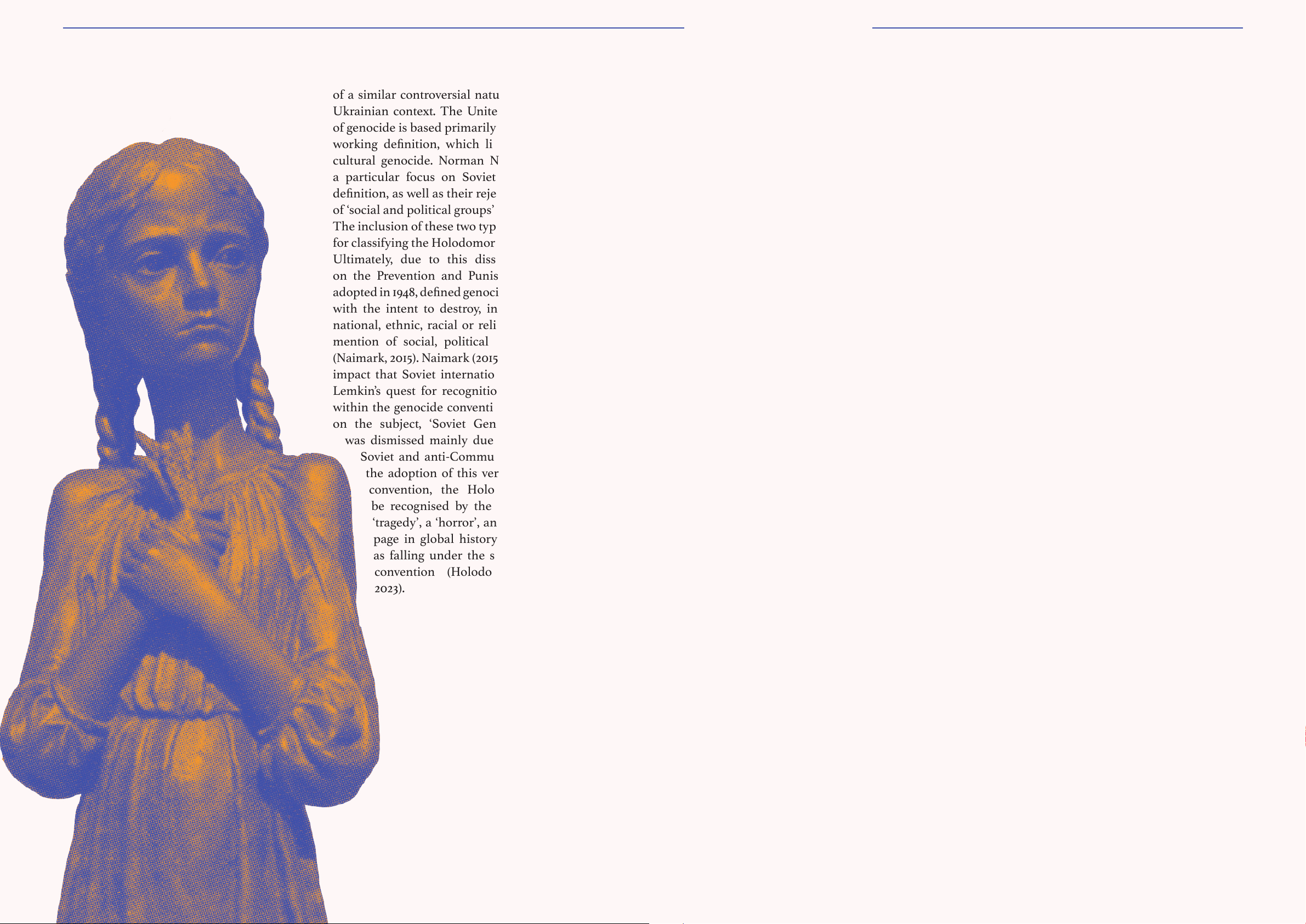
The international political and academic reaction to
the proposition of the Holodomor as a genocide was
of a similar controversial nature to that within the
Ukrainian context. The United Nations’ denition
of genocide is based primarily on Raphael Lemkin’s
working denition, which links mass killing and
cultural genocide. Norman Naimark (2015) places
a particular focus on Soviet dissent to Lemkin’s
denition, as well as their rejection of the inclusion
of ‘social and political groups’ within the denition.
The inclusion of these two types of groups is crucial
for classifying the Holodomor under this denition.
Ultimately, due to this dissent, the Convention
on the Prevention and Punishment of Genocide,
adopted in 1948, dened genocide as ‘acts committed
with the intent to destroy, in whole or in part, a
national, ethnic, racial or religious group’, lacking
mention of social, political and national groups
(Naimark, 2015). Naimark (2015) analyses the further
impact that Soviet international inuence had on
Lemkin’s quest for recognition of the Holodomor
within the genocide convention, as his 1953 speech
on the subject, ‘Soviet Genocide and Ukraine’,
was dismissed mainly due to his ‘extreme anti-
Soviet and anti-Communist rhetoric’. Due to
the adoption of this version of the genocide
convention, the Holodomor continues to
be recognised by the United Nations as a
‘tragedy’, a ‘horror’, an ‘atrocity’, as a ‘tragic
page in global history’, but is not deemed
as falling under the scope of the genocide
convention (Holodomor Museum Kyiv,
2023).
The path to recognition of the Holodomor as a
genocide has been controversial politically, legally
and academically since the beginning of the atrocity.
Russian inuence over the Ukrainian societal and
political sphere has continued to impact domestic
discussions surrounding the recognition and
memorialisation of both the event and the victims
of the Holodomor. The international inuence
wielded by russia has indeed succeeded in the
implementation of denitions of genocide that t
their agenda of denial. Although, thankfully, in many
academic circles, attempts to obfuscate the intention
behind genocidal governmental policies have been
cast aside. Scholars have instead chosen to analyse in
depth evidence of oppressive and intentional Soviet
policy towards groups of Ukrainian civilians during
the 20th century and have placed the Holodomor
within this context. Ultimately, the battle for the
recognition of the Holodomor is not only about the
past. Its recognition allows us to name injustice,
remember the dead, and resist erasure of Ukraine’s
history in the present day.
Works Cited
Jansen, Marc. 2017. ‘Was the famine in Ukraine
genocide?’. RAAM, hps://raamoprusland.nl/dossiers/
geschiedschrijving/783_was_de_hongersnood_in_
oekraine_genocide.
Khiterer, Victoria. 2020. ‘The Holodomor and Jews in
Kyiv and Ukraine: An Introduction and Observations on
a Neglected Topic.’ Nationalities Papers 48, no. 3.
Kulchytskyi, Stanislav V. 2012. ‘Holodomor in Ukraine
1932–1933: An Interpretation of Facts.’ In Holodomor and
Gorta Mór: Histories, Memories and Representations of
Famine in Ukraine and Ireland, eds. Christian Noack,
Lindsay Janssen, and Vincent Comerford. Anthem
Series on Russian, East European and Eurasian Studies
(Anthem Press, 2012).
Naimark, Norman. 2015. ‘How the Holodomor Can Be
Integrated into Our Understanding of Genocide’. East/
West: Journal of Ukrainian Studies, 2015.
Von Hagen, Mark. 2013. ‘Rethinking the Meaning of the
Holodomor: ‘Notes and Materials’ toward a(n) (anti)
(post) colonial history of Ukraine.’ Taking Measure of the
Holodomor (New York: The Center for U.S.-Ukrainian
Relations, 2013).
Von Hagen, Mark. 2016. ‘Wartime Occupation and
Peacetime Alien Rule: ‘Notes and Materials’ toward a(n)
(Anti-) (Post-) Colonial History of Ukraine.’ Harvard
Ukrainian Studies 34, no.1-4. 2015-2016.
Zhurzhenko, Tatiana. 2014. ‘Commemorating the Famine
as Genocide: The Contested Meanings of Holodomor
Memorials in Ukraine.’ In Memorials in Times of
Transition. Eds. Susanne Buckley-Zistel and Stefanie
Schäfer. Series on Transitional Justice (Intersentia, 2014).
Holodomor Museum Kyiv. hps://holodomormuseum.
org.ua/en/history-of-national-holodomor-genocide-
museum/
DIAS’PORA MAGAZINE 36
35
я люблю як ніколи твої щирі очі,
запам‘ятаю назавжди ці безсонні ночі.
всередині цупко оселився страх,
що ніколи більше не побачу рідний дах.
кожен день, як наступає пітьма,
ввижається, ніби крокує орда.
кожна новина сьогодні нагальна,
кожна ніч неначе остання.
мені шкода, що не обійнялись тоді сильніше.
шкода, бо щось дурне було тоді важливіше.
я не цінувала досі свободи,
сьогодні ж військові захищають наші води.
я думала війна—лише історія.
недалеко ж скрипить під танками колія.
UNTITLED
ANNA KO
I love your sincere eyes more than ever,
I will remember these sleepless nights forever.
Fear settled deeply in my brain,
That I will never see my home again.
Every day as darkness falls,
It feels like a horde is marching round the walls.
All the news today is vital,
Every night feels like survival.
I’m sorry that we didn’t hug each other more,
It’s a pity, as something stupid was what we adored.
I didn’t value freedom until now,
The military today protects our ground.
I thought that war was just the past —
Not far away, tanks roll through rust.
UNTITLED
ANNA KO
DIAS’PORA MAGAZINE 38
37
EXECUTED
RENAISSANCE:
The Geeratio of
Talets Killed by the
Soviet Regie
hen Ukrainians talk about russian
imperialism, they are referring to a long-
term history of cultural appropriation, repressions,
and the consequences of such atrocities.
Almost 100 years ago, the whole generation of
Ukrainian poets, writers, and artists was killed,
repressed, or silenced by the Soviet regime.
The ‘Executed Renaissance’ (Rozstriliane
Vidrodzhennia) refers to a vibrant yet brutally
repressed cultural and intellectual movement in
Ukraine during the 1920s and 1930s. It was a period
known for cultural achievements and ourishing
artistic movements under the early Soviet regime,
and then violently repressed during Stalin’s Great
Terror. The movement is remembered today as
a symbol of Ukrainian national resilience under
Soviet rule.
Right after the russian revolution and Ukraine’s
brief independence (1917–1921), the Soviet regime
created a tricky policy of Ukrainisation, which
was the promotion of the Ukrainian language
and culture as part of the regime’s eorts to gain
control over opposition to the Soviet Union.
This policy encouraged the emergence of a new
generation of Ukrainian writers, poets, artists,
W
and intellectuals eager to promote the culture,
eliminate the narrative of the ‘poor’, and foster
creativity with movements. This opportunity
allowed poets to write in their native language.
Artists also had a chance to get recognition for their
talents, and playwrights gained the staging skills to
showcase the richness of Ukrainian theatre.
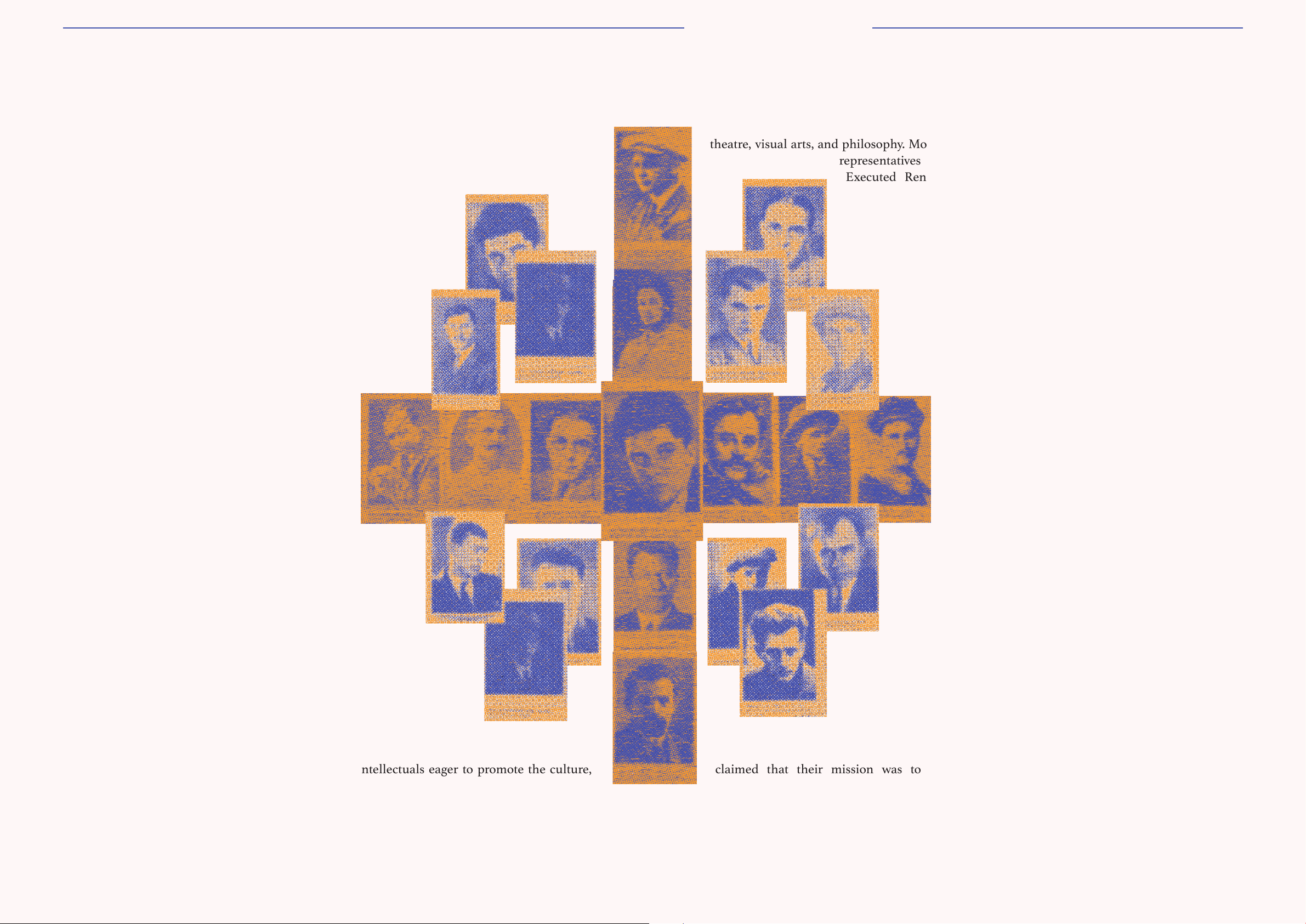
Figures such as Mykola Khvylovy, Les Kurbas,
Valerian Pidmohylny, Mykola Kulish, and Mykhailo
Semenko became well-known Ukrainians
through the burst of creativity in literature,
theatre, visual arts, and philosophy. Most of the
representatives of the
Executed Renaissance
ALISA BYSTRYTSKA
claimed that their mission was to educate
future generations on new moral and ethical
principles and to raise national art to a higher
artistic level.
This period also saw the founding of key institutions
such as the Berezil Theatre, led by Les Kurbas, and
literary groups like VAPLITE (Free Academy of
Proletarian Literature), which debated Ukraine’s
cultural trajectory and its place in the global literary
landscape.
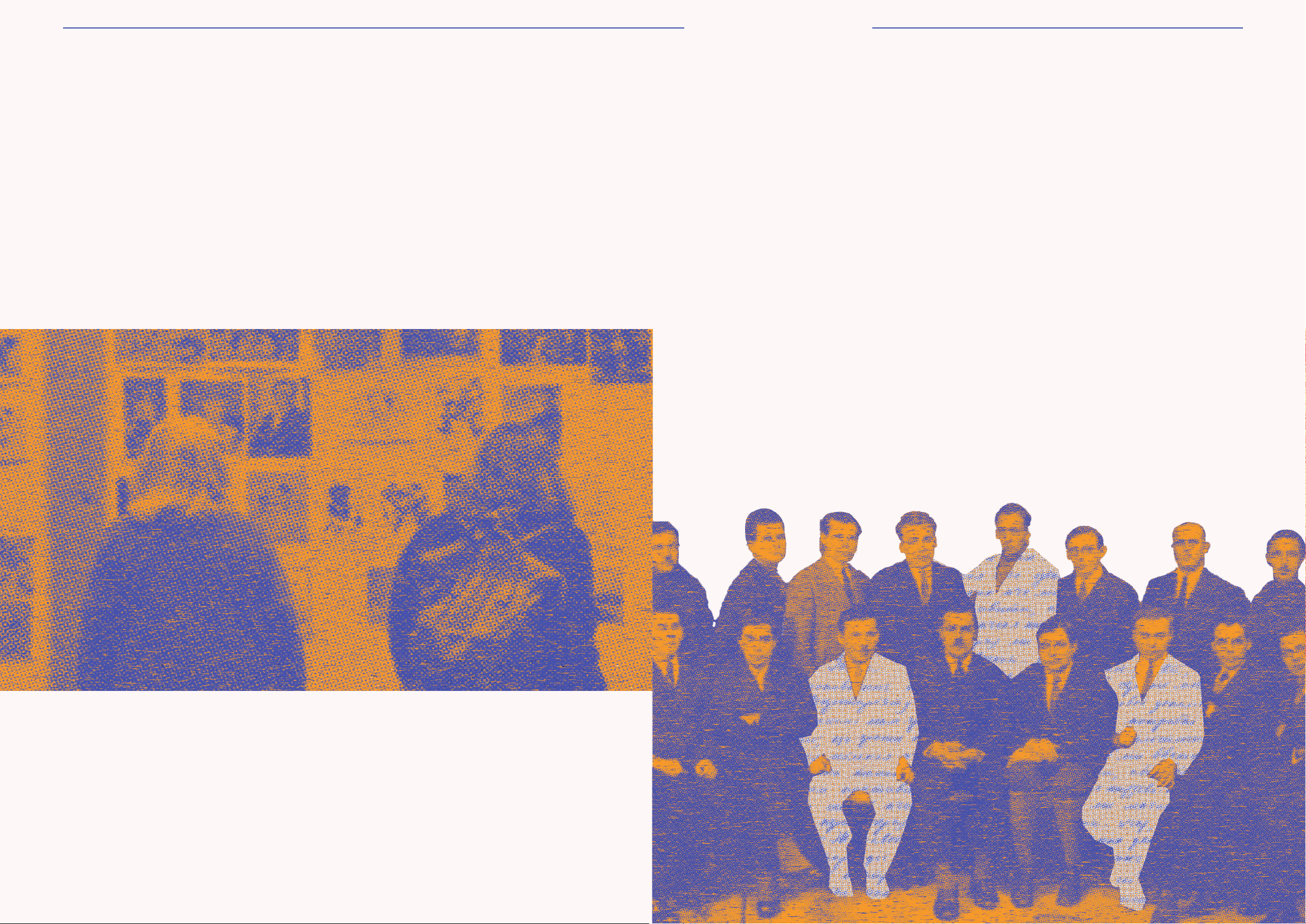
One of the greatest symbols of the Executed
Renaissance is the Slovo House in Kharkiv (then the
capital of Soviet Ukraine). Built in 1927 specically
for Ukrainian writers to live in, it was a modernist
building where nearly all of Ukraine’s leading literary
minds resided. ‘Slovo’ means ‘word’ in Ukrainian,
reecting the creative purpose of the residence. The
state oered apartments in the Slovo House as part
of its eort to elevate Ukrainian culture under the
Ukrainisation policy. The building became a hub of
artistic exchange, intellectual debate, and literary
innovation. But it was also a gilded cage.
As the Soviet repression intensied in the 1930s,
the Slovo House became a trap. The walls that
once nurtured creativity now witnessed arrests,
surveillance, and fear. The NKVD (The People’s
Commissariat for Internal Aairs) agents inltrated
the building, and one by one, its residents were
taken — often in the middle of the night — never
to return.
Among those who lived in the Slovo House and
were repressed were Mykola Khvylovy, who died by
suicide in 1933 as a protest against the growing Soviet
repression, and Mykola Kulish, who was executed in
1937 in the Sandarmokh forest massif, the Respublic
of Karelia, Russia, which became an execution site
for the thousands of victims of Stalin’s Great Terror.
Today, the Slovo House is remembered as both a
monument to cultural brilliance and a site of mass
repression. It stands as a haunting reminder of
how creativity and state violence coexisted under
totalitarian rule.
Despite the initial support, the Soviet Regime began
to consider literature and art as one of the areas of the
‘cultural front’. The wave of mass repressions against
cultural gures of the movement began in May 1933,
after the authorities had arrested Mykhailo Yalovyi
— a Ukrainian poet-futurist, a playwright and a
prose writer. Mykhailo was arrested on charges of
espionage and organising an assassination attempt
DIAS’PORA MAGAZINE 40
39
on the second secretary of the Communist Party,
Pavlo Postyshov. This arrest was the last straw for
Mykola Khvylovy, who committed suicide in a
protest on 13th of May, 1933. On that day, he invited
his friends over. At the end of the gathering, he told
them that he would show them how a proletarian
writer should work in the current conditions and
went into another room. Instead of presenting a new
work, a few moments later, a shot rang out, killing
the writer. In his suicide note, he said: ‘Yalovyi’s
arrest was the execution of an entire generation.
For what? For being the most sincere communists?
I don’t understand anything…’ (‘The suicide note’,
2021).
The massacre of Ukrainian artists culminated in
1937. From 27 October to 4 November, to ‘over full
the plan’ to destroy the ‘enemies of the people’ on the
20th anniversary of the October Revolution, NKVD
executioners shot 1111 prisoners of the Solovetskiy
special purpose camp in the Sandarmokh (Kotubei-
Gerutska, 2022). More than 250 of them were the
representatives of the Executed Renaissance.
According to the researchers, the prisoners were
‘prepared’ for the execution in three rooms of
their barracks. Their personality was checked in
the rst room, and the prisoners were undressed.
In the second room, they were tied up, and in the
third room, they were beaten on the head to make
them lose consciousness. Then, the prisoners were
loaded onto trucks and transported towards the
Sandarmokh. The half-alive prisoners were thrown
into large pits, and a member of the execution
brigade — Mikhail Matveyev — personally shot
each prisoner in the head.
The term ‘Executed Renaissance’ was popularised
in 1959 by Ukrainian literary critic Yurii Lavrinenko,
who compiled a landmark anthology of Ukrainian
literature from 1917 to 1933, published in the West.
The book served as a memorial and a call to restore
Ukraine’s lost literary heritage. For decades, Soviet
authorities suppressed knowledge of these gures,
censoring their works and rewriting cultural
history. Only in the late 1980s and early 1990s,
during ‘perestroika’ (political reform movement by
Mykhailo Gorbachov, the last leader of the Soviet
Union) and following Ukraine’s independence in
1991, did a full reevaluation of the period begin.
Today, the Executed Renaissance is recognised
as one of the most crucial and tragic periods in
Ukrainian cultural history. Here, in Scotland, the
Executed Renaissance wasn’t left without attention.
On the 31st of May 2025, ‘shevchenko.philia’, a non-
prot organisation that promotes Ukrainian culture
in Scotland, hosted a tribute exhibition dedicated
to the Executed Renaissance, followed by the
documentary screening of ‘Slovo House’ (2017) by
Taras Tomenko. The exhibition included a memorial
plaque of every artist aected by the regime,
documents from NKVD describing their searches
and arrests, the exploration of literary organisations
and magazines that existed at the time and a much
more in-depth description of this signicant period.
As Arina Tishchenko, who came up with the idea of
such exhibition, explains: ‘When I rst learnt about
the Executed Renaissance, I kept coming back to the
gures of the period and philosophy of their art...
One thing was always clear — Ukrainian culture
would have looked completely dierent if thousands
of people had not been killed or imprisoned in
the 1930s. Wrapping the only reason — Ukrainian
identity — in false denunciations, accusations, and
solemn speeches for everyone and no one. It was
important for me to make it clear to the locals how
much art was destroyed and how barbaric it was. I
did not have a question about organising this event,
the idea came to me organically, as something that
went without saying, leaving me no choice but to
bring it to life.’
Works Cited:
‘Передсмертна записка Миколи Хвильового.’
[‘The suicide note of Mykola Khyvoly’]. Digital
Archive of Ukrainian Liberation Movement, 2021
Olesya Kotubei-Gerutska. ‘Сандармох: трагедія
“Розстріляного відродження”, яку Україна не
має права забути.’ [‘1111 victims of Sandarmokh:
the tragedy of the “Executed Renaissance”,
which Ukraine has no right to forget’]. Суспільне
Культура, 3 November 2022,
‘Розстріляне Відродження: Як Москва вбивала
українських митців 90 років тому.’ [‘The Revival
of Those Shot Dead: How Moscow Killed Ukrainian
Artists 90 Years Ago’]. Ukrinform.ua, 7 July 2023,
‘“Розстріляне відродження” як культурний
процес на Україні в 30-х роках.’[‘The Executed
Renaissance’ as a cultural process in Ukraine during
the 1930s’]. Освіta.UA, 8 October 2010
‘Slovo Building. How Did the Executed Renaissance
Aect Kharkiv’s Cultural Identity?’. Svidomi.ua,
DIAS’PORA MAGAZINE 4
412
SILLY
MARYNA
SANTALOVA
DREAM
it’s holding me —
tying my hands, closing my eyes.
‘sleep, girl, it’s warm here—
let me show you around’.
tighter and tighter
it’s tying the knots;
the longer I hide—
the further I fall.
taken into captivity
by the tricks of my mind,
deeper and deeper into oblivion—
I’ve gone very far.
a forgotten anthem
stuck in my thoughts.
dreaming of something charming;
my legs can no longer walk.
dreaming of ower elds,
clear skies and no ceilings—
in this silly dream
I feel the freest.
DIAS’PORA MAGAZINE 4
434
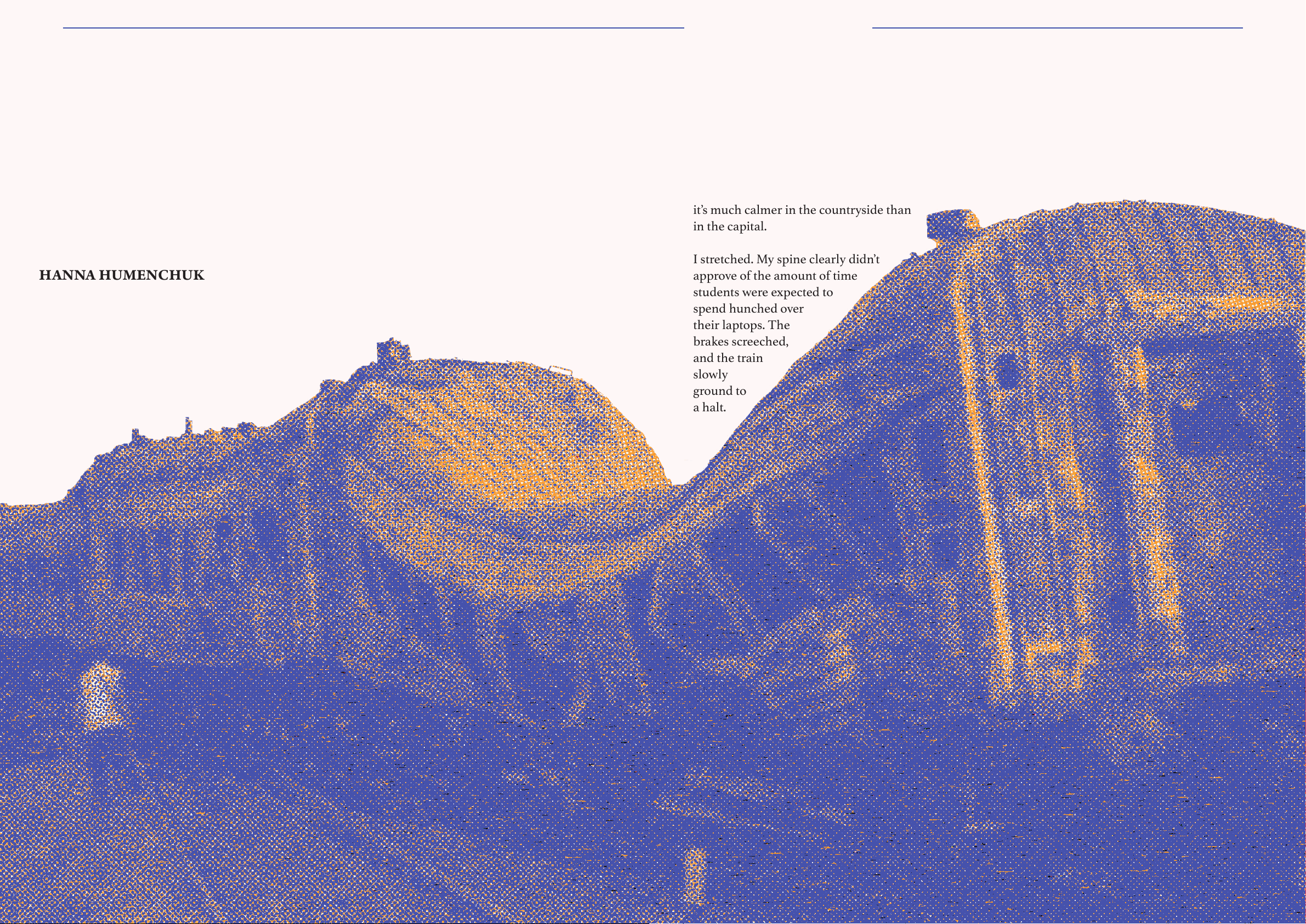
HANNA HUMENCHUK
thought as I stared at the half-nished university
essay on my laptop screen. It had to be done by the
end of next week. But for now, a weekend awaited
me—away from the chaos of Kyiv, with its constant
air alarms and missile strikes. To be honest, there is
no truly safe place in Ukraine now. But still
it’s much calmer in the countryside than
in the capital.
I stretched. My spine clearly didn’t
approve of the amount of time
students were expected to
spend hunched over
their laptops. The
brakes screeched,
and the train
slowly
ground to
a halt.
‘Fastiv, dear passengers!’ bellowed a portly, sweaty
conductor as he rushed through the old and tired
third-class carriage.
New passengers entered, heads turning every
which way in search of their seats. After a few
minutes, an elderly woman settled into the seat
across from me,
he rhythmic clatter of the train lulled me. I
rubbed my dry eyes, trying to weave a coherent
T
THE WAR
DOESN’T
RIDE THE
RAILS
DIAS’PORA MAGAZINE 46
45
long skirt and carrying a large checkered bag.
‘Good afternoon,’ I nodded politely.
‘And a good afternoon to you, child,’ she replied.
The train started moving again. My earbuds had
nally died, so I tucked them away and went back
to watching the trees icker past the window. The
woman clearly saw my empty ears as an invitation
to talk.
‘So you’re… a student, I suppose?’ she said as
she wiped her nose with a cotton handkerchief, then
tucked it into her pocket. ‘I am,’ I replied, eyes still
xed on the window.
I didn’t feel like chatting. I didn’t want to
spend the next two hours hearing about grandkids,
ungrateful youth, and government subsidies.
‘I knew it! So young, and with a laptop too—must be
a student!’ she continued cheerfully.
I sighed inwardly and silently scolded myself for not
charging my earbuds.
‘You see, my youngest daughter’s nishing her
second year. That’s why I can always tell who’s a
student,’ she added with a grin. I forced a weak
smile in return.
‘What year are you in?’ She studied me with curiosity.
‘First,’ I replied curtly.
She must have sensed my disinterest because she
fell silent and pulled out some knitting. And just
as I caught the pungent smell—boiled eggs, and
probably sausages too.
Of course: third-class carriage, heat, and eggs
with sausages. Classic. Please, God, don’t let
her have onions as well…
She clicked her needles busily, and I found peace in
the quiet, even if it came with the scent of eggs and
meat. Minutes passed. The train rumbled on, and
my eyes drifted to the rhythm of the knitting in her
hands. She noticed my gaze and smiled.
‘I’m knitting this for my grandson,’ she said
gently.
‘That’s very sweet,’ I replied—and I meant it.
Her eyes sparkled with joy.
‘He’s turning two soon. I’m on my way to see
him for his birthday. Got him a gift,
an expensive one, been saving from
my pension. And I’m knitting him this little
outt too.’
‘Sounds lovely,’ I nodded.
‘Oh yes,’ she brightened, clearly happy I
was nally engaging. ‘He’s a good
boy. But lately a little bit naughty, not
listening to his mama—my daughter,
Solomiya.’
She shed a phone from her pocket, the kind with a
ip cover, and looked ready to show me photos.
I sighed internally again and braced myself for
the parade of baby pictures. In adulthood, there’s
an unwritten rule: you pretend to be fascinated by
photos of other people’s children, no matter how
little you care. So I leaned in with a polite smile.
‘He’s adorable,’ I told her. She nodded, pleased, and
swiped to the next photo.
‘And here’s a vest I made him last month.
Pretty, right?’ ‘Very pretty,’ I said, wondering how
many babies and vests I still had to compliment.
She kept swiping. I kept watching. And then—
suddenly—a photo of a young man in military
uniform appeared. Smiling broadly, rie in hand.
Dust lined the creases around his eyes. His face was
unshaven. I must’ve reacted, because she glanced at
the screen and said, ‘Oh, that’s my son-in-law Andrii.’
I looked at her, then back at the screen. The man
looked barely older than a teenager.
‘He was killed at the beginning of June. Not even
forty days yet…,’ she added softly.
Something thudded in my chest. I looked at the
woman—really looked at her—for the rst time.
‘Honestly,’ she continued, her voice hollow and far
away, ‘I thought Solomiya would lose her mind. She
was home alone when they told her. Oh, she was
screaming and crying desperately… I thought I’d
lose my daughter too.’
I heard her voice as though through water. My eyes
stayed xed on the soldier’s face.
She swiped again. A young woman stared back at us
from the screen—barely older than me, red-rimmed
eyes, a black mourning band on her forehead. Her
face pale, almost blue. A chubby little boy leaned
against her shoulder. I wanted to say something. To
that mother. To the woman sitting in front of me,
who carried her daughter’s grief as though it were
her own. But the relentless years of war had bred a
strange immunity in me.
Not numbness—no. I felt it all. Deeply, truly.
But if you let yourself break over every fallen
soldier, every wounded civilian—you’ll end up in a
psychiatric ward before long. My tongue forgot how
to move.
‘May Andrii rest in peace,’ I muttered, barely
audible. ‘Thank you…’ she sighed. ‘He would’ve
turned twenty-three this August. Dropped out of
law school and volunteered for the front. The rst
time he was given leave, he and my daughter got
married. You see, they were in such a hurry
to live…’
She paused.
‘Then came Tymoy. Andrii saw his child maybe
three times. And now… now Tymoy visits his
father at the cemetery. Kisses the cross on his grave,
my sweet boy. Kisses it, and looks up at the sky—
because that’s where his daddy is. And Solomiya…
She’s like a ghost now. Only that kid keeps her alive.
If it weren’t for him, I’d have buried not just my
son-in-law, but my daughter too.’
DIAS’PORA MAGAZINE 48
47
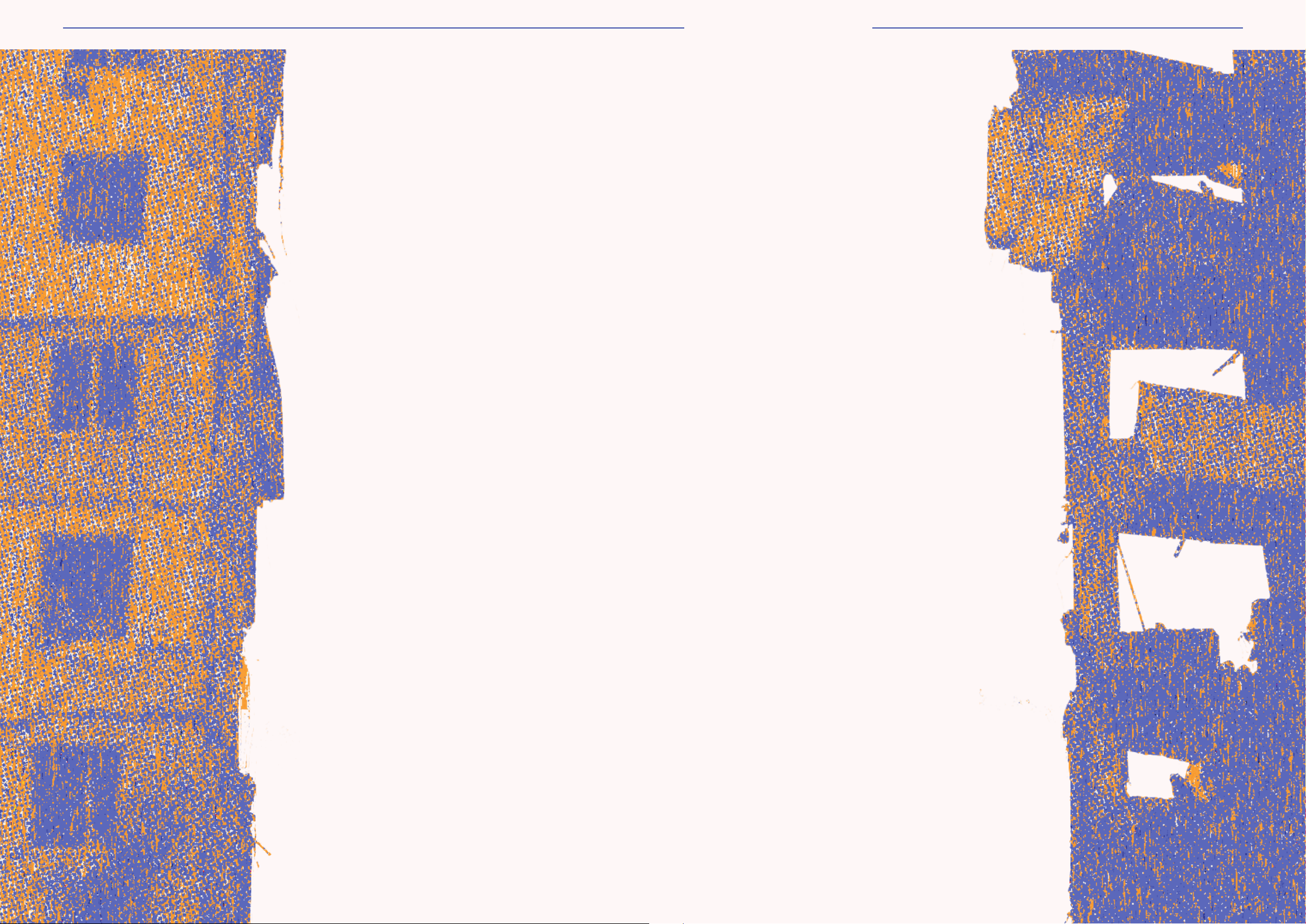
I glanced from the photo to the woman. I had no
words. Nothing I could say would be enough. Her
grandson would never know their father—so I
could travel to see mine. So I could write an essay
and forget, sometimes, that the war was still here.
That soldier should’ve nished his education.
Should’ve lived out his youth, travelled the world.
Raised his kids—children who might never have
been born if war hadn’t breathed down their parents’
necks, urging them to live decades in a single year.
I found myself wanting to see another photo of
Tymoy. That child suddenly felt like part of me.
Even the stench of eggs stopped bothering me. She
composed herself and swiped again. I hoped to see
the boy—his knitted pants and his vests. Instead,
a photo appeared: another man, framed in black
ribbon. Older. Rougher features. Thick brows. I held
my breath.
‘That’s their godfather, Mykhailo,’ she explained.
‘He died this year too. He used to run a business. A
missile hit his apartment in Dnipro. His wife and
daughter were home. He’d just stepped out to the
store or somewhere… who knows. Came back—no
home, no family. Who would want to live after that?
So right after the funeral, he signed up. Said: ‘At
least I’ll be useful. I’ll take revenge. I’ll drive that
lth o our land.’
She sighed.
‘Now he’s with his beloved girls… Well, Mykhailo
had lived a little. He was thirty. But my son-in-law…
Just a boy indeed. Imagine, only twenty-one years
old.
A child, really. He didn’t want to live u n d e r t h e
tricolor. And Solomiya… She didn’t stop him. She
said, ‘If not you, then who? This is our land. And
we want to raise our children here.’
I sighed.
Twenty-one. My generation.
And yes. Solomiya was right. This is our land, our
country.
But what a price we pay to call it ours…
I probably should’ve said something. But the
woman didn’t need words—just someone to listen.
My thoughts were interrupted by her phone ringing.
‘Hello! Yes, dear, I’m almost there. I think
we’re close to Koziatyn.I’ll call once I get o.
Yes… okay. Bye!’
She cleared her throat. Then silence spread around.
I stared ahead, seeing nothing. The young female
voice on the phone echoed in my mind.
‘They say heroes never die,’ the woman suddenly
said—not to me, but to the void. ‘Lies. They do
die. They burn out like sparks from a re. And
their children visit cemeteries more often than
playgrounds.’ I nodded slowly—automatically.
‘Heroes die.’ I whispered, teeth clenched. ‘Russia
kills them.’ She looked me in the eye. In her pupils, I
saw rage, pain, and something else. Something vast
and wordless, that lived in my own eyes too.
‘I hope they all rot,’ she said, each word like a nail.
‘Those who kill our people. May Hell be too small for
them all!’ Her fury was cut short by the conductor.
‘Dear passengers, Koziatyn in ten minutes!’
‘Well, here’s my stop.’ She dabbed her
eyes with her handkerchief and stood, lifting her
checkered bag.
‘Take care, child.’
‘Thank you,’ I nodded. ‘You too. Goodbye.’
She smiled kindly and then disappeared into the
vestibule of the train.
I hugged my knees to my chest.
‘May Hell be too small for them all…’
DIAS’PORA MAGAZINE 50
49
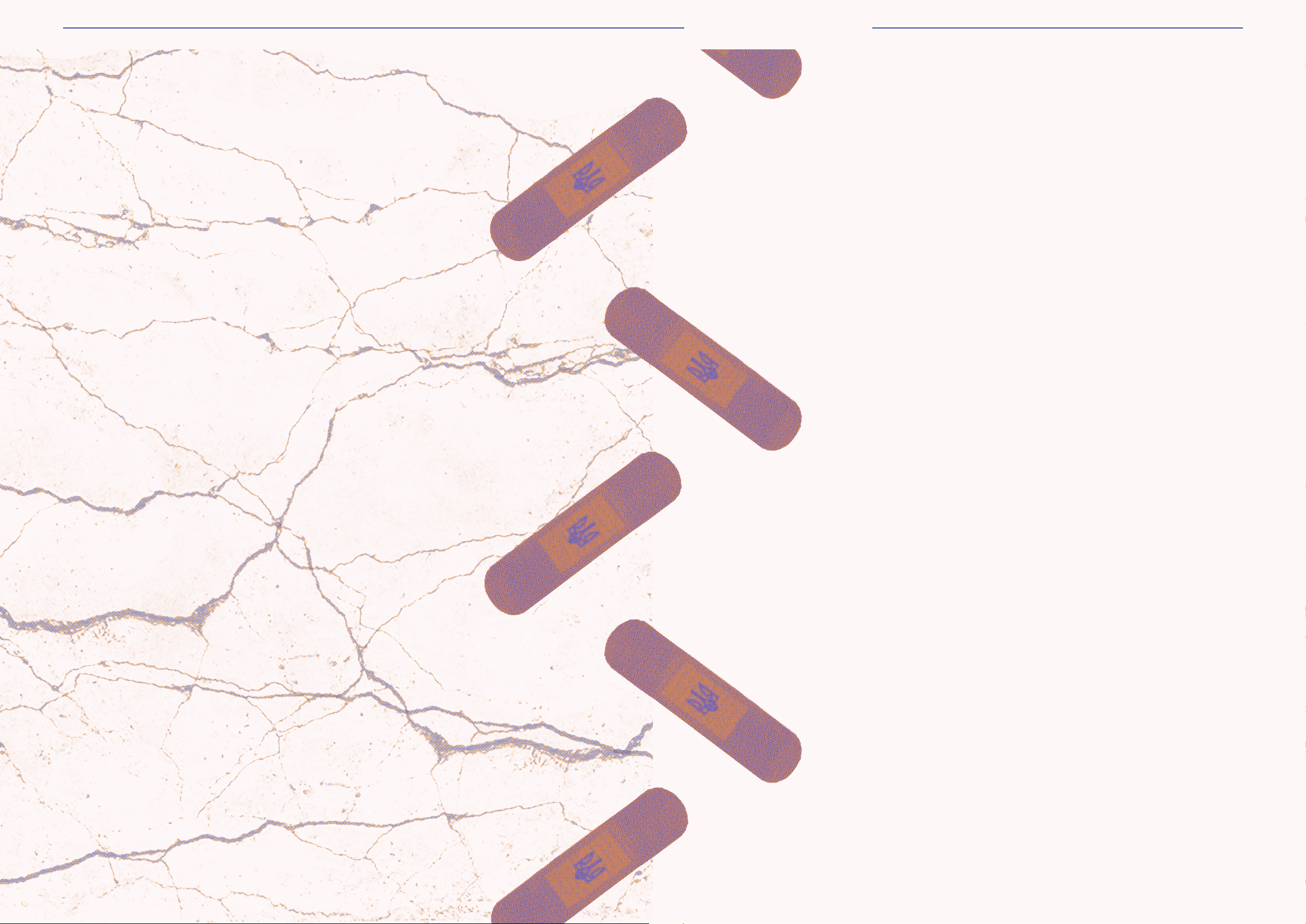
THE
SCARS
ARE
SHOWING
THE
HISTORY
MARYNA SANTALOVA
The scars are showing the history
of the life you had once before.
Time is a mystery;
secrets are left in the walls.
Some things you wish could have stayed,
and some you used to hide from.
Run! Run as fast as you can,
but come back when your legs start to feel sore.
The scars are showing the history,
that you wanted to keep for so long —
a growing re in the chest of a familiar building;
a fantasy stuck in your thoughts.
That little line on the top of your arm?
It shows that the dream used to be real.
So much has been left untouched —
you never nished the story; you never started on the
list.
It’s all coming back to you —
daisies on long-forgotten elds,
and rivers owing so free —
it just can’t be true.
But the scars are showing the history,
and it should not be simply erased.
Embrace the moments you carry over the distance —
a reminder that nothing was simply left there.
DIAS’PORA MAGAZINE 5
512
RESILIENCE IN RIFFS
Telema ad the Rise of Ukraie’s
Wartie Metal Scee
rom the onset of russia’s full-scale invasion
of Ukraine in 2022, the country’s cultural
‘There are no deep meanings or hidden subtexts—
we just wanted to convey the atmosphere of chaos
that engulfs us and the crowd when we play,’ Roman
once explained during an interview about their
single ‘Kolotnecha.’
Since the war began, their environment has dictated
not only the mood of their music, but its production
and distribution logistics as well. ‘We’ve learned to
adapt,’ says Taras. ‘You get used to playing in these
conditions. The main obstacle is the russians—
everything else, we’ve found ways to manage.’
Recording now happens in bursts between power
outages, using guitars laid down during brief
electricity windows, vocals tracked with basic
setups, and mixes passed across Telegram threads.
landscape has undergone seismic shifts. Among the
most vibrant transformations has been the surge
of a ercely resilient metal scene—gritty, deant,
and deeply embedded in wartime reality. At the
heart of this wave stands Telema, a metalcore outt
from Ivano-Frankivsk, whose name has become
increasingly synonymous with the emotional
urgency and sonic intensity of contemporary
Ukrainian heavy music.
FORGED IN CRISIS
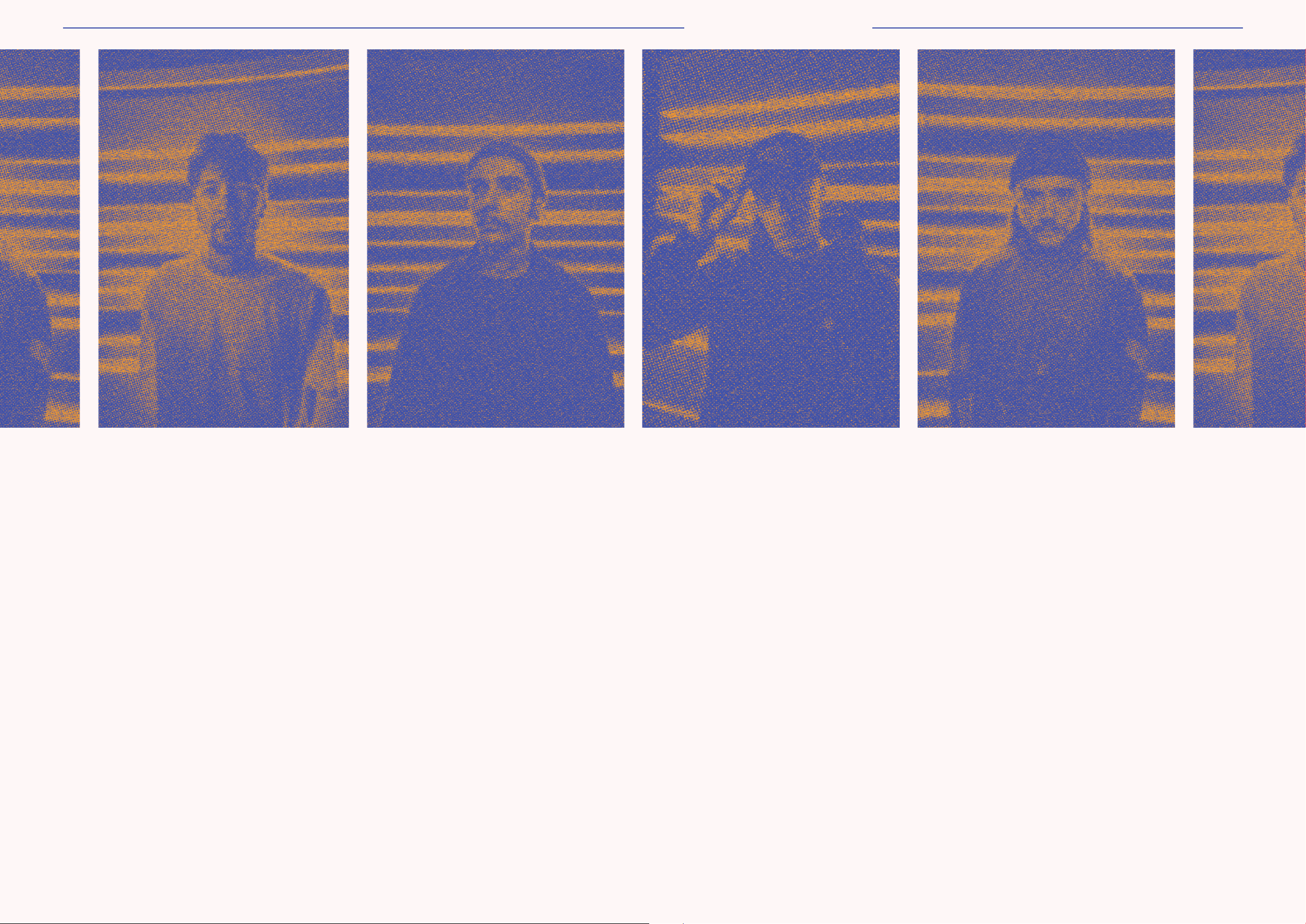
Telema emerged in 2019, founded by brothers Taras
and Roman Fihol, with a clear mission: to sonically
replicate the chaotic energy of basement shows and
funnel it into tightly wound, cathartic recordings.
F
RESILIENCE IN RIFFS
ARTEM PISHEL
The urgency of creation mirrors the urgency of life.
CONCERTS AMID CURFEWS AND SIRENS
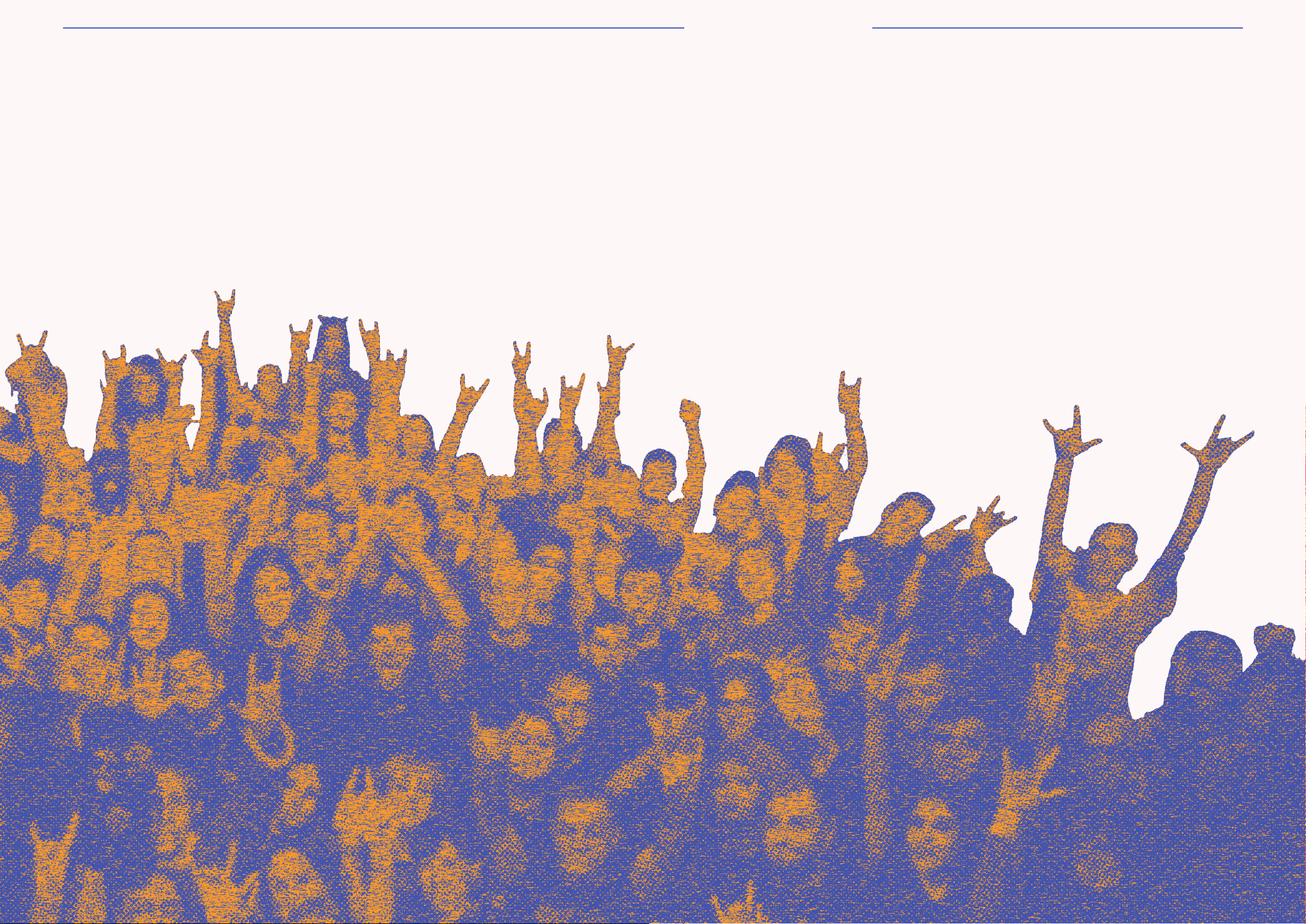
Live performances in wartime Ukraine are
unpredictable. ‘Air raid sirens can completely
disrupt a show,’ says Vlad, the band’s bassist. ‘There
are times when everything is exploding with energy,
and suddenly you have to evacuate to a shelter.’
Despite these disruptions, the band remains
committed. ‘We’re used to it now,’ adds Roman.
‘Most of our concerts are for charity. We’re always
contributing to fundraisers.’
Logistical challenges are also formidable. Touring
across Ukraine involves curfews, shifting venues,
travel restrictions, and often hauling gear across the
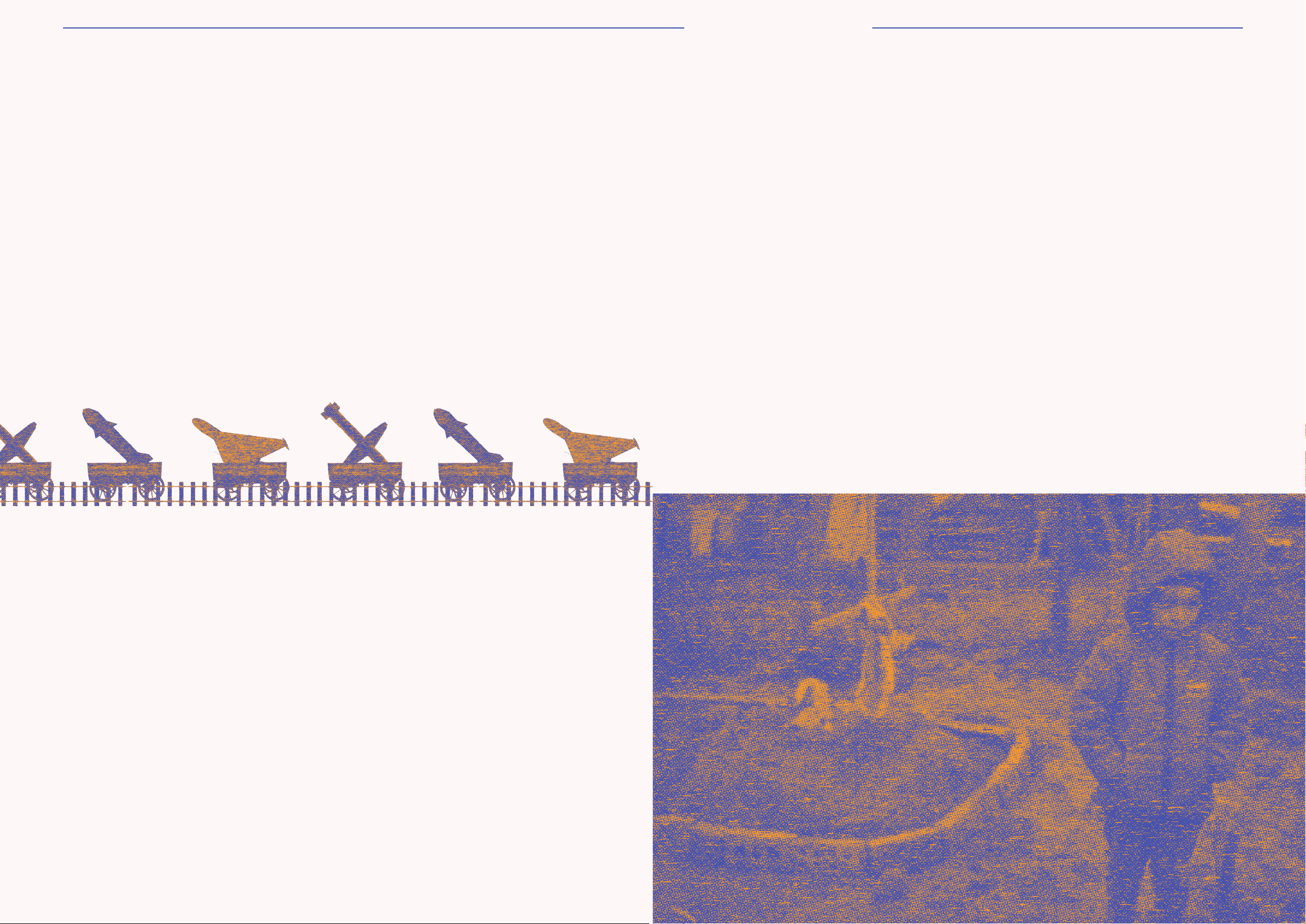
country via train. ‘Trekking with cymbals, guitars,
merch, and tech is a challenge,’ Roman notes. ‘But
our booking agency now handles most of the hard
parts, which lets us focus on the music.’
Yet even amidst such obstacles, the band continues
to rise. In 2024, Telema graduated from an early
slot to headlining the Dark Stage at Faine Misto,
one of Ukraine’s largest alternative festivals. It
was a milestone that underscored their growing
prominence.
CONNECTING WITH A NEW GENERATION
As foreign acts stopped touring Ukraine, local
audiences turned inward—and upward. ‘We see
new faces at every concert,’ says Taras. ‘And more
importantly, we see younger people, those who are
still forming their musical tastes. It’s rewarding to
RESILIENCE IN RIFFS
DIAS’PORA MAGAZINE5354
know they’re choosing our direction and sticking
with us.’
This surge in local engagement has also led to a
linguistic and emotional pivot. ‘We switched entirely
to Ukrainian lyrics after the full-scale invasion,’
explains Roman. ‘It allows us to be more honest and
expressive. Vlad adds: ‘Oddly enough, the war has
had a positive eect on modern Ukrainian culture.
People have rejected russian inuences, and this has
elevated homegrown music.’
AIMING FOR THE WORLD STAGE
Despite their local focus, the members of Telema
harbour ambitions that extend far beyond Ukraine.
‘Why do it otherwise?’ Roman asks. ‘Reaching a
wider audience is essential for growth.’ Taras agrees,
‘We want to share our music with people abroad
who may have been listening to us online for years
but never had the chance to see us live.’
Asked what message they hope to deliver, the band’s
answer is simple and powerful: sincerity. ‘We want
to convey honest emotions, without melodrama,’
Roman says. ‘What you see onstage in Ukraine is
what we’d bring to any other country.’
THE FUTURE OF UKRAINIAN METAL
AND OF TELEMA
The Ukrainian metal scene continues to evolve
rapidly. ‘It’s growing,’ Roman observes. ‘And those
who aren’t afraid to be themselves, who don’t try to
conform, are the ones who’ll break through.’ Taras is
equally optimistic. ‘There are so many young bands
now—breathing down our necks. That’s a great
sign.’
Within Telema, the focus is on rening their identity.
‘Our goal is to achieve a sound that is unmistakably
ours,’ Roman says. Long-term? ‘A European tour,’ he
adds with a smile. Vlad echoes the sentiment: ‘We
want to leave our mark on the history of Ukrainian
heavy music—and, ideally, reach a global level.’
The group is already working on new material,
planning releases, and hinting at surprises before
the year is out. ‘It’s about growth and connection,’
says Taras. ‘We’re not just writing songs—we’re
trying to build something lasting.’
SHATTERING STEREOTYPES, ONE
BREAKDOWN AT A TIME
Among the band’s quieter missions is destroying
misconceptions about Ukrainian music. ‘There’s this
stereotype that if it’s Ukrainian, it must be of lower
quality than American or European work,’ Vlad
says. ‘We don’t just want to break that stereotype—
we want to obliterate it.’
Despite past lineup changes, Telema’s creative heart
has remained stable. ‘The songwriting team hasn’t
changed,’ Taras conrms. ‘We’ve all been friends
for a long time, so even the newer members t in
naturally.’ As Roman puts it: ‘Now we’re nally all
moving in the same direction.’
DIAS’PORA MAGAZINE 56
55
SOFT POWER
A Opportunity to Engage Fro Abroad
ANDRII KUZMA
storytelling — to connect with the world, especially
during the war. Instead of tanks and weapons,
soft power is about winning hearts and minds.
From global campaigns like Brave like Ukraine to
something as simple as a bowl of borsch, Ukrainians
are showing the world who they are and what they
stand for. People like First Lady Olena Zelenska and
chef Yevhen Klopotenko remind us that culture can
be a powerful form of resistance. But soft power
doesn’t work on its own — it needs people to keep
it alive. That can be through lms, food festivals,
student projects, or just talking about Ukraine.
Whether you’re Ukrainian or just someone who
cares, there are many ways to be involved. The
message is simple: soft power lives in everyday
actions — and each of us can help keep Ukraine’s
story alive.
In 2023, Ukraine was ranked among the top 20
countries globally in terms of cultural inuence and
soft power, according to research by the Ukrainian
Institute and the Nation Brands Index (Ukrainian
Institute, 2023). At the heart of this visibility is what
we call soft power — and that’s exactly what I want
to explore with you here: what it means, how it
works, and how each of us can be part of it.
What is So Power?
Let’s start simple. The general
denition in political science
says that power is the ability
to get others to do what you
want, through force, money,
or persuasion. Soft power is
when people choose to follow
or support you because they’re
inspired, not because they’re
forced or payed so (Nye, 2004).
The term was coined by American
political scientist Joseph Nye, who
noticed that cultural appeal and values often
shaped international outcomes just as much as
military strength. Back at my university in Bratislava,
we were given a great example of Hollywood lms or
even McDonald’s, as they don’t just export products,
they export a way of seeing the world, attracting
millions of people to the United States of America
through their global culture.
In today’s world, where Ukraine is ghting a full-
scale war, tanks and planes matter, but so does soft
power. It’s harder to measure, but just as crucial. As
Ukraine’s First Lady, Olena Zelenska, put it:
Dialogue and humanity is more
eective than the economic and
nancial coercion used by our enemy.
That is why we call the anniversary of
the Russian attack in Ukraine dierently
– the anniversary of resistance, solidarity,
and fortitude. The anniversary of not only
armed self-defence, but also
of soft power”
(City nation place, 2023).
This article looks at how Ukraine uses soft
power — things like culture, values, food, and
DIAS’PORA MAGAZINE 58
57
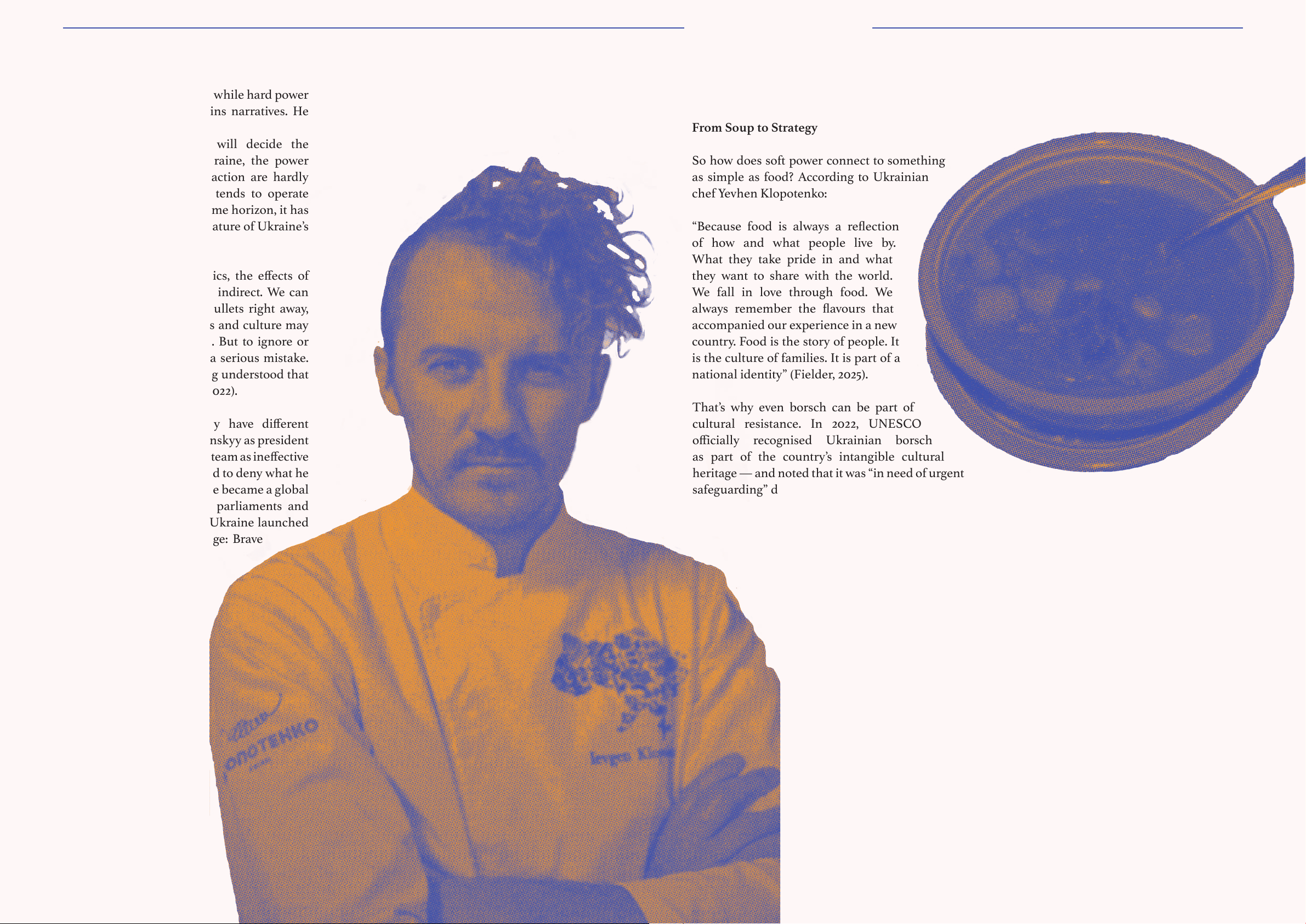
From Soup to Strategy
So how does soft power connect to something
as simple as food? According to Ukrainian
chef Yevhen Klopotenko:
Ukraine and So Power
Joseph Nye also reminds us that while hard power
may win battles, soft power wins narratives. He
commented on war in Ukraine:
“While hard military power will decide the
outcome of russia’s war in Ukraine, the power
of values, persuasion, and attraction are hardly
irrelevant. Though soft power tends to operate
more subtly and over a longer time horizon, it has
nonetheless emerged as a key feature of Ukraine’s
defense.
Likewise, in international politics, the eects of
soft power tend to be slow and indirect. We can
see the eects of bombs and bullets right away,
whereas the attraction of values and culture may
be visible only in the long run. But to ignore or
neglect these eects would be a serious mistake.
Smart political leaders have long understood that
values can create power” (Nye, 2022).
Even though each of us may have dierent
opinions about Volodymyr Zelenskyy as president
in 2025, considering him and his team as ineective
or raising valid concerns, it’s hard to deny what he
represented in 2022. That year, he became a global
symbol. He was applauded in parliaments and
senates around the world, and Ukraine launched
a powerful international message: Brave
like Ukraine.
This campaign is a striking
example of soft power. We all
want to be brave — so why
not like Ukraine? A country
that, when faced with a
full-scale invasion, stood
its ground and fought back
against a larger army and
state. Millions of Ukrainians
abroad, along with the viral
reach of social media, helped
spread this narrative. And
in 2022, they succeeded in
putting Ukraine at the heart
of the global conversation.
British journalist Jez Fielder captured this perfectly:
“To understand the role Ukrainian cuisine plays
in this cultural war with russia... I’ll need to eat it.
And that means borsch.” (Fielder, 2025). The main
goal of soft power is to show the attractiveness of a
culture to others, and thereby win people over in
general. Borsch is a good t because it is associated
with Ukrainian culture due to the eorts of many
Ukrainians around the world.
Borsch is always noticeable, it is quite unconventional,
as it can be described as “beetroot soup,” which
sounds very strange at rst glance. However, it is
delicious (an objective opinion as a Ukrainian,
haha!), and this is what makes it a pleasant memory
for many people who have tried it, thus associating
this experience with Ukraine. When borsch reaches
foreign restaurants and homes, it carries stories with
it, stories of identity, resilience, and pride. That’s soft
power in action.
That’s why even borsch can be part of
cultural resistance. In 2022, UNESCO
oicially recognised Ukrainian borsch
as part of the country’s intangible cultural
heritage — and noted that it was “in need of urgent
safeguarding” due to the war.
“Because food is always a reection
of how and what people live by.
What they take pride in and what
they want to share with the world.
We fall in love through food. We
always remember the avours that
accompanied our experience in a new
country. Food is the story of people. It
is the culture of families. It is part of a
national identity” (Fielder, 2025).
DIAS’PORA MAGAZINE 60
59
Soft power lives in values and convictions. That’s
why Ukrainians who stand for light and justice
must keep sharing their stories, culture, and truth,
because that’s how peace gets closer.So Power In The Hands
Interestingly, soft power is already in your hands,
literally, if you’re holding a physical copy of this
magazine! This journal brings together diaspora
voices and students from across Scotland who share
stories about Ukraine, making it more relatable
and appealing through personal experiences and
knowledge. It may seem like a small gesture, but it’s
part of a much bigger picture, one shaped by the
eorts of tens of thousands of Ukrainians around
the world.
As a Ukrainian media Suspilne showed in their
documentary “Soft Power: Moving Europe”,
Ukrainians across the world are building bridges
through art, music, workshops, and activism. Their
inuence may be quiet, but it travels far (Suspilne,
2023).
Metaphorically, soft power is also in your hands,
especially if you’re Ukrainian. You can start your own
initiative or join projects already happening around
you. If you’re a student, you have the chance to
connect and collaborate with Ukrainian university
societies, local organisations, attend cultural
workshops, explore creative projects or volunteer.
There’s truly no shortage of ways to get involved.
If you’re not Ukrainian - take an interest in
Ukraine. This country is layered, diverse, and full
of unexpected connections. Talk about Ukraine,
because without voices like yours, it risks being
forgotten. The fact that you’ve read this far already
means a lot. So, thank you. Thank you for caring
At the same time, Ukrainian cultural diplomacy
has already shown it can work. Programs like
Books Without Borders and Ukrainian Institute
London’s lm and lecture series have sparked
real conversations. They’ve brought Ukraine into
schools, cinemas, libraries, and public squares—
not as a warzone, but as a living culture.
Fading Aention, Rising Urgency
Despite the visibility Ukraine gained in 2022–2023,
recent trends show a slow decline in global attention
(Ukrainian Institute, 2024). Festivals that once
hosted Ukrainian programs now shift their focus.
Media coverage drops. Cultural partnerships dry up.
Soft power only works when it’s sustained. If global
audiences stop hearing Ukrainian voices, other
louder voices take their place.
Researcher Anna-Maria Mandziy argues that we
need long-term strategy, not one-time actions. That
means strengthening institutions like the Ukrainian
Institute, supporting Ukrainian Studies abroad,
and investing in platforms that promote Ukrainian
culture on equal terms. (Mandziy, 2023).
Mandziy, A.-M. (2023). Recommendations for the use
of ukraine’s so power in certain countries (G7, Austria,
Switzerland, Greece). Analytical center ADASTRA.
hps://analytics.intsecurity.org/so-power-of-ukraine-
in-europe/
Nye, J. (2004). So Power: The Means to Success in
World Politics. PublicAffairs.
Nye, J. (2022). So Power Aer Ukraine. Project syndicate.
https://www.project-syndicate.org/commentary/
soft-power-after-russia-war-in-ukraine-by-joseph-s-
nye-2022-05
Suspilne. (2023). М’яка сила. Зрушити Європу [So
Power. Moving Europe]. hps://corp.suspilne.media/
newsdetails/6138/#
Ukrainian Institute. (2023). Ukraine in the global
so power ranking. hps://ui.org.ua/en/sectors-en/en-
projects/ukraine-in-the-global-so-power-ranking/
UNESCO. (2022). Inscription of Ukrainian borscht
cooking culture. hps://ich.unesco.org/en/USL/
ukrainian-borscht-culture-01852
In conclusion, soft power is a powerful tool in the
struggle for support. It works by attracting people
through culture and national values. It grows through
the work of individuals and the strategies of states
that create an image that inspires connection and
solidarity. In Ukraine’s case, this means everything
from local activism to global conversations about
borsch. No matter where you’re from, you can be
part of this. Soft power is in our hands - yours and
ours.
Works Cited
City nation place (2023). Ukraine, sustainability, and the
impact of so power. hps://www.citynationplace.com/
ukraine-sustainability-and-the-impact-of-so-power
Fielder, J. (2025). Gastro-diplomacy: Ukraine’s so power
gambit for stomachs, hearts, and minds. Euronews.
hps://www.euronews.com/culture/2025/03/02/gastro-
diplomacy-ukraines-soft-power-gambit-for-stomachs-
hearts-and-minds
DIAS’PORA MAGAZINE6162
This issue of Dїaspora is made possible by the kind and generous support of The University of Edinburgh
Ukranian Society, which issued the magazine and oversees its distribution, and the Association of
Ukrainians in Great Britain, Edinburgh Branch, which has generously funded the entire project.
“There are over 30 Ukrainian societies across the UK, and the University of Edinburgh’s Ukrainian
Society stands out. What began with small fundraising events has grown into large-scale gatherings of up
to 200 people, successful grant applications for major events, and even the launch of this journal, Dїaspora,
dedicated to tell about Ukrainian community abroad.
Our core mission is to unite, represent, and encourage. The strength of our community drives everything
we do. We are proactive, collaborative, and always open to new ideas and support from our members.
The Ukrainian Society is built on the passion and enthusiasm of individuals connected by a shared love
for Ukrainian culture. It’s this community that motivates and accelerates our eorts—enabling us to dream
bigger and achieve more.”
- Taras Harasym, President
“The Association of Ukrainians in Great Britain (AUGB) is the largest representative body for
Ukrainians and those of Ukrainian descent in the UK. We exist to develop, promote and support the
interests of the Ukrainian community in Great Britain & beyond!”
- Hannah Beaton-Hawryluk, Chair of
AUGB Edinburgh
The University of Edinburgh Ukrainian Society
Association of Ukrainians in Great Britain
Cover
1-2
7
10
13
17-18
19-22
23
23-24
24
25-26
27-28
29-30
42
43
33
-4
3
32
9-41
4
Narodowe Archiwum Cyfrowe
Benya Pyatski
Oleg Dubyna
Sergei Supinsky
43-44
Sergei Supinsky
Yuriy Tsvirkun
63
53
49-50
-54
Associated Press/Tass
(L) Militarnyi
Collective Awareness to Unexploded
Ordnance (CAT-UXO)
(R) Wikimedia Commons: Illuminatedbay
Annika Haas
Donald Tong, Rasbak
Wikimedia Commons: Misha Reme
Min An, Taras Gren , Frankie Fouganthin, 37-38
Oleksandr Ratushniak
Danzeisen, Peter
Peter Collins
Alisa Bystrytska
Ira Smirnova
(T) Bre Sayles
(B) Bruno Glätsch
Leo Correa
Rodrigo Abd
Vadim Ghirda
Roman Tymchenko
president.gov.ua
45-46
Benya Pyatski
To submit to future issues, lear about future
Daspora evets, or just keep up with us, follow
our instagra!
@diiaspora.magazie
DIAS’PORA MAGAZINE63
IMAGE CREDITS
64
58
48
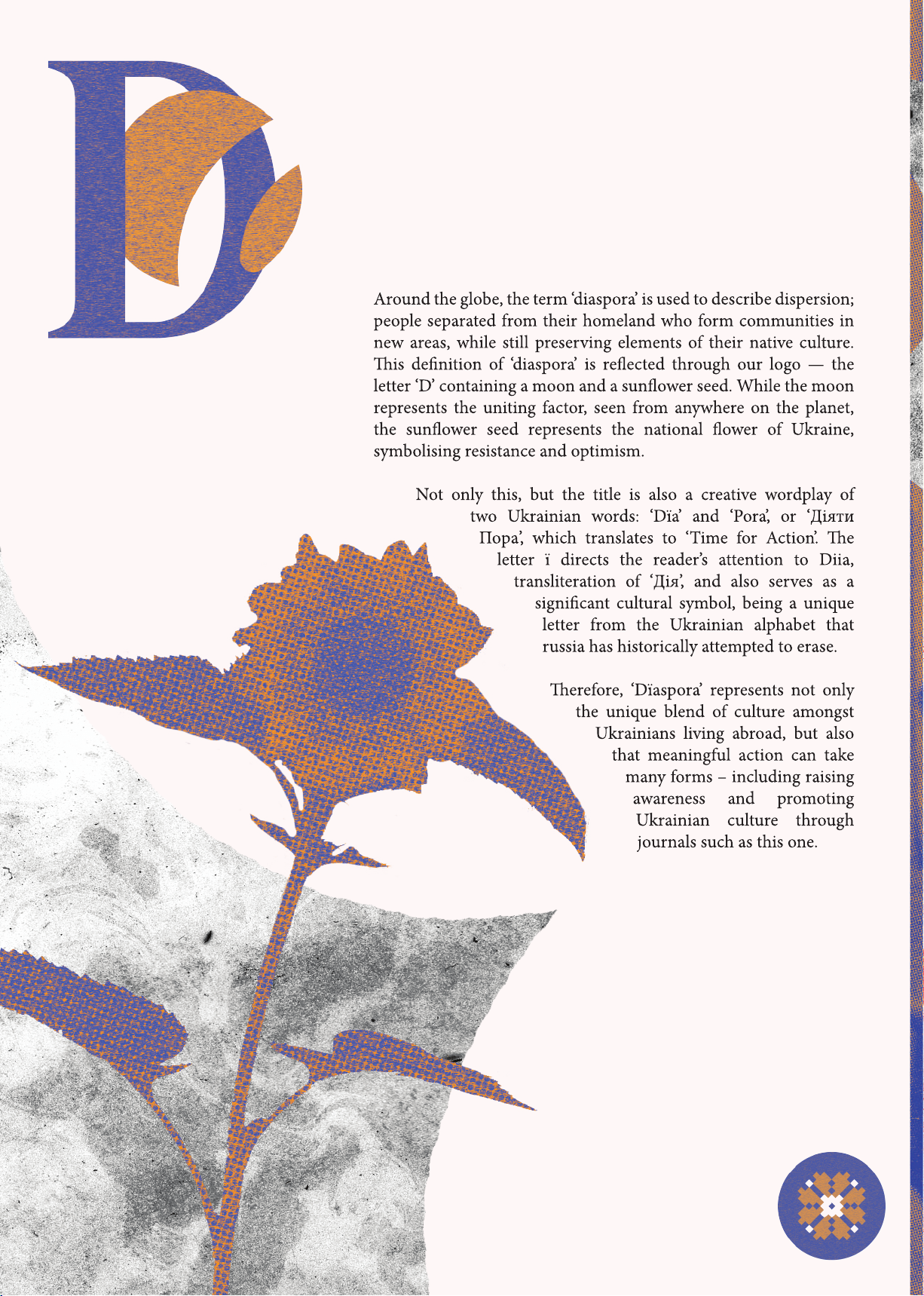
WHAT
WHO &
WHY
