WHY CHANGE THE TITLE
DIANA POSTAVKA
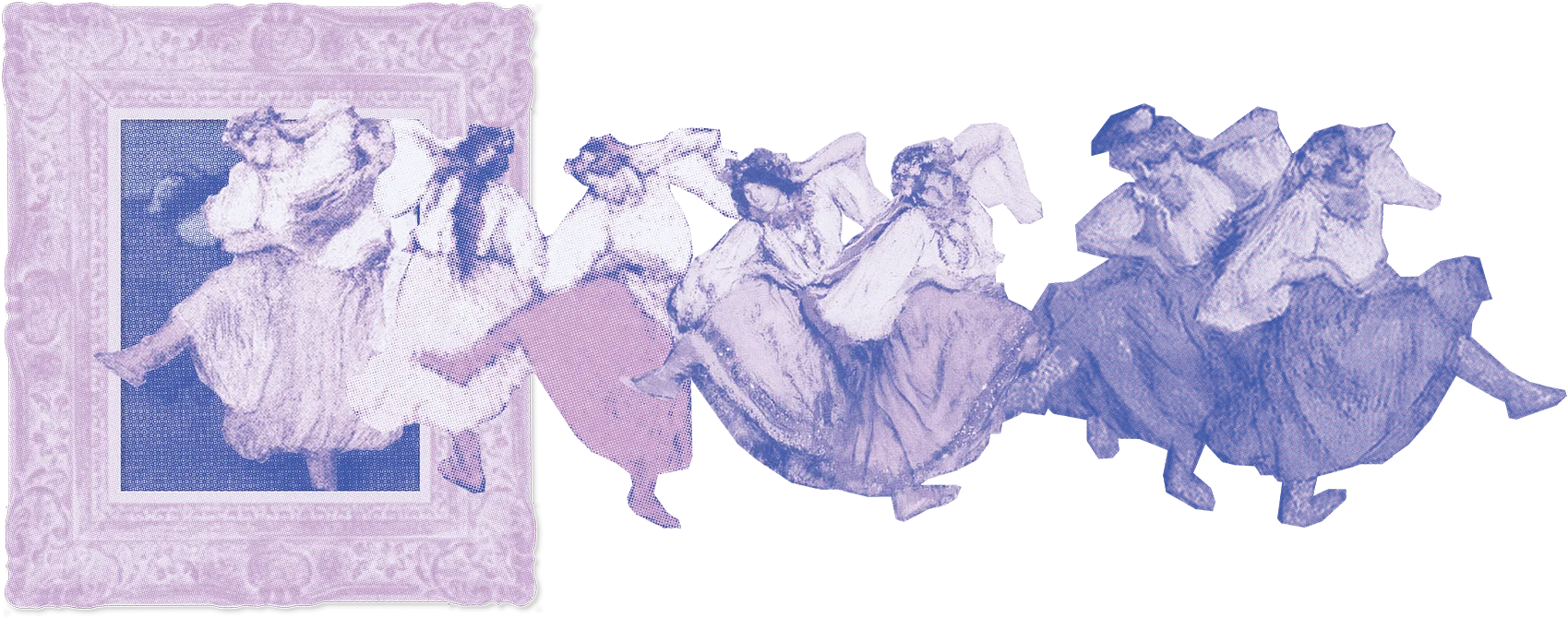
During one of my visits to London, I had the chance to spend a few hours in the famous National Gallery. Whilst exploring one of the magnificent impressionist halls, my eye was caught by a painting hanging in the middle of the wall. In places like this, where every corner is filled with a masterpiece, it's hard to imagine something standing out so sharply. It wasn't the form or technique that sparked my attention; it was the subject. Several women in the foreground were depicted in an active dancing motion. Dressed in loose white shirts, long bright skirts, and red boots, with red necklaces around their necks and flower wreaths with colourful ribbons in their hair, their appearance clearly resembled traditional Ukrainian costume. Turning my head to the object label, I was not surprised to learn that this was 'Ukrainian Dancers' by Edgar Degas. I looked back at the painting and then let my gaze slide around the room. I felt a warm sense of pride, realising that a troupe performing traditional dances of my country had inspired the work of a famous French impressionist, and now was admired by thousands of gallery visitors every day.
Doing further research on this artwork later, I was, however, very much surprised to find out that the title 'Ukrainian Dancers' was only assigned to this painting in April 2022. Before that, it was titled 'Russian Dancers', reflecting the original name 'Les Danseuses Russes' given to the painting by Degas. A spokesperson for the National Gallery revealed to The Guardian that the title of the work "has been an ongoing point of discussion for many years," and the change process was accelerated following Russia's full-scale invasion of Ukraine in February that year (Quinn 2022). This change received a varied response from the public: some were encouraged by it, highlighting the need to correct the misrepresentation of national culture, while others were critical, concerned with the politicised distortion of the original idea of the artist.
WHY IS IT NECESSARY TO CHANGE THE TITLE?
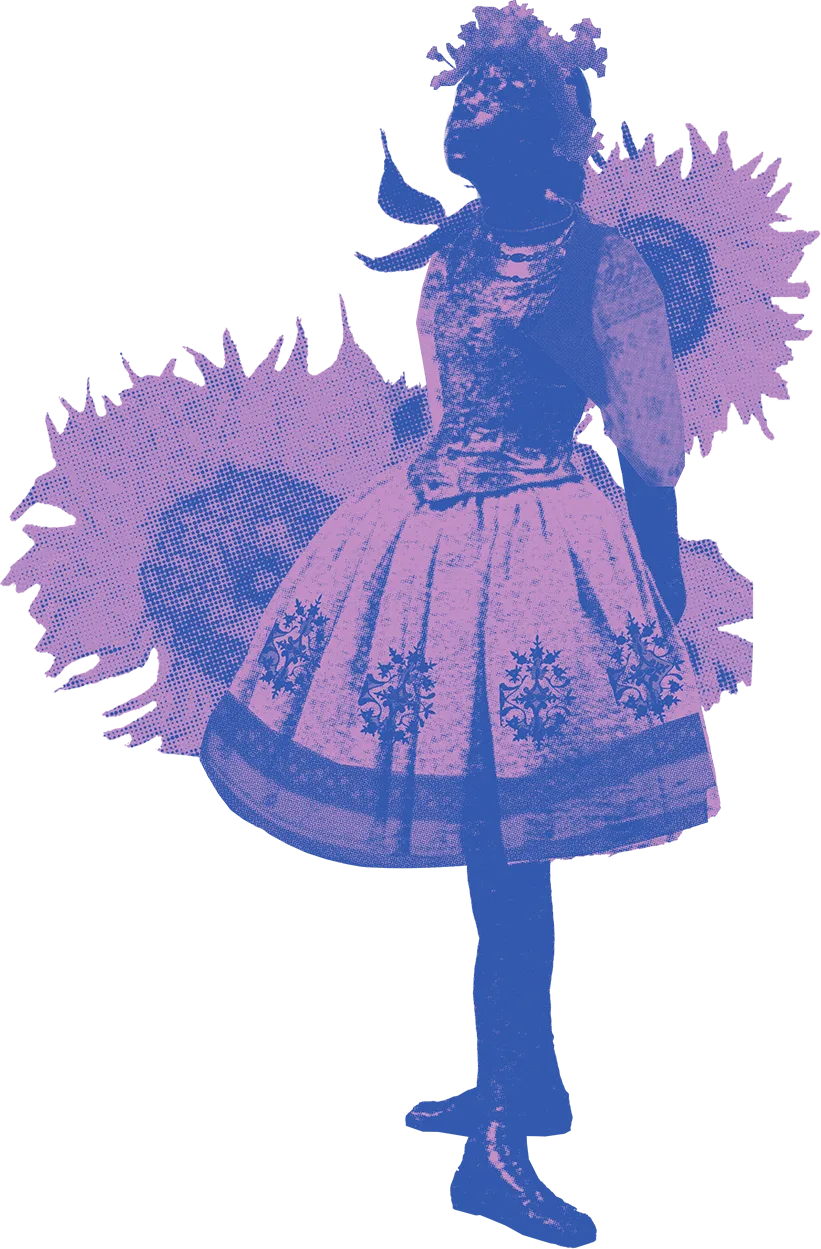
The first reason for this is a correction of the public's idea about Ukrainian and Russian national heritage. The change of this painting's title was not a purely political move but, as also mentioned by the National Gallery's spokesperson, was widely covered in scholarly literature (Quinn 2022). For example, a study by Bixenstine (1987, 105–114) explored the resemblance of depicted costumes to ethnographic records of traditional Ukrainian attire. Thus, the original title was giving a wrong impression of the illustrated dancers representing Russian culture and tradition. While there may be little significance in this when a painting is lying in storage, the potential impact becomes substantially more adverse when the artwork goes on display. The National Gallery welcomed over 3.2 million visitors in 2024 (The National Gallery 2024), and if the title hadn't been changed, each one of those people would potentially have stopped to admire Ukrainian dancers, just like I did, only to think that they were contemplating an example of Russian cultural heritage.
This issue was also recognised by the Metropolitan Museum of Art in New York City. Holding another work from the same series, the MET updated the title even though the work is not currently on view (The MET n.d.). In contrast, the Houston Museum of Fine Arts, which also holds two works from this series, kept the title of 'Russian Dancers', while highlighting the Ukrainian origin of the depicted women in the label description (MFAH n.d.). While this solution seems to balance between the two viewpoints, its effectiveness in addressing the issue of viewers' perception can be questioned. On average, gallery visitors spend 27 seconds looking at a single work of art, meaning that the majority of visitors rarely read labels beyond the painting title (Smith 2001, 229). Yet, even with such a small amount of time allocated per work, a painting can leave a memorable impression on visitors' minds, so it's important to make sure that this impression is not misleading.

The second issue highlighted by this title change is the geographical generalisation of cultural heritage and artistic achievement. When Degas created his work, circa 1899 (The National Gallery n.d.), Ukraine did not exist as an independent state, and most of its current territory was under the Russian Empire. This explains why, in the original name 'Les Danseuses Russes', the artist did not correctly recognise the national identity of the dancing troupe whose performance he encountered in Paris. The lack of state sovereignty, however, cannot rewrite the belonging of cultural heritage and traditions to a specific nation. Throughout the centuries, Ukraine was split under the control of different states, and yet our people managed to nourish and preserve their unique identity despite all odds. This title change, nevertheless, unveils a wider problem of the prescription of historical, artistic and scientific contributions made by Ukrainian people to the heritage of the state that controlled their territory at the time. Ukraine is not the only one facing this problem: it is familiar to any nation that was occupied or colonised in the past, as dominating states often appropriate significant cultural attainments.
Critics of this title change were quick to label it a distinctly politicised move, but the truth is that art is never free of politics. Our surroundings shape our views, opinions and ideas, so it is unreasonable to expect that any output of the human mind will not be influenced by such external factors. In addition, artworks aren't just pictures hanging on a wall, and art galleries are not just places where these pictures are kept. Every museum and gallery serves an educational purpose and thus has a responsibility to provide its audience with information that best reflects the accumulated knowledge around the subject. The adjustment of the original name of the artwork is, therefore, not an unprecedented practice: galleries, on many occasions, have updated titles to remove offensive terms and colonial language, as well as to contextualise the subject matter and correct generalisations. A prominent case is the 2015 initiative in the Rijksmuseum in Amsterdam, where the whole collection was reviewed to update unethical terminology (Hooton 2015). Such changes are necessary for art to fit in with and reflect contemporary society.
WHY DOES THIS MATTER?
Putting this case into a wider perspective, it isn't merely a title change. This is a prominent example of the international effort to address cultural appropriation and facilitate the restoration of Ukrainian national identity on the world stage. The main significance, however, lies in how this case can be relevant for other countries, serving as a model for reclaiming national achievements and correcting generalised mislabelling. To sum up, many lessons can be learned from Ukraine regarding the preservation of national identity, and I hope this one will help us build a world where, when walking into a gallery or museum, we can see the culture of every nation represented and credited correctly.

BIBLIOGRAPHY
Bixenstine, Lisa. 1987. "Edgar Degas' Russian Dancers Series (1897–99): Their Dating, Pastel Technique, and Their Context within His Late Period (1885–1908)." The Ohio State University.
Hooton, Christopher. 2015. "Museum to Rename Any Artworks with Offensive Titles." The Independent, Accessed December 14, 2025. https://www.the-independent.com/arts-entertainment/art/news/museum-to-rename-any-artworks-with-offensive-titles-a6772616.html
MFAH (Museum of Fine Arts, Houston). n.d. "The Russian Dancer." Accessed December 17, 2025. https://emuseum.mfah.org/objects/40670/the-russian-dancer
Quinn, Ben. 2022. "National Gallery Renames Degas' Russian Dancers as Ukrainian Dancers." The Guardian. https://www.theguardian.com/artand-design/2022/apr/03/national-gallery-renames-degas-russian-dancers-as-ukrainian-dancers
Smith, Jeffrey. 2001. "Spending Time on Art." Empirical Studies of the Arts 19 (2).
The Metropolitan Museum of Art (The Met). n.d. "Dancers in Ukrainian Dress." Accessed December 15, 2025. https://www.metmuseum.org/art/collection/search/459097
The National Gallery. 2024. "National Gallery Anniversary Attracts 4.7 Million Worldwide Visits in 2024 and Over 159 Million Digitally." Accessed December 20, 2025. https://www.nationalgallery.org.uk/about-us/press-and-media/press-releases/national-gallery-anniversary-attracts-4-7-million-worldwide-visits-in-2024-and-over-159-million-digitally
The National Gallery. n.d. "Ukrainian Dancers by Hilaire-Germain-Edgar Degas." Accessed December 14, 2025. https://www.nationalgallery.org.uk/paintings/hilaire-germain-edgar-degas-ukrainian-dancers
Images used: Glen Dahlman on Flickr, CC BY-SA 2.0, https://creativecommons.org/licenses/by-sa/2.0/deed.en, Edgar Degas, Wikipedia Commons, CC BY-SA 4.0, https://creativecommons.org/licenses/by-sa/4.0/deed.en, Mark Peters on Flickr, CC BY 2.0 https://creativecommons.org/licenses/by/2.0/deed.en, Ilya Kuzniatsou on Flickr, CC BY 2.0 https://creativecommons.org/licenses/by/2.0/deed.en, Lisa Garcia on Flickr, CC BY 2.0 https://creativecommons.org/licenses/by/2.0/deed.en, Glen Dahlman on Flickr, CC BY-SA 2.0 https://creativecommons.org/licenses/by-sa/2.0/deed.en